
How to create viral video: A repeatable framework for rapid growth
Let’s get one thing straight: viral videos aren’t accidents. They’re engineered.
Behind every viral sensation is a repeatable blueprint that taps directly into human psychology. It’s a simple but powerful combination: a killer hook that stops the scroll, an emotional trigger that makes people feel something, and a frictionless way to share it. The best part? You can master this framework without ever showing your face on camera.
Decoding the Blueprint for Viral Content
Forget the idea that going viral is like catching lightning in a bottle. It's far more science than luck. True viral potential is built from the ground up on a deep understanding of what makes people tick and what platform algorithms crave.
At the core, a viral video has to connect on an emotional level. We're talking about the big ones: awe, gut-busting humor, genuine surprise, or that "I feel so seen" moment of relatability. When your video makes someone laugh out loud or nod in agreement, their first instinct is to pass that feeling on. That emotional transfer is the engine of viral growth.
This is the entire process in a nutshell. It's a loop that starts with capturing attention and ends with your audience doing the marketing for you.
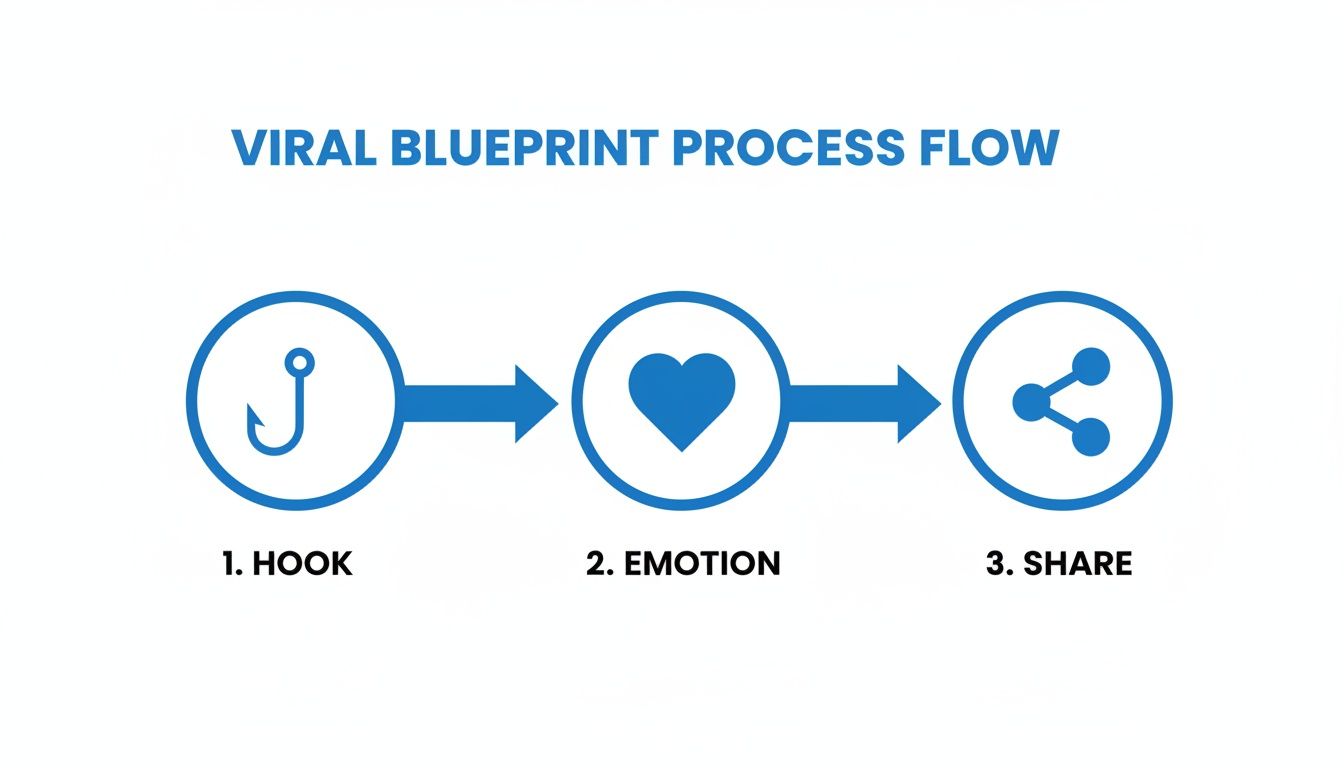
It all starts with that hook, flows into an emotional connection, and ends with a share—creating a cycle that can explode your reach.
To really nail this, you need to understand the three core pillars that support every successful viral video.
The Core Pillars of a Viral Video
This table breaks down the foundational elements you need to build into every single video. Think of it as your pre-flight checklist before you hit publish.
| Pillar | What It Means | Why It Drives Virality |
|---|---|---|
| Hook | The first 1-3 seconds of your video. It must be captivating enough to stop someone from scrolling. | With short attention spans, a weak hook means your video is dead on arrival. A strong hook earns you the viewer's time. |
| Emotion | The feeling your video evokes—humor, surprise, relatability, inspiration, or shock. | Emotion is the currency of social media. People share feelings, not just content. It’s what makes a video memorable. |
| Shareability | Content that is inherently easy and desirable to share with others. | Virality is mathematically impossible without shares. It’s what turns one view into hundreds, then thousands. |
By consciously building these three pillars into your content, you're no longer just hoping for virality—you're strategically designing for it.
The Modern Viral Formula
Platforms like TikTok, Instagram Reels, and YouTube Shorts have completely rewritten the rules. Attention is the only currency that matters, and you have about three seconds to earn it. That tiny window is where your hook has to do all the heavy lifting.
Today’s algorithms are obsessed with one metric above all else: watch time. If people watch your video to the end (or better yet, watch it again), you're sending a powerful signal to the platform that your content is high-quality. The algorithm's response? It pushes your video to more and more people, kicking off a viral snowball effect.
The Takeaway: Stop chasing views and start chasing retention. Your number one job is to make a video so compelling that people can't look away. The algorithm will handle the rest.
Short-form videos (under 60 seconds) are the undisputed kings of organic reach right now. In fact, social videos generate 1200% more shares than text and images combined. This is how faceless accounts can rack up millions of views and drive real business results without ever stepping in front of a camera. If you're curious about the mechanics, you can dive deeper into what makes a video go viral in our detailed guide.
Shareability Triggers in Action
The final piece of this puzzle is what I call "shareability triggers." These are specific elements you bake into your video to give people a reason to hit that share button. Sometimes it’s a direct call to action, but the most effective triggers are far more subtle.
Here are a few that work like a charm:
- Identity Association: Creates a "this is so me" moment that makes viewers feel understood.
- Relatability: Taps into a shared experience, a common struggle, or a universal funny moment.
- High-Value Information: A quick tutorial, a surprising fact, or a life hack that feels like a secret people need to pass on.
Faceless creators are absolute pros at this because they put 100% of the focus on the content's value and emotional payload. By removing themselves, they make the message the hero. To get a more advanced look at putting these ideas into practice, I highly recommend exploring these Video Growth strategies.
Crafting Hooks That Stop the Scroll

Let's be brutally honest: your video's entire fate is sealed in the first three seconds. If you don't instantly grab someone, they're gone. The algorithm sees this, learns your content isn't compelling, and your reach flatlines before it ever had a chance to breathe.
This is why a killer hook isn't just a "nice-to-have." It's your single most critical asset in the quest for virality.
Saying "be engaging" is useless advice. You need a reliable toolkit of proven formulas you can pull from for any niche, even if you never plan on showing your face. Think of these as templates for sparking curiosity—they're designed to stop a thumb dead in its tracks.
The Problem-Agitation Hook
This one is devastatingly effective because it taps directly into a real, nagging pain point your viewer is already feeling. You start by calling out the problem, then you twist the knife a bit by describing just how frustrating it is. Only then do you hint at the solution. They have to keep watching.
It’s a classic copywriting formula, just supercharged for the speed of social media. The goal is to make them think, "Wow, they get it. That's exactly my problem."
Here’s how you could run this play in a faceless format:
- Initial Script Idea: "Tired of your Shopify store getting no sales? It’s probably because your product descriptions are boring."
- Visuals: Open with a screen recording of a Shopify dashboard showing $0 in sales. Slap a big, frustrated emoji on it. Use a jarring text overlay like, "Your Store is a Ghost Town."
- Voiceover: The AI voice says, "Your ads are running, you have traffic, but your sales are still zero. It feels like you're shouting into the void, right?"
That combination of a relatable struggle, emotional language, and simple visuals creates an immediate bond and a desperate need for the answer you're about to give.
The Contrarian Take Hook
Nothing stops a scroll faster than challenging a belief everyone takes for granted. This hook works by leading with an unpopular opinion or a surprising take that makes people stop and question what they think they know. It immediately sparks debate and drives comments, which are gold for the algorithm.
A contrarian hook doesn't have to be outrageously controversial. It just needs to be different enough to break the pattern of whatever content they were just watching. You're trying to make them pause and think, "Wait, what?"
Let’s say you're in the personal finance space, where "make a budget" is the standard advice.
- Standard Hook: "Here's how to create a budget." (Snooze.)
- Contrarian Hook: "Budgeting is the #1 reason you're still broke." (Now I'm listening.)
For a faceless video, you could script this with a bold text overlay that screams: STOP BUDGETING. DO THIS INSTEAD. The voiceover would confidently state, "Everything you've been taught about saving money is wrong. Cutting out lattes won't make you rich, but this will." Pair that with AI-generated animations of money being tossed in a trash can to really drive the point home.
The Story Gap Hook
Humans are wired for stories—and we absolutely hate leaving one unfinished. The Story Gap hook plays on this by opening a curiosity loop that the viewer feels an intense urge to close. You present the start of a fascinating story or a wild situation but leave out the most important part.
This technique is perfect for faceless storytelling channels. It creates an information vacuum that can only be filled by watching the rest of your video.
Here are a few formulas that work like a charm:
- The "How I..." Formula: "How I turned a simple Google Doc into a $100k/year business."
- The "This is the..." Formula: "This is the weirdest side hustle I've ever tested, and it actually works."
- The "You Won't Believe..." Formula: "You won't believe what happens when you post a TikTok at 3 AM."
To make this work without showing your face, you need to build suspense with your voiceover and visuals. For the "Google Doc" example, your video could start with an animation of a document icon morphing into a pile of cash. The AI voiceover, set to a slightly mysterious tone, would begin the story, promising the big reveal is coming. This structure keeps retention sky-high because the payoff always feels right around the corner.
Scripting Stories That Keep People Watching
A killer hook gets you their attention for a few seconds. A great story keeps it for the entire video—and that’s the single most important signal you can send to any platform's algorithm. Retention is the name of the game, and your script is how you win.
This isn't about writing a Hollywood screenplay. It’s about structuring a narrative, even a simple one, that holds a viewer captive. Think of your video not as a one-off piece of content, but as a miniature episode. This mindset is the secret to building a loyal audience that actually looks for your next video.
The 60-Second Hero's Journey
You don’t need to reinvent the wheel. Classic storytelling frameworks are powerful tools for short-form video, and the Hero's Journey is a perfect example. You can shrink its core emotional arc into a format that fits snugly inside a 60-second clip.
This framework creates a satisfying narrative loop that feels familiar and compelling, making it a fantastic blueprint for your script.
Here’s how you adapt it:
- The Ordinary World: Start with a relatable problem or a common situation your viewer instantly gets.
- The Call to Adventure: Introduce a new idea, a challenge to the status quo, or your unique solution.
- The Ordeal & Transformation: This is the meat of your video. Show the struggle, the test, or the application of your new idea. This is where you provide the value.
- The Return with the Elixir: End with the result, the takeaway, or the transformed state. This is the "aha!" moment that makes people want to share.
Using this structure turns a simple tip into a mini-saga, making it far more memorable than just a dry list of facts.
Writing Voiceovers That Connect
Even in a faceless video, your voice (or the AI voice you pick) is your main tool for connection. A robotic, flat delivery will kill your retention faster than anything. Your goal is to sound like a real person having a conversation, not an announcer reading a teleprompter.
Write your scripts the way you talk. Use contractions like "you're" and "it's." Ask questions. Keep your sentences short and to the point. And always, always read your script out loud before you record. If it feels awkward to say, it will be even more awkward to hear.
Pro Tip: When you're using an AI voiceover tool, play around with the different tones and inflections. A slightly faster pace can build excitement, while adding a few strategic pauses can create suspense. Never just accept the default settings—tweak the delivery to match the emotional arc of your story.
Authenticity is everything. The explosion of user-generated content (UGC) proves that viewers crave genuine connection, not polished perfection. Data shows that episodic content—like a TikTok series or an Instagram Reel saga—builds incredible loyalty. Platforms prioritize this authentic vibe; social videos have a staggering 1200% share advantage over other content, and 73% of consumers say a brand's social media presence influences their decisions.
Embracing the Power of Episodic Content
Ever notice how a "Part 2" video almost always does well? It’s because it taps into the Story Gap hook on a much larger scale. Creating a mini-series is one of the most reliable strategies for sustained growth because you’re literally training your audience to come back for more.
You don't need some complex plot. Your series could be about anything:
- Testing a different side hustle every day for a week.
- Documenting your journey of learning a new skill.
- Answering a common question in your niche with a daily tip.
This approach builds anticipation and transforms passive viewers into an active community. It's a powerful way to engineer virality by making each video part of a larger, must-see story. For a deeper dive, our guide on creating an effective YouTube video script has a ton of principles that apply directly to short-form content.
Automating Your Workflow with AI Video Tools
Going viral demands a relentless pace. The algorithms on TikTok and Instagram reward consistency, but trying to create high-quality videos every single day is a surefire recipe for burnout if you're doing it all by hand.
This is where you make the switch from being just another creator to a smart operator—by automating your entire production process.
With the right AI tools, you can take a simple script and turn it into a polished, engaging faceless video in minutes, not hours. This frees you up to focus on what actually moves the needle: strategy, creativity, and testing new ideas at the speed the platforms demand.
AI-powered video creation is exploding. The global market is projected to jump from $534.4 million to a staggering $2,562.9 million by 2032. Think about that. Nearly 57% of online ads already use AI-generated content, and 50% of small businesses are on board.
The playing field is leveling out, giving individual creators like you the power to compete with big brands without needing a massive budget or a pro editor on standby.
From Script to Polished Video in Minutes
The real magic of faceless video automation is turning simple text into a compelling visual story. Modern AI video generators are built to make this process almost effortless. You start with your script—the one you already crafted to maximize retention—and just feed it into the platform.
The AI takes it from there. It analyzes your text and instantly matches each line with relevant visual clips, whether that's stock footage, slick animations, or completely unique AI-generated imagery. What would take an editor an hour of searching, downloading, and splicing clips now happens in less than a minute.
This isn't just about saving time; it's about enabling rapid-fire experimentation. You can now test five different video ideas in the time it used to take you to produce just one.
Comparing Manual vs AI Video Production
This table really drives home how AI tools accelerate the content creation process, making the consistency required for viral growth not just possible, but easy.
| Production Step | Typical Manual Time (Hours) | AI-Powered Process (Minutes) |
|---|---|---|
| Script Writing | 1 - 2 Hours | 5 - 10 Minutes |
| Voiceover Recording | 1 Hour | 2 - 5 Minutes |
| Sourcing & Editing Visuals | 2 - 4 Hours | 5 - 15 Minutes |
| Adding Captions & B-Roll | 1 - 2 Hours | 5 - 10 Minutes |
| Total Time | 5 - 9 Hours | 17 - 40 Minutes |
The difference is night and day. This efficiency is what allows top creators to dominate the feed with fresh content daily.
Finding Your Brand's Voice with AI
Your voiceover is the soul of your faceless video. It sets the tone, builds trust with your audience, and delivers your story with real emotional punch. But manually recording, editing, and mastering audio for every single video is a huge bottleneck.
AI voiceover tech has come a long way from the robotic voices of the past. Today's tools offer a massive library of incredibly lifelike voices with different accents, genders, and emotional tones.
- Matching Tone: Is your brand authoritative and educational? Go for a deep, confident voice. Is it more fun and quirky? Opt for an energetic, upbeat tone.
- Global Reach: With options in dozens of languages, you can easily repurpose your content for international audiences without hiring a team of voice actors.
- Consistency: An AI voice ensures your brand sounds the same in every video, building a recognizable audio signature for your channel that people will remember.
The key is to treat the AI voice selection process like casting a character for your brand. Don't just settle for the default. Experiment with different options until you find one that perfectly represents the personality you want to project.
Designing a Unique Visual Aesthetic
A common worry with AI content is that it all looks the same. But the best tools give you a ton of visual styles to help you create a unique and memorable look for your channel. Instead of pulling random stock clips, you can direct the AI to generate visuals in specific styles.
Consider these options to get you started:
- Cinematic: Creates a dramatic, high-quality feel that’s perfect for powerful storytelling.
- Anime: Taps into a hugely popular aesthetic that works great for engaging narratives or explainers.
- Comic Book: A bold, graphic style that grabs attention and is perfect for fun, high-energy content.
This level of control allows you to build a cohesive look across all your videos, making your content instantly recognizable in a crowded feed. Check out our guide on the best AI tools for content creators to explore more options.
And if you want to streamline other parts of your production and marketing process, it’s worth exploring solutions in AI marketing automation to help get your content in front of a wider audience.
Distributing Your Content for Maximum Reach

Here's the hard truth: a perfect video that nobody sees is just a file taking up space on your hard drive. The real art of going viral hinges just as much on smart distribution as it does on a killer hook or a gripping story.
Those first few hours after you hit "post" are everything. This is your window to get enough initial velocity to convince the algorithm your content is the real deal and deserves to be pushed to a much wider audience. It's not about spamming your link everywhere; it’s a calculated game of timing, trends, and using platform-specific features to your advantage. This is how you turn one great video into a true viral moment.
Strategic Timing for Initial Velocity
Your first lever to pull is timing. You need to drop your video right when your target audience is most likely to be mindlessly scrolling. This maximizes the potential for instant likes, comments, and shares—the exact signals the algorithm is looking for.
While every account's audience is a bit different, there are some well-known peak times that are a great starting point.
- TikTok: Think about when people are taking a break. Weekday afternoons (3 PM to 6 PM) and late evenings (7 PM to 10 PM) in your target timezone are usually hotbeds of activity.
- Instagram Reels: Similar to TikTok, lunch breaks (12 PM to 2 PM) and post-work hours (6 PM to 9 PM) are solid bets. Don't sleep on weekends, either.
- YouTube Shorts: Activity here tends to peak in the late afternoon and evening (4 PM to 8 PM). Viewers might be settling in for longer videos but are snacking on Shorts in between.
The golden rule? Always, always check your own analytics. That data tells you exactly when your followers are online, and it’s way more valuable than any generic advice.
Writing Captions and Hashtags That Work
Your caption and hashtags aren't just an afterthought—they're crucial discovery tools. They give both the viewer and the algorithm the context needed to find the right audience for your video.
A good caption can continue the story from the video or, even better, pose a question to get the comments flowing. Keep it short, punchy, and focused on starting a conversation.
When it comes to hashtags, you want a strategic mix of broad and niche tags. This approach helps you tap into massive conversations while still reaching your core community.
The 3x3 Hashtag Method: This is a simple but powerful formula. Use three broad, high-traffic hashtags (like
#sidehustle), three medium-sized niche hashtags (like#onlinebusinessforbeginners), and three ultra-specific tags that describe your video's content precisely (like#shopifytips2024).
This balanced attack tells the algorithm exactly who your video is for, dramatically increasing the odds it gets served to people who will actually watch and engage.
Smart Trend and Feature Integration
Jumping on a trend is one of the fastest ways to get seen, but you have to be smart about it. Don't just copy what everyone else is doing. The real magic happens when you adapt a trending sound or format to fit your unique niche and message. That authenticity helps you stand out while you ride the trend's wave.
On top of that, you need to use the platform's native features. These tools are built to boost engagement, and the algorithms love it when you use them.
- TikTok Stitch & Duet: Use these to react to or build on another popular video. You're basically inserting yourself into a much larger, ongoing conversation.
- Instagram Collabs: This is a game-changer. Invite another creator to be a collaborator on your Reel, and it gets pushed to both of your audiences at the same time. You can instantly double your initial reach.
- YouTube Shorts Remix: Just like TikTok's features, this lets you use audio or a video clip from another YouTube video, tapping directly into its existing audience.
These features are powerful because they create an interconnected web of content, which is exactly what these platforms are designed to reward.
A Multi-Platform Repurposing Strategy
Finally, don't let your video live and die on a single platform. A smart repurposing strategy can triple your chances of a viral hit without tripling your workload. That one video you worked so hard on can easily be adapted for TikTok, Instagram Reels, and YouTube Shorts.
The trick is to make small, platform-specific tweaks. You might switch up the caption, use different hashtags, or find a trending sound that's hot on that specific app. This simple act of tailoring the content shows you understand the unique culture of each platform, making your video feel more native and boosting its performance. This isn't just about how to create a viral video; it's about giving one video multiple shots at glory.
Using Analytics to Engineer Future Hits
Making one video go viral is a rush. Making them go viral consistently? That's a business.
The secret to repeatable success isn't some mystical formula or dumb luck. It's building a data-driven feedback loop where you let your audience's behavior tell you exactly what to create next. Virality is engineered, and your analytics are the blueprints.
Forget fixating on raw view counts. Yeah, a big number feels good, but it tells you absolutely nothing about why a video actually connected with people. To really understand what's working, you have to dig into the metrics that show viewer commitment.
Moving Beyond Vanity Metrics
The true story of your video’s performance isn't in the view count; it's hidden in a few key data points. These don't just tell you if people watched, but how they watched.
-
Average Watch Time: This is your holy grail. A high average watch time is a direct signal to the algorithm that your content is valuable and keeps people on the platform. That's exactly what these platforms are designed to reward.
-
Audience Retention Graphs: This little visual is your most powerful diagnostic tool, period. It shows you, second by second, the exact moment viewers got bored and scrolled away. See a massive drop in the first 3 seconds? Your hook failed. A sudden dip in the middle means your story lost steam.
-
Share Rate: This one tracks the percentage of viewers who hit that share button. Shares are the rocket fuel for viral growth. A high share rate means you created something that hit an emotional nerve or provided so much value people had to pass it on.
Pinpointing Your Weak Spots
Think of your audience retention graph as a treasure map leading you to your content's weak points. Look for those sudden, steep drop-offs.
What happened right at that moment? Did you use a boring visual? Was your voiceover energy starting to lag? Did you take way too long to get to the point?
Every dip in your retention graph is a lesson. By figuring out what caused viewers to leave, you can systematically eliminate those mistakes from future videos, making each new piece of content stronger than the last.
This isn't about guesswork. It’s a clinical process. If you notice viewers consistently bailing at the 10-second mark, go back and analyze what’s happening in your videos right at that moment. Then, change it.
Simple A/B Testing for Short-Form Video
You don't need fancy software or a data science degree to test your ideas. A/B testing on short-form video can be as simple as trying two different hooks for the same core idea and seeing which one sticks.
For your next video idea, try creating two versions:
- Version A: Kick it off with a "Problem-Agitation" hook.
- Version B: Go with a "Contrarian Take" hook instead.
Post them a day or two apart and dive into the analytics. Which hook grabbed a higher average watch time? Which one held attention better through the first five seconds? That's your winner.
This is how you stop gambling on what might go viral and start building a reliable engine for growth.
Your Burning Questions Answered
Got questions about going viral? I've got you covered. Here are the quick answers to the things creators ask most.
What's the Real "Viral Length" for a Video?
Forget what you've heard—there's no magic number. But if you're aiming for that sweet spot on TikTok, Reels, or Shorts, you're generally looking at something between 15 and 60 seconds.
The secret isn't the length, it's the density. Your one job is to tell your story as tightly as possible to keep people watching. A punchy 20-second video that holds viewers until the very end will crush a 60-second video that people swipe away from. It's all about that watch time.
Can You Really Go Viral Without Showing Your Face?
Absolutely. In fact, "faceless" content is a massive and exploding category. It's living proof that your success comes down to the power of your story, visuals, and audio—not your face. This approach puts 100% of the focus where it belongs: on the message.
Think about it. You can build incredibly emotional videos with stunning stock footage, AI visuals, screen recordings, and a killer voiceover (yours or AI-generated). That's how you connect with millions of people.
Thousands of creators are building empires right now without ever stepping in front of the lens.
Are Trending Sounds a Must-Use?
On platforms like TikTok and Instagram, they’re a huge shortcut to visibility. Using a trending sound is like giving the algorithm a little nudge to push your content out to more people, right from the jump.
But here’s the pro move: don't just tack a trending sound onto a random video. The magic happens when you weave the trend into your content so it feels completely natural and actually elevates your story. Find a creative angle that fits your niche, and you'll see much better results.
Ready to put this on autopilot? ClipShort transforms a simple script into a scroll-stopping video complete with AI visuals, realistic voiceovers, and animated captions—all in minutes. Start creating for free and see just how easy it is to scale your content game.