
How to Make a Video Viral on YouTube: how to make video viral on youtube
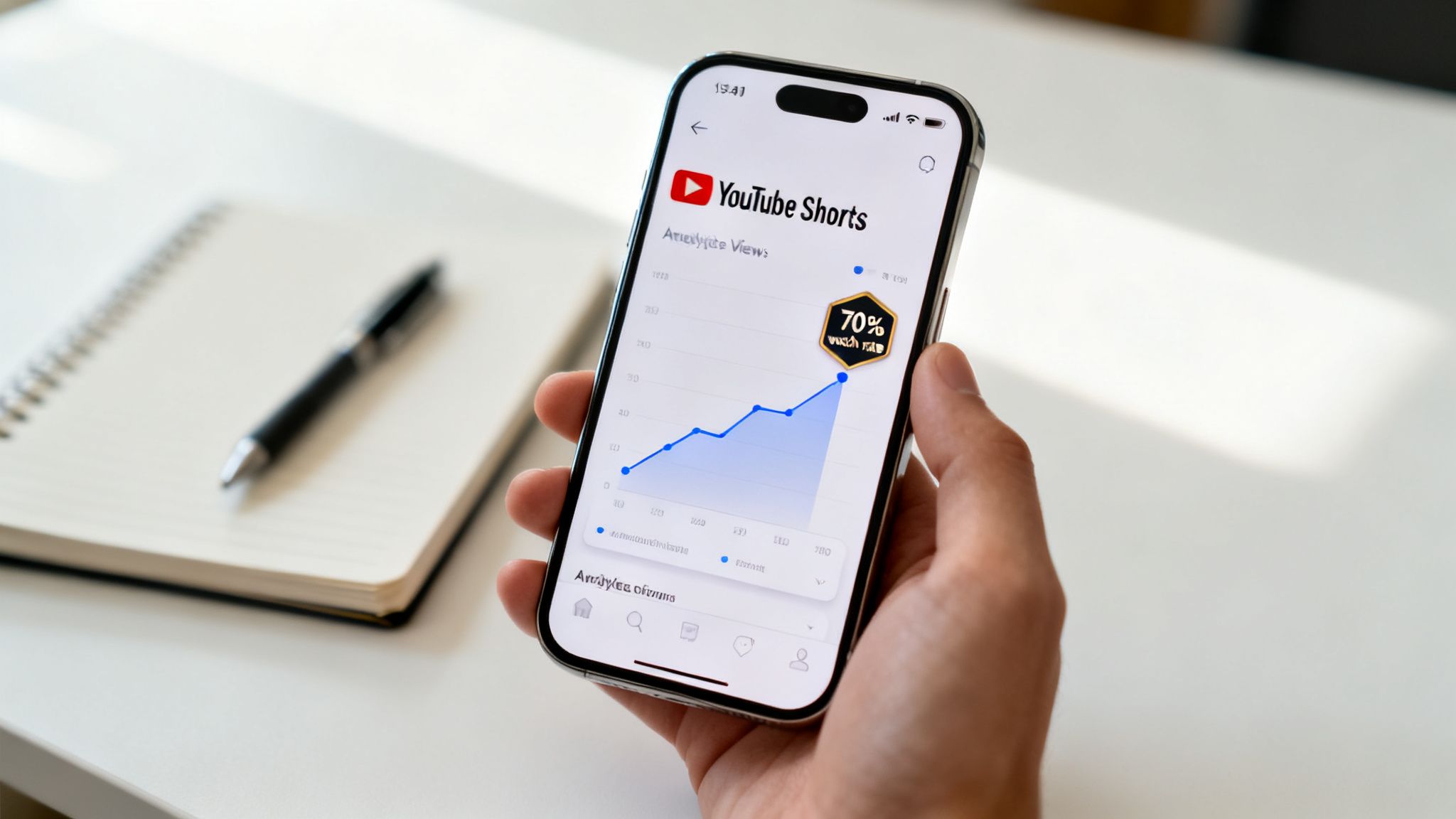
If you want your video to go viral on YouTube, you have to get one thing right: the retention hook. The modern playbook is all about short-form content that keeps over 70% of viewers watching in the first few seconds. Get that right, and you're signaling to the algorithm that your video is worth showing to millions.
Decoding the Modern YouTube Viral Playbook
Forget what you thought you knew about YouTube virality. The road to explosive growth isn't paved with long, high-production videos anymore. Today, both the algorithm and the audience have shifted, making YouTube Shorts the fastest way to grow a channel and get discovered.
The whole game has changed. YouTube now pushes Shorts to massive audiences, most of whom have never even heard of your channel. This is a huge opportunity for new and small creators to get seen almost overnight. If you can make content that hits the mark in this rapid-fire format, you're plugging directly into a powerful discovery engine.
The Science of the Retention Hook
At the heart of this new strategy is the retention hook. We’re not just talking about a decent intro. This is about engineering the first 3-5 seconds of your Short to be so magnetic that viewers feel an almost psychological need to see what happens next.
When a huge chunk of your viewers—the magic number is over 70%—stick around past that hook, it sends a massive signal to YouTube's algorithm. This tells the system your video is satisfying viewers and is likely to do well with an even bigger audience. The algorithm then starts showing it to more and more people, creating a snowball effect that can rack up millions of views. For a deeper dive into this, check out our guide on https://www.clipshort.co/en/blog/what-makes-a-video-go-viral, where we break down the psychology behind it.
Understanding Viral Thresholds
Just because a video gets a lot of views doesn't mean it's truly "viral." There are specific benchmarks—let's call them "viral thresholds"—that separate a popular video from a genuinely viral one. It’s all about hitting a certain number of views in a specific window of time.
And this is exactly where Shorts have a massive advantage.
The infographic below paints a clear picture of just how different the path to virality is for Shorts compared to long-form videos.
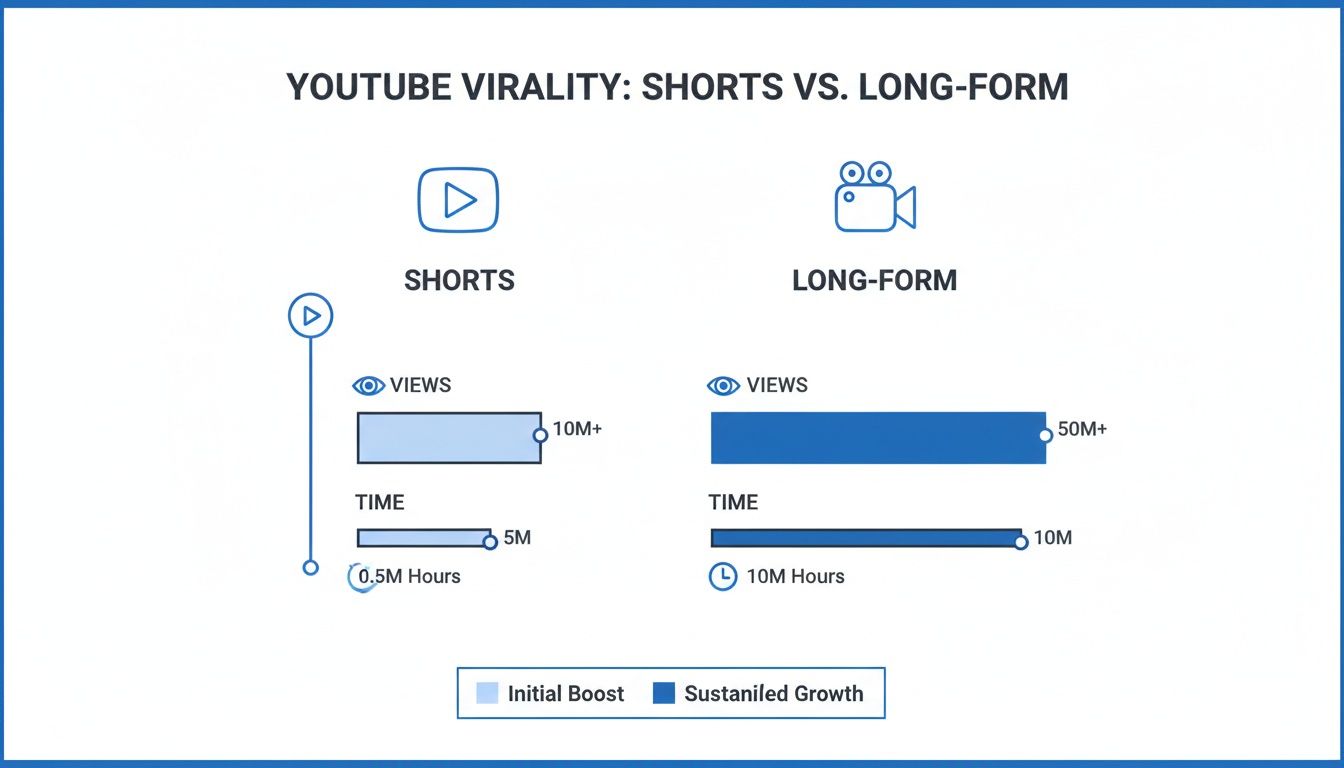
As you can see, Shorts can go viral with a slower, more sustained burn over several days. Long-form videos, on the other hand, need a huge, immediate explosion of views to achieve the same status.
To put some numbers on it, Shorts are pulling in a mind-boggling 200 billion daily views, and a whopping 74% of those views come from non-subscribers. The algorithm is your best friend here.
A quick comparison really highlights the difference:
Viral Thresholds: Shorts vs Long-Form Video
| Metric | YouTube Shorts | Long-Form Video |
|---|---|---|
| Views for Virality | 2-3 million | 2-3 million |
| Timeframe for Views | 5-7 days | 1-2 days |
The takeaway is clear: the path to virality with Shorts is far more forgiving and accessible. To really master these dynamics, it’s worth exploring a Proven Growth Playbook for YouTube Views.
Key Takeaway: The modern viral formula isn't about getting lucky once. It's about consistently creating Shorts designed for high initial retention. The algorithm rewards content that proves its worth—fast.
This doesn't mean you should abandon long-form content. It just serves a different purpose now, like nurturing the audience you find through the massive reach of your Shorts. By embracing this Shorts-first approach, you're aligning your strategy with how YouTube discovery works today, and that’s how you give yourself the best possible chance to go viral.
Crafting Your Viral Blueprint Before You Record
Here's a secret most aspiring creators miss: viral videos aren't born in the editing software. They're engineered long before you even think about hitting the record button.
This pre-production phase is what separates the hopefuls from the strategists. It's your shot to build a solid framework for success, making sure every single second of your short is designed to do one thing: keep people watching. Don't just brainstorm—build a blueprint for retention.
Identifying Trends You Can Actually Use
Jumping on a trending dance or meme out of nowhere just feels awkward. Real trend research is about finding emerging formats and sounds inside your niche and giving them your own unique spin. You want to join a conversation your audience is already part of, not shout into an empty room.
Let's say you're a finance creator and you see the "3 things I'd never do" trend taking off. You don't ignore it. You adapt it: "3 Money Mistakes I'd Never Make as a Financial Advisor." It's authentic, it provides real value, and it still rides the wave of a popular format.
Here’s a quick way to find trends that fit your brand:
- Watch Your Competition: What formats are the successful channels in your space experimenting with?
- Dig into YouTube's Trending Tab: Ignore the specific viral videos and look for recurring audio clips or storytelling structures.
- Explore the Shorts Audio Library: Tap on a popular sound and just watch. You'll see how dozens of creators use the same audio to tell completely different stories.
This process gives the algorithm familiar signals that can give your content that crucial initial push.
Expert Insight: The best viral content is almost always a clever twist on an existing trend. Don't just copy what you see; innovate on it. Ask yourself, "How can my unique perspective make this feel totally fresh?"
Scripting for Maximum Retention
In the world of Shorts, your script is your single most powerful tool for keeping viewers hooked. Every single word matters. A truly viral script is built on a simple structure that grabs attention instantly and doesn't let go.
The first 1-3 seconds are everything. This is your hook. It has to create immediate curiosity, urgency, or a sense of "that's so me." Vague, slow introductions are the fastest way to get swiped away.
Once you have their attention, the rest of your script needs to deliver on the promise you made in the hook. Keep the pacing quick, use simple language, and tell a clear story—even if it's only 30 seconds long. End with a strong call to action or a satisfying punchline that makes the viewer feel like their time was well spent. For a deeper dive into nailing this structure, you can learn more about writing an effective YouTube video script and see how it directly impacts your watch time.
Using AI as Your Creative Co-Pilot
Let's be real: coming up with killer, retention-focused ideas day after day is exhausting. This is where AI tools can become your most valuable partner in the entire pre-production workflow.
Forget generic text generators. Modern tools can help you structure your ideas and build a solid foundation fast. For example, you could give a tool like ClipShort a simple prompt: "a 45-second script about a common productivity hack." It won't just spit out a paragraph; it will generate a structured script with a hook, key points, and a conclusion.
Imagine this workflow:
- Generate Core Ideas: Use AI to brainstorm a few different angles on your topic.
- Refine the Hook: Take the AI-generated hook and inject your own personality and specific details into it.
- Structure the Story: Use the AI's output as a skeleton to make sure your video flows logically from start to finish.
This approach doesn't just save you hours of staring at a blank page; it helps you systematize your creativity. You get to focus on polishing and perfecting your content instead of starting from scratch every single time.
Production Techniques That Stop the Scroll
You’ve nailed the script, but that’s only half the story. In the endless firehose of content people scroll through, your video's production is what actually earns you their time. This isn’t about having a Hollywood-level budget; it’s about knowing the psychology of visual engagement and using clever techniques to keep eyes locked on the screen.
The tiny gap between a swipe and a watch is often decided in the first few frames. Your production needs to feel alive from the jump, promising the viewer that this is worth their next 30 seconds. This is where smart editing and visual strategy turn a good idea into an unskippable video.
Mastering Visual Hooks and Pacing
The hook you wrote in your script needs a powerful visual partner. It’s a classic one-two punch. The words spark curiosity, and the visuals instantly confirm that something interesting is happening right now.
A killer visual hook can be a lot of things:
- An abrupt scene change: Think a hard cut instead of a gentle fade-in.
- A surprising element: Show something totally unexpected or out of place.
- Fast-paced motion: Immediate action makes the viewer lean in and wonder what's going on.
For example, a video about a productivity hack could kick off with a rapid-fire montage of messy desks and stressed-out faces before smashing to a shot of a pristine, organized workspace. You’ve just created instant visual tension and contrast.
The pace of the entire video has to keep that energy up. Use quick cuts, zooms, and pans to create a constant sense of movement. This technique, known as a pattern interrupt, constantly resets the viewer's attention. It makes it much harder for their brain to get bored and check out.
Key Insight: Treat every single second of your video like prime real estate. If a shot hangs around for even a moment too long without adding new information or visual flavor, you're bleeding viewers. Keep it moving.
Why Animated Captions Are Non-Negotiable
If there's one production element that's practically mandatory for virality today, it's on-screen text. Specifically, dynamic, animated captions. These aren't just an accessibility feature anymore—they are a core engagement tool.
A massive slice of your audience is watching videos on mute, whether they're in public, at work, or scrolling in bed at night. For them, your captions are the video. And static, boring subtitles just don't cut it. To really hold their attention, your text needs to be part of the show.
This means doing things like:
- Color Changes: Popping a key word in a different color to make it stand out.
- Emojis and Icons: Sprinkling in relevant emojis to add personality and visual spice.
- Animated Effects: Having words appear one-by-one or using subtle motion to keep the eyes engaged.
These little touches make the video far more watchable for silent viewers while reinforcing the message for everyone else.
The Power of Production Automation
Creating this level of dynamic content for every single video sounds exhausting, because doing it all by hand is exhausting. This is where production automation becomes an absolute game-changer for anyone serious about learning how to make a video go viral on YouTube.
Tools like ClipShort put this process on steroids. It can auto-generate scripts, produce lifelike voiceovers in over 50 languages, and create the kind of animated captions that grab and hold attention. This is critical, since 50% of viewers watch silently and depend on subtitles.
In huge markets like India (491 million users) and the US (253 million), where YouTube has a staggering 2.7 billion monthly active users, this is a massive advantage. Faceless Shorts with emoji overlays and trend-aware visuals made with ClipShort can absolutely explode. In fact, Shorts hit a 7.91% engagement rate in H1 2025, making it the king of short-form video. Check out more of these video marketing statistics on sellerscommerce.com.
Using an AI co-pilot means you can pump out videos that have all the hallmarks of a high-retention edit—like animated text and punchy visuals—in a fraction of the time. This frees you up to focus on the big-picture creative strategy while the tool handles the grunt work. You can test more ideas, post more often, and keep your quality high without burning out. This is how you build a real system for creating viral content at scale.
Optimizing Your Video for Maximum Discovery
You can craft the most amazing video in the world, but if nobody sees it, it might as well not exist. Once your content is polished and ready, the real work begins: getting it in front of the right eyeballs.
This isn't about trying to "game" the system. It's about speaking the YouTube algorithm's language so it knows exactly who will love your video. You're setting the stage for virality by packaging your content in a way that makes people need to click.
The Irresistible Title and Thumbnail Combo
Think of your title and thumbnail as your video's one-two punch. They're the first thing anyone sees, and their only job is to earn that click. A high click-through rate (CTR) is the first green light you can give the algorithm, signaling that you've got something special.
The secret is to create a powerful curiosity gap without veering into cheap, misleading clickbait. A great title makes a bold promise or poses a question that demands an answer. Pair that with a thumbnail that’s bright, clear, and ideally features a human face showing a strong emotion.
Let's break it down:
- Weak Combo: "My Morning Routine" with a stock photo of a coffee cup. Yawn.
- Strong Combo: "The 5 AM Habit That Changed My Life" with a thumbnail showing you looking energized next to a simple graphic checklist.
See the difference? The second one sparks intrigue and promises a real benefit. That's a click waiting to happen.
Expert Insight: Stop thinking of your thumbnail as just a random frame from your video. It's a custom-designed ad for your content. Use high-contrast colors and minimal, bold text that's easy to read even on a tiny phone screen.
Mastering Your Metadata
While your title and thumbnail hook the viewer, your metadata—the description and tags—is what you use to have a quiet word with the algorithm. This is your chance to give YouTube the context it needs to rank you in search and recommend you next to similar, popular videos.
Your video description is prime real estate. The first two or three sentences are everything because they show up before the "Show more" cut-off. Weave your main keyword in there naturally, then fill out the rest with related terms, helpful links, and even timestamps to create chapters for your viewers.
Tags may not have the weight they once did, but they still help paint a complete picture for YouTube. A good mix looks something like this:
- Specific Tags: Think long-tail keywords that describe your video perfectly (e.g., "how to edit viral youtube shorts").
- Broad Tags: These are the general categories that define your niche (e.g., "video editing," "content creation").
- Branded Tags: Always include your channel name to help YouTube connect all your content.
This layered approach helps the algorithm build a solid profile of what your video is about. It's also critical to avoid copyright strikes on YouTube, as nothing will tank your channel's health and discoverability faster than a copyright claim.
The Hidden Power of Shorts Optimization
For traditional videos, titles and thumbnails are king. But on Shorts, the discovery engine is a different beast entirely. An incredible 74% of the 200 billion daily Shorts views come from non-subscribers. That’s a massive audience of 2.85 billion potential new fans just waiting to find you.
It's no wonder 29.58% of marketers plan to ramp up their YouTube investment in 2025. This is where tools like ClipShort come in, letting you generate scripts, use realistic AI voices in over 50 languages, and add animated captions to grab the 50% of viewers watching on mute.
Sparking Engagement with Clear Calls to Action
Finally, you have to tell people what you want them to do. The algorithm is watching likes, comments, and shares like a hawk—these are powerful signals that people are invested.
Don't just hope for engagement, ask for it.
Bake a call to action (CTA) right into your script and pop it up as on-screen text. Instead of a lame "Leave a comment," ask a specific question tied to your video. For example, "What’s the one productivity hack you can't live without? Drop it in the comments below!"
This small change makes the request feel personal and actionable. You’re not just asking for a comment; you're starting a conversation, turning passive viewers into an active community and feeding the algorithm all the positive signals it craves.
Fuelling Momentum After You Hit Publish

Hitting "Publish" isn't the finish line—it's the starting gun. A brilliant video is only half the battle; it needs an initial push to catch the algorithm’s eye. Your distribution strategy is what provides that first crucial spark.
Think of the first 24 hours as a high-stakes audition. In this window, YouTube is testing your video with a small slice of your audience to see how it performs. A strong, immediate surge of views and engagement sends a powerful signal that your content is a winner, prompting the algorithm to show it to more and more people. This is where a smart plan turns a great video into a viral one.
Engineer a Consistent Posting Schedule
If there’s one language the YouTube algorithm understands perfectly, it’s consistency. A regular posting schedule does more than just keep your subscribers coming back for more. It tells the algorithm your channel is active and reliable, making it far more likely to feature your new uploads.
This doesn't mean you need to burn out posting five times a day. Find a rhythm that works for you—whether that’s three Shorts a week or one polished long-form video—and lock it in. This is where production automation tools become a massive advantage, helping you maintain a steady flow of quality content without draining your energy.
Key Takeaway: A predictable schedule builds both audience anticipation and algorithmic trust. You’re essentially training the algorithm to expect great content from you on a regular basis, which dramatically increases the odds of it pushing your next video to millions.
Cross-Promote Your Content Everywhere
Your audience isn't just sitting on YouTube waiting for your next video. They’re scrolling through TikTok, browsing Instagram, and diving into Reddit threads. To really maximize your reach, you have to meet them where they are.
But this is about more than just spamming a link. Each platform has its own vibe, and your promotion needs to feel native.
- TikTok & Instagram Reels: Don't just post a boring link. Grab a punchy, 15-second clip from your Short and use it as a teaser. Slap on a text overlay that says "Full video on YouTube!" and point people to the link in your bio.
- Reddit: Find subreddits where your content actually provides value. Made a video on a weird productivity hack? Share it in r/productivity with a title like, "I tested this strange productivity method for 30 days. Here's what happened." The key is to engage in the comments, not just drop a link and disappear.
- Community Posts: Don't forget YouTube's own Community tab. Use it to run polls, ask questions, or share behind-the-scenes photos to build hype for your next upload.
For a deeper look into this, check out these powerful content repurposing strategies to help you adapt your videos for every platform.
Build an Internal Content Ecosystem
Often, your best promotional tool is your own channel. By strategically linking your videos together, you create a web that keeps people watching longer. This is a massive signal to YouTube that boosts your channel's authority and average watch time.
Playlists are your secret weapon here. Grouping related Shorts by topic or series is a fantastic way to encourage binge-watching. When one video ends, YouTube is more likely to auto-play another from the same playlist, keeping viewers locked into your channel.
Also, get smart with YouTube Cards and End Screens. If you mention a related concept in a video, add a Card that pops up with a link to that other video. It’s a simple tactic, but it can massively increase session duration—one of the most important metrics for telling the algorithm your channel is the place to be.
Frequently Asked Questions About Going Viral
Even when you've got a solid plan, trying to go viral can feel like a total crapshoot. It's only natural to wonder what separates a smash hit from a total dud, and more importantly, what to do after you finally catch lightning in a bottle. Let's dig into some of the most common questions creators have on their journey to viral fame.
Think of your strategy as loading the dice in your favor. You can't guarantee a perfect roll every time, but by mastering trends, scripting for retention, and optimizing every last detail, your odds are way better than someone just tossing the dice and hoping for the best. Virality isn't a lottery; it's a game of calculated risks.
Is Going Viral Just Luck or Pure Strategy?
This is the big one, isn't it? The honest answer is that it's a mix of both, but strategy heavily outweighs luck. Luck is the unpredictable magic—like a huge influencer stumbling upon your video and sharing it. Strategy is everything else you can actually control.
Your strategy is your playbook. It includes:
- Trend Selection: Picking the right wave to ride at the perfect moment.
- Hook Crafting: Engineering those first 3 seconds to be an absolute scroll-stopper.
- Audience Understanding: Making something that genuinely connects with a specific community.
- Optimization: Using the right titles, thumbnails, and keywords so people can actually find your masterpiece.
Key Insight: A single viral video might be a fluke. But a channel that consistently churns out high-performers? That's the result of a deliberate, repeatable system. Stop chasing a lucky break and start building a system.
What Should I Do if My Video Flops?
First thing's first: don't panic. And definitely don't delete it. Every video, especially a "flop," is a goldmine of data. A video that goes nowhere gives you critical feedback on what your audience doesn’t want, which is just as valuable as knowing what they love.
So, instead of hitting delete, put on your detective hat. Dive straight into your YouTube Analytics for that specific video and start asking the hard questions. Where did people drop off? A massive dip in the first 5 seconds means your hook failed, plain and simple. If the audience bailed halfway through, your story or pacing probably lost its mojo.
Look for the patterns. Was the topic too niche? Was the thumbnail confusing? Was the audio tinny and distracting? Compare its stats to your bangers. This deep-dive analysis is how you sharpen your strategy and stop making the same mistakes. Treat every dud as a free lesson that makes your next video that much stronger.
How Does One Viral Video Affect My Channel?
A single viral video can feel like winning the lottery, but its true value is all about what you do next. The immediate hit is a huge surge in views and subscribers, plus a massive algorithmic high-five. YouTube will start pushing your other content to a much wider audience, giving your whole channel a lift.
But here's the catch: that momentum is fleeting if you don't capitalize on it. The thousands of new subscribers who found you through that one video are there for a reason—they expect more of the same. If your viral hit was a hilarious cat video but your next upload is a serious tutorial on tax software, you're going to see a massive drop-off.
This is exactly why having a clear, focused niche is so critical. A viral video that perfectly nails your channel's core promise is the ultimate growth hack. It brings in the right kind of audience—people who will actually stick around and become loyal fans. If you strike gold, double down on that topic and format immediately to keep the fire going.
Ready to stop hoping for luck and start building a real strategy for viral content? ClipShort gives you the tools to automate the production of high-retention videos, from AI-generated scripts to animated captions that keep viewers hooked. Scale your content creation and build your system for success. Start creating for free at https://www.clipshort.co.