
Crafting the Perfect Script for YouTube Video Success
A solid script for your YouTube video is the blueprint for viral success. It's what turns a loose idea into a high-retention masterpiece that keeps viewers hooked. Long before you even think about hitting record, the most important work happens on the page, setting the stage for content that both your audience and the algorithm will love.
Why Your Script Is the Secret to YouTube Growth
Don't think of a script as a creative limitation. It's actually the opposite—it's your ultimate tool for creative freedom and strategic growth. A script is the line between a rambling, unfocused video and a sharp, compelling piece of content that respects your viewer's time. When you have a script, every single second of your video has a purpose.
This level of planning is absolutely essential for grabbing attention, especially since viewer retention is a primary signal to the YouTube algorithm. When your video is clear and engaging from the get-go, people watch longer. That increased watch time tells YouTube your content is valuable, which means they'll show it to more people.
Maximize Engagement and Efficiency
A script does more than just organize your thoughts; it directly supercharges your production workflow and your audience metrics. When you take the time to script your content, you can:
- Eliminate Rambling: You get to cut out all those "ums" and "uhs" that make viewers lose interest and click away.
- Sharpen Your Message: It forces you to get straight to the point, making your core message clear, concise, and far more memorable.
- Speed Up Production: With a finished script, filming and editing become dramatically faster. You already have a clear roadmap for visuals, audio cues, and pacing.
This efficiency is a game-changer in the fast-paced world of short-form content. The growth of YouTube Shorts has been absolutely explosive, with daily views jumping an incredible 200% from 30 billion in 2021 to over 90 billion more recently. If you want to tap into that massive audience, you need a tight, impactful script to stand out from the noise. You can discover more YouTube Shorts statistics that really drive home its dominance.
To really nail this, let's break down the core components that make a script work.
Core Script Elements for High-Retention Videos
Every script that successfully keeps viewers watching shares a few key ingredients. Think of them as the non-negotiables for holding attention. This table summarizes what you need to focus on.
| Element | Purpose | Impact on Viewer |
|---|---|---|
| The Hook | Grab attention in the first 3-5 seconds. | Creates immediate curiosity and a reason to keep watching. |
| Clear Value Proposition | Quickly tell the viewer what they will get from the video. | Sets expectations and promises a tangible benefit or solution. |
| Core Content | Deliver on the promise with structured, easy-to-follow information. | Builds trust and provides the value the viewer came for. |
| Pacing & Transitions | Maintain momentum with varied sentence length and smooth shifts between points. | Prevents boredom and keeps the energy high. |
| Call-to-Action (CTA) | Tell the viewer what to do next (like, subscribe, comment). | Guides audience engagement and helps grow the channel. |
Getting these elements right is what separates a video that gets a few views from one that takes off.
Connect Scripting to Viral Potential
Ultimately, a strong script is the foundation for creating content that genuinely resonates with people. It allows you to strategically build a narrative, craft a powerful hook, and deliver a satisfying payoff—all critical elements of any high-performing video.
A great video starts long before the camera rolls. It begins with a clear idea and a script that translates that idea into a compelling story for a specific audience. This is the bedrock of every successful YouTube channel.
By mastering the art of the script, you directly influence the metrics that matter most: watch time, subscriber growth, and overall channel authority. It’s a vital first step in understanding what makes a video go viral and building a lasting presence on the platform.
Crafting an Irresistible Hook to Stop the Scroll
In the endless river of content on social feeds, you don’t have minutes to earn a viewer's attention—you have seconds. The first three seconds of your video are the most critical real estate you have. If your opening doesn't immediately signal value or spark curiosity, you’ve already lost to the next swipe.
A powerful hook is the single most important part of your script for a YouTube video. It acts as a pattern interrupt, breaking the viewer's mindless scrolling and forcing them to pause. This isn't about clickbait; it's about making a compelling promise that the rest of your video will deliver on.
The Art of the Immediate Question
One of the most effective ways to hook someone is to hit them with a provocative question they can't help but want the answer to. This creates an open loop in their mind, making them stick around to see how you close it. The trick is to make the question super specific and relatable to your audience.
For instance, a finance creator might ask:
- "Are you making this one portfolio mistake that costs investors thousands every year?"
That’s so much more powerful than a generic "Want to save money?" It targets a specific fear and implies a clear, actionable solution is coming right up. A gaming channel could try something similar: "What if I told you the hardest boss in this game has a secret weakness nobody talks about?"
The goal is to make your opening line so magnetic that viewers feel an internal pull to see what happens next. It’s less about just asking a question and more about creating an intellectual or emotional itch they need you to scratch.
Dropping Viewers into the Action
Another killer technique is to start in media res—right in the middle of the action. This approach skips the boring introductions and throws the viewer directly into the most exciting or intriguing part of your story. You can fill in the context later, but that initial shock of sound and visuals is what grabs them.
Imagine a DIY channel. Instead of a slow start like, "Today, I'm going to show you how to fix a wobbly table," the video opens with the sound of a crash and the creator saying, "Well, that definitely wasn't supposed to happen." The viewer is immediately hooked, thinking, "What went wrong? And how are they going to fix it?"
This strategy just plain works. It respects the viewer's time and delivers an immediate dopamine hit of action or conflict. By figuring out what resonates most with your audience—be it curiosity, a need for a solution, or pure entertainment—you can craft an opening that makes scrolling away feel like a missed opportunity. Building this skill is a crucial part of learning how to make videos viral and consistently growing your channel.
Structuring Your Script for Maximum Impact
A short-form video isn’t just a long video chopped up into smaller pieces. It's a completely different storytelling animal. To make it work, your script for a YouTube video needs a structure built for speed and instant gratification. Forget the slow burns and complex plotlines of traditional video; the key is a lean, mean, three-act narrative that gets straight to the point.
This isn't just theory—it's a proven framework that makes your content incredibly easy for a fast-scrolling audience to digest. Think of it as a reliable blueprint you can pull out again and again to create videos that consistently deliver on their initial promise.
This visual gives a great overview of how to kick things off with a solid hook.
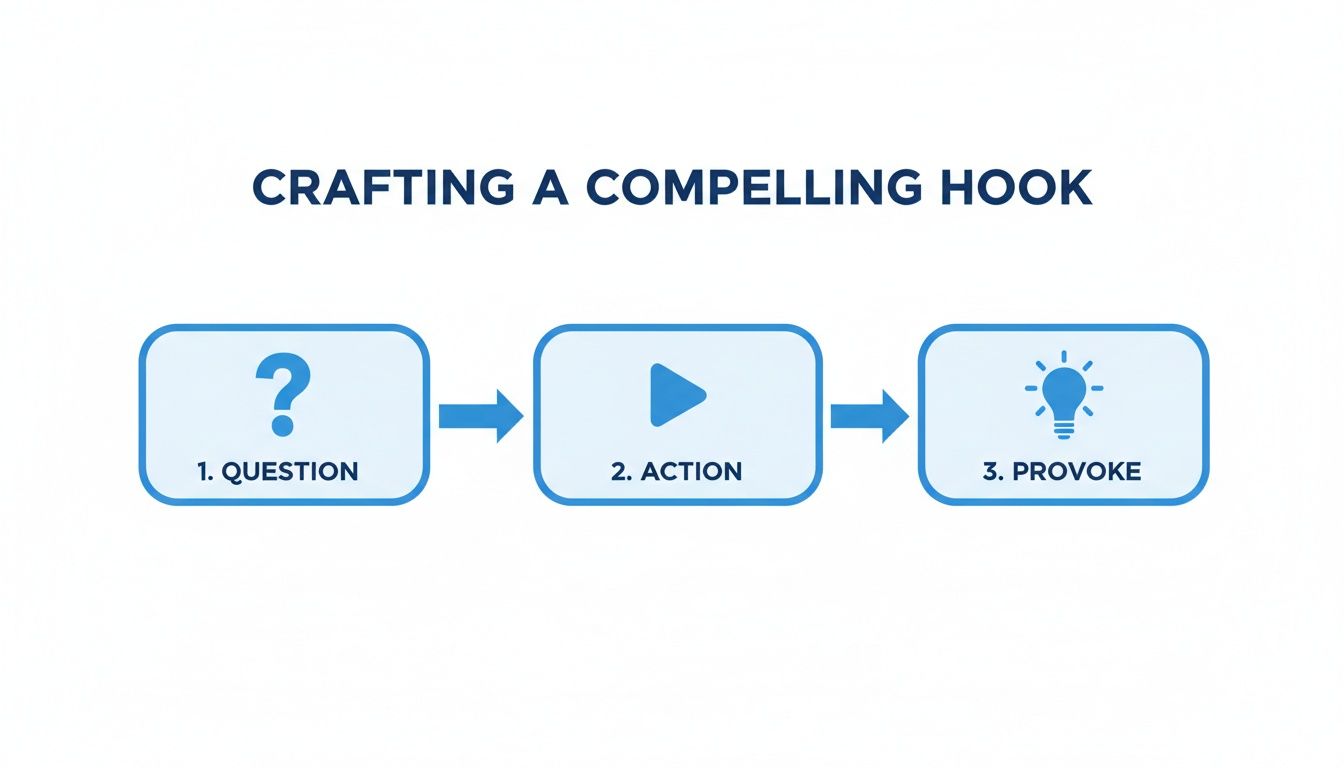
As you can see, the idea is to immediately grab the viewer with a question, an action, or something provocative. This sets the stage for the rest of your script.
Act One: The Hook
We've touched on this already, but it’s worth repeating: this is the most critical part of your script. Your hook is the promise you make to the viewer in the first one to three seconds. It's not just an intro; it's the only reason they’ll stop scrolling. You're basically presenting a problem, a burning question, or a bold statement that they can't ignore.
Take a cooking Short, for example. A great script might start with: "You've been making grilled cheese wrong your whole life. Here's the secret." That hook immediately opens up an information gap and promises a satisfying answer.
Act Two: The Core Value
This is the heart of your video—the meat of the sandwich, if you will. It’s where you deliver on the promise you made in the hook. Act Two is where you show the solution, walk through the "how-to," or reveal that surprising piece of information. It has to be direct and completely free of fluff. For a 60-second video, you're looking at a runtime of roughly 20 to 40 seconds for this part.
Let's stick with the grilled cheese example. This is where you’d reveal the technique: using mayonnaise instead of butter on the bread. You'd show the process clearly and explain why it works better (it creates a crispier crust and doesn't burn as easily). The visuals and your voiceover have to work together here to deliver that promised value as efficiently as possible.
The middle of your script is a transaction. The viewer gave you their attention; now you have to give them the value you promised. If you break that trust, you’ve lost them for good.
Act Three: The Payoff
The final act is your conclusion and call-to-action (CTA). This is where you close the loop you opened with the hook, giving the viewer a satisfying resolution. The payoff is the "big reveal"—the golden-brown, perfectly melted grilled cheese. It’s the visual and narrative confirmation that you delivered on your promise.
Right after that satisfying moment, you drop your CTA. Keep it quick and direct: "Follow for more simple cooking hacks." This whole final part should only take up the last five to ten seconds.
This simple three-act structure—Hook, Value, Payoff—is an incredibly powerful framework for scripting short-form content. It forces you to be concise, respect the viewer's time, and tell a complete, satisfying story in under a minute. That's the secret to driving retention and growing your channel.
Finding Your Voice and Setting the Tone
The words you write in your script are only half the battle. The real magic happens in how they sound. Writing for the ear is a totally different ballgame than writing a blog post—it’s about creating a rhythm and a personality that feels genuine, even when an AI voice is doing the talking.
The tone you settle on is everything. It dictates how your audience will receive your message. Are you going for witty and fast-paced? Authoritative and serious? Or maybe something more empathetic and reassuring? Nailing this down from the start will shape every single word you choose for your video.
Pacing Your Script with Sentence Structure
Your primary tool for controlling the video's energy is sentence structure. Seriously. Think of it like composing a piece of music where the rhythm is what keeps people hooked.
-
Short, Punchy Sentences: These are your go-to for creating energy, excitement, or a sense of urgency. They're perfect for your hook or when you're dropping quick, actionable tips. Think: "Stop scrolling. This is important. You need to hear this."
-
Longer, Flowing Sentences: Save these for storytelling, explaining a complex idea, or just creating a more thoughtful, relaxed moment in your video. They give the viewer a chance to breathe and absorb what you're saying without feeling rushed.
Mixing these up intentionally is what keeps your narration from sounding flat and monotonous. This is especially crucial if you're using AI voices, since the punctuation and phrasing in your script are the direct instructions for the AI's delivery and emotional inflection.
A great script anticipates what the listener needs to hear. It strategically uses pauses, switches up sentence length, and picks words that just roll off the tongue. The goal is a seamless listening experience that holds attention from start to finish.
How Tone Transforms the Same Message
Let's look at how a single idea can be completely transformed just by changing the tone. Imagine your core message is: "Using a budget is important for financial health."
Example Tones in Action:
-
Authoritative Tone: "Failing to implement a budget is the single most common obstacle to wealth creation. To secure your financial future, disciplined tracking of every dollar is non-negotiable." This approach is direct, serious, and immediately positions you as an expert.
-
Empathetic Tone: "I know how overwhelming money can feel. If you're stressed about finances, starting with a simple budget can give you a sense of control and peace of mind." This builds a foundation of trust and connection with your viewer.
-
Witty/Energetic Tone: "Your bank account is begging you to stop guessing where your money went! Let's build a dead-simple budget that actually works so you can finally buy that thing you really want." This is fun, relatable, and keeps the energy high.
Choosing the right voice and sticking with it is what builds a memorable channel personality. It's what makes your content instantly recognizable and helps you pull in the exact audience you're looking for. For a deeper look into developing a style that sticks, check out some resources on mastering tone and voice in writing.
Using AI to Accelerate Your Scripting Workflow
Scaling a YouTube channel feels like a constant race against the clock. If you want to boost your output without burning out, you have to work smarter, not just harder. This is exactly where AI tools come in, turning the grind of scriptwriting into a fast, efficient workflow that can literally double your content production.
Imagine having a great idea and turning it into a complete script for a YouTube video in just a few minutes. That's the power of AI. Script generators become your creative co-pilot, taking a simple prompt and fleshing it out into a structured narrative with a solid hook, core value, and satisfying payoff.
The real trick? You have to give the AI good instructions to get good results back.
Mastering AI Script Prompts
The quality of your AI-generated script is a direct reflection of the quality of your prompt. If you give it vague instructions, you'll get generic, uninspired content in return. You have to be specific and provide enough context to steer the AI in the right direction.
For example, a weak prompt would be something like: "Write a script about saving money."
A much stronger, more effective prompt looks like this: "Write a 60-second YouTube Short script for an audience of 25-year-olds. The tone needs to be witty and energetic. Start with a hook about the #1 mistake young people make with their finances. The core value should reveal three simple, actionable saving tips. End with a CTA to follow for more money hacks."
See the difference? This detailed prompt gives the AI clear guardrails, making sure the final script actually fits your channel’s voice and the video's goals. For creators who are really serious about visual storytelling, digging into enhanced video prompt engineering can unlock even more powerful ways to craft prompts for video.
To help you get started, here are a few proven formulas you can adapt for different video styles.
AI Prompt Formulas for Script Generation
| Prompt Type | Formula | Best For Niche |
|---|---|---|
| Problem-Agitate-Solve | "Write a script about [Problem]. Agitate the problem by highlighting [Pain Points]. Solve it by introducing [Your Solution/Tip]." | Self-Improvement, Finance, Tech |
| Myth-Busting | "Create a script debunking the common myth that [Myth]. Reveal the truth and provide [Evidence/Fact]." | Health & Wellness, History, Science |
| Quick Tip/Hack | "Generate a 30-second script for a quick hack on [Topic]. Start with a hook that asks '[Question]' and end with a CTA." | DIY, Cooking, Productivity |
| Storytelling Hook | "Write a script telling the story of [Event/Person]. Start with the most dramatic moment to hook the viewer." | True Crime, Educational, Motivational |
These formulas are a great starting point. Tweak them to fit your specific topic and audience, and you'll find the AI delivers much more targeted and engaging scripts.
From Text to a Finished Video
Once you have a solid AI script, the automation doesn't have to stop there. Modern tools can bring that text to life without you ever needing to touch a camera or microphone.
- AI Voiceover Selection: Pick from a huge library of lifelike voices to match your script's tone. Whether you need a deep, authoritative narrator for a history short or an upbeat voice for a product review, you can find the perfect match in seconds.
- Caption Timing and Animation: The AI can instantly generate and time on-screen captions. You can then add custom animations to punch up key words—a proven tactic for boosting viewer retention on Shorts and TikTok.
- Visual Generation: Based on your script, AI can suggest or even generate relevant visuals. This could be anything from cinematic b-roll to custom illustrations, ensuring your video’s visuals perfectly support the story.
This integrated workflow is the exact process used by many of the top automated YouTube channels. They use AI not just for ideas, but for the entire production line, which is how they're able to publish high-quality content every single day.
By embracing these tools, you can slash your production time. This frees you up to focus on the bigger picture: analyzing your performance, planning your content strategy, and building a channel that truly grows. To see this workflow in action, check out our guide on how to create videos with AI.
Common Questions About Writing YouTube Scripts
Even with the best script frameworks in your back pocket, you're bound to run into some practical questions when you actually start writing. It's the small details that often separate a decent video from a truly great one.
Let's clear up a few of the most common hurdles I see creators face when they finally sit down to write. Think of this as the final tune-up before you hit record, giving you the confidence to bring your vision to life.
How Long Should a Script for a 60-Second Short Be?
For a 60-second YouTube Short, the sweet spot is 150 to 160 words. This number isn't random; it perfectly matches the average speaking pace of about 150 words per minute. This gives you just enough breathing room for a dramatic pause or to let a key visual hit home without making you sound rushed.
Could you push it? Maybe. If you're going for a super high-energy, rapid-fire delivery, you might get away with 170 words. Any more than that, though, and your message will likely turn into a garbled mess. On the flip side, if you're telling a more relaxed story, aiming for around 140 words is a much safer bet.
The best way to know for sure? Do a timed read-through. Read the script out loud, at the speed you intend to perform it. If you’re tripping over words or running out of air, it’s a clear sign you need to trim some fat. Pacing is everything.
What Is the Best Way to Format a Video Script?
Hands down, the most effective way to format any video script is the classic two-column Audio/Visual (A/V) layout. This simple structure is a total game-changer because it forces you to think about what the audience sees and what they hear at the same time.
Here’s the basic setup:
- Left Column (Visuals): This is where you map out all your visual cues. Note down specific B-roll clips, on-screen text, camera angles, or even the emojis you want to pop up.
- Right Column (Audio): This side is for everything audible. That means your spoken dialogue, specific sound effects (like a whoosh or a ding), and even notes about the background music.
Using an A/V format creates a synchronized blueprint for your video. It takes the guesswork out of editing and ensures your visuals are actively supporting your story, not just decorating it.
Can a Faceless Channel Succeed with Good Scripts?
Absolutely. In fact, for a faceless channel, the script isn't just important—it's the star of the show. Without a personality on camera to connect with, your words, storytelling, and voiceover have to do all the heavy lifting to build that bond with your viewers.
Just look at a few popular niches. History explainers, psychology channels, and finance tutorials often blow up without ever showing a face, and it's almost always because their script quality is top-notch. A masterfully written script can paint such a vivid picture in the viewer's mind that the visuals almost become secondary.
When you pair that killer script with a high-quality, lifelike AI voiceover, you've got everything you need to build a massive, loyal audience. You can absolutely grow a hugely successful channel without ever stepping in front of the lens. A compelling story is the ultimate hook.
Ready to turn your ideas into scroll-stopping videos without ever touching a camera? ClipShort uses AI to generate scripts, add lifelike voiceovers, and create stunning visuals in minutes. Start creating viral Shorts today at https://www.clipshort.co.