
How to Make a Faceless YouTube Channel: Quick Guide to Winning Content
Starting a faceless YouTube channel is all about picking a profitable niche, using AI tools to create your scripts, voiceovers, and visuals, and then optimizing everything for discovery. It's a proven path to build a successful brand and generate income without ever stepping in front of a camera.
The Rise of the Anonymous Creator
The old dream of YouTube stardom—bright lights, a camera on you—is fading. A massive shift is happening right now, proving that you can build an incredibly profitable channel while staying completely anonymous. This isn't just a quirky trend; it's a full-blown movement fueled by a desire for privacy, total creative freedom, and just a smarter way to make content.
This new wave of creators is tapping into a huge change in how people watch videos. Audiences, especially younger ones, care way more about getting high-value, engaging content than they do about the personality presenting it. They're on YouTube to learn something, be entertained, or just chill out—the creator's identity is an afterthought if the experience is good.
Why Viewers Embrace Faceless Content
So, why does this work so well? Anonymous channels get straight to the point. Their value-first approach is what hooks viewers. Just think about some of the most popular formats crushing it today:
- Educational Deep Dives: Channels that make complex topics like finance, history, or science easy to understand.
- Relaxing Ambiance: Those lofi music streams or guided meditation videos that create a whole mood.
- Compelling Storytelling: Animated stories or true crime deep dives that grab you with the narrative, not a face.
- Product Reviews: Unbiased breakdowns using screen recordings and detailed voiceovers, focusing 100% on the product.
In every one of these, the information and the experience are the real stars. To really get a handle on this space, it's worth understanding the bigger picture of how to become a digital creator and build an actual business from the ground up.
The numbers don't lie. By 2025, faceless YouTube and TikTok accounts are projected to make up a massive 38% of all new creator monetization ventures. This momentum is powered by a generational shift, with 72% of Gen Z viewers saying they prioritize the quality of the content over seeing the creator's face.
The big takeaway is simple: YouTube pays for views, not faces. The only thing that truly matters is your ability to create valuable, engaging videos.
This whole evolution has made content creation more accessible than ever. AI-powered tools are now doing the heavy lifting—writing scripts, generating voiceovers, and even creating visuals. This means you can produce top-tier videos without needing expensive gear or on-camera talent. You can see this in action by checking out some of the top faceless YouTube channels that are absolutely thriving right now.
How to Find a Profitable Faceless Niche
Picking your niche is hands-down the most important decision you'll make. It’s the foundation for everything—your content, your audience, and ultimately, your bank account. Get this right, and you're setting yourself up for success. Get it wrong, and you're in for a long, slow grind, no matter how amazing your videos are.
Forget about chasing whatever's trending this week or picking a topic just because it looks popular. The real goal is to find that sweet spot where genuine audience demand, serious monetization potential, and your own interests all meet. That intersection is where sustainable, profitable channels are born.
Think Beyond AdSense from Day One
Look, getting paid from YouTube ads is great, but the truly successful faceless channels don't stop there. They build multiple streams of income, and your niche choice directly impacts how easily you can do that. A channel reviewing high-end software is going to have a much higher CPM (what advertisers pay per 1,000 views) and way more affiliate opportunities than a channel that just posts random funny clips.
Before you commit to a niche, think about these money-making angles:
- High CPM Topics: Niches like personal finance, real estate, technology, and business attract advertisers with deep pockets. This means you earn more from AdSense for the exact same number of views.
- Affiliate Marketing: Can you naturally talk about products or services? Gaming setups, tech reviews, and software tutorials are perfect for this. Every recommendation can become a potential commission.
- Digital Products: Could you eventually create and sell an e-book, a course, or a set of templates? Educational and self-improvement niches are practically built for this model.
When you look at a niche through this financial lens from the very beginning, you start building a real business, not just a hobby you hope pays off one day.
Gauging Demand and Competition
Okay, so you have a few ideas. Now it's time to see if they have legs. You're looking for topics that have a real, dedicated audience but aren't so crowded that you'll never get noticed. Luckily, some free tools make this research pretty straightforward.
First, head over to Google Trends. Pop in your topic and check out its long-term interest. Is it a flash in the pan, or does it have consistent, stable search volume? For example, a search for "AI tools for business" shows steady, sustained growth. A niche built around a single video game, on the other hand, might fizzle out after the initial hype dies down. This one simple check can save you from betting on a dying trend.
Next, it's time to become a YouTube detective. Search for your niche ideas directly on the platform and see who the top players are. Don't let competition scare you off—it's actually a good sign that an audience and money are there. Instead, look for the gaps. Are the top videos kind of low-quality? Could you bring a fresh perspective or go way deeper on a specific sub-topic?
Pro Tip: Keep an eye out for channels with huge view counts but surprisingly low subscriber numbers. This is often a golden ticket, indicating a topic with strong search demand where people are looking for a specific solution, not just a personality to follow.
To give you a clearer picture, it helps to see how different niches stack up against each other.
Top Faceless YouTube Channel Niche Comparison
Here’s a quick breakdown of some popular faceless niches. This table lays out their monetization potential, how complex the content is to create, and what kind of engagement you can typically expect.
| Niche | Monetization Potential (CPM) | Content Complexity | Audience Engagement |
|---|---|---|---|
| Personal Finance & Investing | Very High ($15 - $50+) | High (Requires research & accuracy) | Moderate (Viewers seek information) |
| Tech & Software Tutorials | High ($10 - $30) | Moderate (Screen recording & clarity) | Moderate to High (Solving problems) |
| Meditation & Relaxation | Low to Moderate ($2 - $8) | Low (Simple visuals, long audio) | High (Long watch times) |
| History & Documentary | Moderate ($5 - $15) | High (Deep research, storytelling) | High (Engaged, curious audience) |
| Gaming (Guides/Lore) | Low to Moderate ($3 - $10) | Moderate (Gameplay capture, editing) | Very High (Strong community) |
As you can see, there are always trade-offs. A finance channel can bring in a massive CPM, but you absolutely have to be on top of your game with fact-checking. On the flip side, a meditation channel is much simpler to produce but makes its money differently, usually through long watch times and sponsorships rather than high ad rates. Your final decision should be a balance between pure profit potential and the kind of content you can actually create consistently without burning out.
Your AI-Powered Content Creation Workflow
Alright, let's get into the fun part—actually making the videos. This is where we turn your niche and ideas into real, high-quality content without a camera, fancy mic, or a complicated editing suite. Your AI workflow is about to become your production team, working 24/7 as your scriptwriter, voice actor, and video editor.
The whole system is built for speed and consistency, two things you absolutely need to win on YouTube. You handle the creative vision, and the AI does the heavy lifting. It breaks down into a few simple stages, from scripting to final export.
Crafting the Perfect Script with a Single Prompt
Every great video starts with a solid script. For a faceless channel, your words and voice are everything—they have to grab and hold attention. Instead of staring at a blank page, you can use an AI script generator to get a structured, engaging narrative in seconds.
The trick is being specific. A lazy prompt like "Write a script about ancient Rome" will get you a boring, generic result. You have to be better than that.
Try something like this instead:
"Write a 500-word YouTube script for a faceless history channel called 'Unseen History.' The topic is 'The 3 Most Misunderstood Roman Emperors.' Write in a captivating, storytelling tone. Start with a surprising hook to grab attention and end with a question to get comments. The structure should be a short intro, three main points (one per emperor), and a quick conclusion."
A detailed prompt like that gets the AI 90% of the way there. All you have to do is spend a few minutes tweaking the language, adding your own flair, and making sure the pacing feels right.
Finding Your Channel's Voice with AI
With your script ready, you need a compelling voiceover to bring it to life. Audio quality is non-negotiable; it’s how you build a real connection with your viewers. Thankfully, modern AI voice generators sound incredibly human and can match any vibe you're going for.
You have a ton of control:
- Gender and Accent: Pick a voice that fits your audience. A tech channel might sound great with a crisp, clear American accent, while a mystery channel could use a deep, resonant British accent.
- Tone and Emotion: Need a serious, documentary-style narration? Or something more upbeat and exciting? You can dial in the exact emotional tone to match your script.
This completely removes the headache of buying an expensive microphone or finding a quiet place to record. The AI gives you a clean, professional audio file every single time, giving your channel a polished and consistent sound.
Assembling Visuals with AI Video Generation
This is where the magic really kicks in. Finding and editing B-roll used to be the most painfully slow part of making faceless videos. Not anymore. AI video generators have changed everything. You just paste your script into a tool like ClipShort, and the AI instantly analyzes the text to find relevant, high-quality stock footage and images for every scene.
If you want to create a truly unique look, you can dive deeper into how to create videos with AI. These platforms let you swap out clips, upload your own media, or even generate brand-new AI images in any style you want—cinematic, anime, photorealistic—to perfectly match your channel's brand.
The flowchart below shows how this content creation process fits into the bigger picture of finding a profitable niche. You have to nail the foundation first.
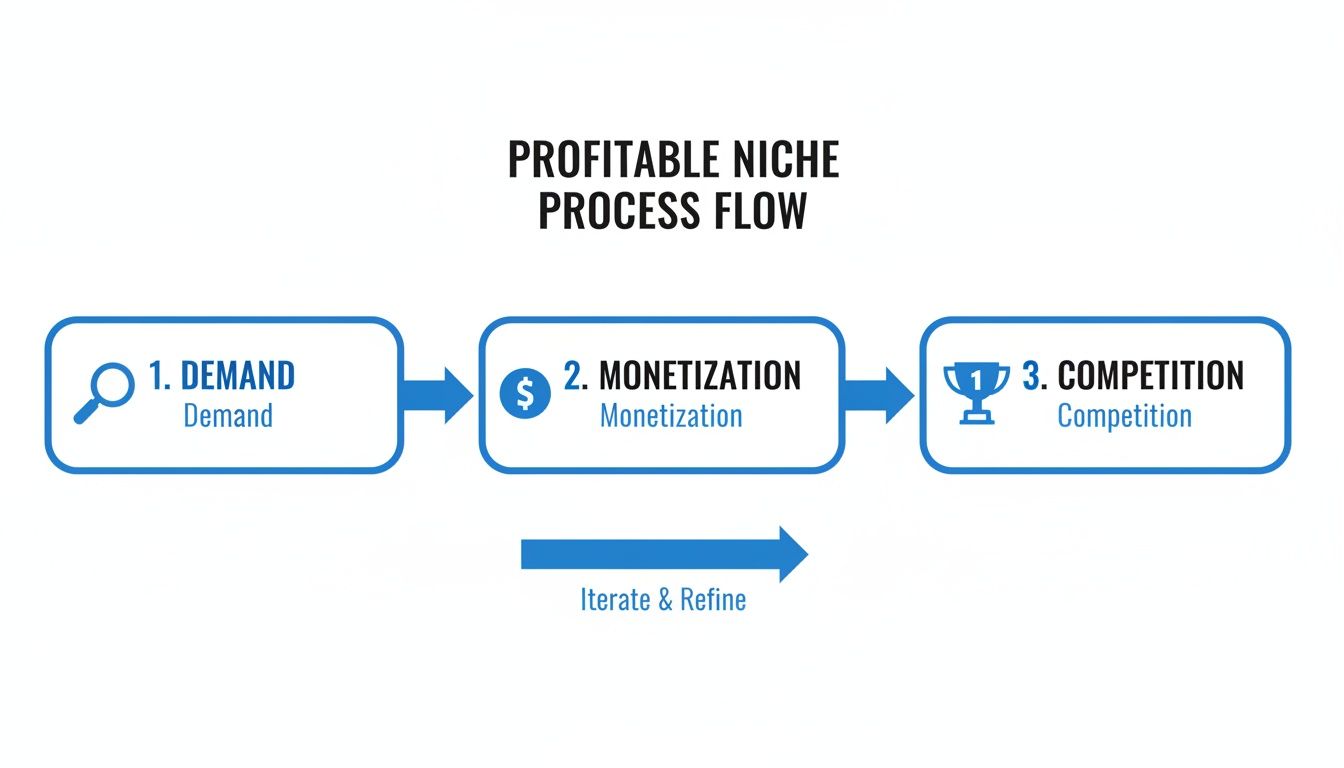
A good workflow only works if it's built on a solid strategy that accounts for audience demand, monetization potential, and the competitive landscape.
Refining and Polishing Your Final Video
The AI's first draft is a huge time-saver, but the final touches are what will set your content apart. This is where you inject personality and optimize for viewer retention.
First up: captions. Animated, easy-to-read captions are non-negotiable, since a huge number of people watch with the sound off. Use tools that let you create dynamic captions that make key words pop and keep the viewer engaged.
Next, add your branding. This can be a small watermark, a consistent intro and outro, or a specific color scheme for your text overlays. These details build brand recognition over time. To get your captions perfect, you'll need an accurate transcript. Using a good tool for YouTube to text transcription makes this process fast and ensures your content is accessible and easy for YouTube's algorithm to understand.
Finally, think about sound design. A subtle background music track that fits the video's mood can make a world of difference. Most AI video tools have built-in libraries of royalty-free music, so you can add a professional audio layer in one click without ever worrying about copyright strikes.
Optimizing Your Videos to Get Discovered
Look, creating an amazing video is only half the job. If nobody ever finds it, all that effort was for nothing. This is where you have to get smart about YouTube SEO. Your mission is to send crystal-clear signals to both the algorithm and potential viewers, telling them exactly what your video is about and why they absolutely need to click on it.

Think of each video as a product on a shelf. The content is what's inside the box, but the title, thumbnail, and description are the packaging. If the packaging is boring, no one’s going to grab it, even if the product inside is incredible. For a faceless channel, this is everything—you're relying completely on these elements to pull in your audience.
Writing Titles That Demand a Click
Your title is your first, and maybe only, chance to make a sale. It has to be magnetic, searchable, and honest—all at the same time. A killer title nails the balance between a solid keyword and genuine human curiosity.
Whatever you do, avoid bland, forgettable titles. "History of Rome" is a snooze-fest. But what about "The Roman Empire's Most Overlooked Mistake"? Now that gets a click. It still targets the "Roman Empire" keyword but creates an immediate knowledge gap people want to fill.
Here are a few title formulas that just work:
- The How-To: "How to Animate a Story in 10 Minutes (Even If You're a Beginner)"
- The Listicle: "5 AI Tools That Feel Like a Cheat Code for Creators"
- The Curiosity Gap: "Why Most Meditation Channels Get This One Thing Wrong"
Each one clearly signals the video's value while making you feel like you have to find out what's inside. They’re built for search engines but written for people.
Crafting Descriptions That Work for You
Your video description is some of the most underused real estate on YouTube. It’s your chance to spoon-feed the algorithm rich context and give your viewers more value. Honestly, a well-written description can make a huge difference in how your video gets discovered.
Start with a punchy opening paragraph. Weave your primary keyword into the first two sentences naturally. This is the snippet people see before they click "Show more," so it needs to hook them. After that, go deeper with more details, links to affiliate products or your socials, and timestamps for longer videos.
Think of your description as a mini-blog post that supports the video. It helps YouTube understand the nuances of your content, which means you can rank for a much wider range of search terms.
And don't forget tags. YouTube has played down their importance a bit, but they're still a great way to add extra context. I use a mix of broad tags (like "personal finance") and super-specific, long-tail ones (like "high-yield savings account strategy 2024").
Designing Thumbnails That Stand Out
On a crowded YouTube homepage, your thumbnail is your visual handshake. It’s often the #1 reason someone clicks your video instead of the one next to it. For faceless channels, a strong, consistent thumbnail style is non-negotiable for building a recognizable brand.
You don’t need to be a graphic design genius. Just stick to the fundamentals:
- High Contrast: Use bold, bright colors that pop.
- Clear Focus: One central image should immediately grab the eye.
- Minimal Text: Stick to 3-5 big, readable words that amplify the title's promise.
- Emotion: Use an image or graphic that sparks curiosity or another strong emotion.
The best thumbnails work hand-in-glove with the title to tell a tiny story. If your title is "This Simple Mistake Is Costing You Money," your thumbnail could be a crisp dollar bill being ripped in half. The combination is way more powerful than either one alone.
Mastering these basics gives your faceless content the fighting chance it deserves to get found, get watched, and get shared.
Building a Real Business from Your Channel
Making great videos is just the starting line. The real endgame is turning your channel into a sustainable business that generates income for years to come. This requires a mental shift—you're no longer just a content creator; you're a business owner. It's all about building systems, digging into your performance data, and opening up multiple revenue streams that go way beyond what YouTube ads can offer.
A top-tier faceless channel doesn’t happen by accident. It's the product of a deliberate, long-term strategy. You have to start treating it like a small media company, where every video is an asset and every viewer is a potential customer. This mindset is what turns a creative hobby into a powerful engine for profit.
Develop a Sustainable Publishing Cadence
On YouTube, consistency is king. The algorithm loves a predictable schedule because it helps build viewer habits, which is exactly what you want. But "consistency" doesn't mean you need to burn yourself out publishing every single day. The key is finding a rhythm you can actually stick with for the long haul.
For a brand new faceless channel, a good target to aim for is one to two high-quality, long-form videos per week. This is frequent enough to feed the algorithm and build momentum, but it’s manageable enough that you won't start cutting corners on quality. And trust me, one incredible video will always outperform three mediocre ones.
Think of your publishing schedule as a promise to your audience. Whether it's every single Tuesday or the first and third Friday of the month, sticking to it builds trust and turns casual viewers into loyal subscribers who actually look forward to your next upload.
Once you’ve settled into a routine, dive into your YouTube Analytics to see when your audience is most active. If you can publish an hour or two before that peak time, you give your new videos a little rocket boost of initial viewership. That initial traction is a huge signal to the algorithm that your content is worth pushing to a wider audience.
Using Analytics to Drive Growth
Your YouTube Analytics dashboard isn't just a vanity board for checking view counts. It's a treasure map that shows you exactly what's clicking with your audience and what's falling flat. To build a real business, you have to stop guessing and start making decisions based on cold, hard data.
Here are the metrics that really matter:
- Audience Retention: This graph is pure gold. It shows you the exact moment viewers start dropping off. Seeing a huge dip in the first 30 seconds? Your hooks need serious work. If everyone bails during a specific segment, you know that part was probably too slow, boring, or confusing.
- Click-Through Rate (CTR): This number tells you how well your thumbnails and titles are doing their job. A consistently low CTR (think below 4%) is a red flag that your "packaging" isn't grabbing attention, even if the video inside is fantastic. A/B test different thumbnail styles and title formulas to see what people actually click on.
- Traffic Sources: Ever wonder how people find you? This section tells you. If "Browse Features" is high, it means YouTube is promoting you on the homepage. If "YouTube Search" is your top source, your SEO game is on point.
By checking in on this data regularly, you can start doubling down on the video formats and topics your audience can't get enough of. This creates a powerful feedback loop where each video you release has a better shot at success than the last, which is how you accelerate your channel's growth.
Diversify Your Income Beyond AdSense
Relying only on YouTube AdSense is like building your house on a single pillar—it’s incredibly risky. True financial stability comes from having multiple streams of income. The great thing about a faceless channel is that it's the perfect launchpad for these other ventures, which often have much higher profit margins than ad revenue alone.
One of the most effective monetization strategies out there is affiliate marketing. If your niche is tech, finance, or even software tutorials, you can recommend products you actually use and earn a commission every time someone buys through your link. It’s a win-win: your audience gets a genuine recommendation, and you get paid for it.
Another powerful move is to create and sell your own digital products. This could be anything from an e-book or a pack of templates to a full-blown online course related to your niche. This puts you in the driver's seat of your earnings and lets you build a direct relationship with your biggest fans.
Many creators are also crushing it with YouTube Shorts. While the direct ad revenue is lower, Shorts are a phenomenal tool for driving new subscribers to your main, long-form content. You can dive deeper into the specifics of how to monetize YouTube Shorts and use them as a top-of-funnel strategy to grow your entire business.
The low financial barrier to entry is a massive plus for faceless channels. Instead of dropping thousands on cameras and lighting, you can invest that money into AI tools that automate most of the work. This allows you to scale your content output at a fraction of the cost, which is a key reason these channels can often outperform traditional productions. You can find out more about how faceless channels offer a cost-effective path to content creation on Voices.com.
Common Questions About Faceless Channels
Jumping into the world of faceless content creation always brings up a few questions. It's a different way to build a presence, and getting the lay of the land from the get-go will help you move forward with confidence. Let's dig into some of the most common things new creators wonder about.
The first question is almost always about the money. Can you really build a profitable channel without ever showing your face?
Can You Really Get Monetized Without Showing Your Face?
Yes, 100%. This is one of the most stubborn myths out there, but it’s completely wrong.
YouTube’s monetization rules are all about the quality and originality of your content, not whether you’re in the video. The platform cares about two main things: that you follow the community guidelines and that you hit the subscriber and watch-time numbers.
As long as you’re creating something new—writing your own scripts, adding your own narrative, and piecing together visuals in a unique way—you are absolutely eligible for the YouTube Partner Program. The algorithm doesn't see a face; it sees viewer engagement and originality.
Thousands of massive channels in history, finance, and meditation prove it every single day. Your face is not a requirement for a paycheck.
What Are the Best AI Tools for Faceless Videos?
Honestly, the best tools are the ones that don’t make you jump through a dozen hoops. Juggling separate subscriptions for a scriptwriter, a voiceover tool, a stock footage library, and an editor is a surefire way to burn through time and money.
The smart move is to find an all-in-one generator. You want a tool that brings everything under one roof. Specifically, look for a platform that offers:
- Integrated Scripting: Can it generate a script from a simple idea you type in?
- High-Quality AI Voices: Does it have a good range of realistic voices to fit your channel's vibe?
- AI-Powered Visuals: The tool should automatically find and assemble relevant, high-quality clips based on your script.
- Customization Options: Being able to swap scenes, upload your own clips, and add things like animated captions is what will make your content feel unique.
This kind of streamlined workflow lets you focus on the big-picture ideas while the AI handles the grunt work. That’s how you keep a consistent publishing schedule without burning out.
How Do I Avoid Copyright Issues?
This is a big one, but it’s actually pretty straightforward if you use the right resources. The golden rule is to use platforms that give you assets with a commercial license.
Good AI video generators solve this for you by sourcing their clips from licensed stock footage libraries or creating new AI-generated images from scratch. That means the content is pre-cleared for you to use. The same goes for AI voiceovers and background music—make sure the platform has the rights to everything it gives you.
The real key to staying safe is adding your own creative layer. Your unique script, your narrative flow, and your editing choices are what turn those stock assets into something original that belongs to you. Never just re-upload someone else's content or use popular music without a proper license. And always take two minutes to read the terms of service for any tool you sign up for.
Ready to stop worrying about the details and start creating? ClipShort is the all-in-one AI video generator that handles scripting, voiceovers, visuals, and animated captions so you can build your faceless YouTube channel faster. Turn your ideas into scroll-stopping videos in minutes at https://www.clipshort.co.