
How to Make a Video Viral A Guide for Modern Creators
Hoping your next video goes viral is a losing strategy. Engineering it is a winning one.
There's a science to why people stop scrolling, watch until the end, and hit that share button. It boils down to four key pillars: a killer hook, a strong emotion, a smart use of trends, and a solid distribution plan. Nail these, and you're no longer gambling on virality—you're building a system for it.
The Real Blueprint for Going Viral
Let's kill the myth right now: viral hits are rarely accidents. The best creators, especially those running successful faceless channels, know that virality is a repeatable process built on human psychology and what the algorithms are designed to reward.
Your goal isn't to create one lucky hit. It's to build a system that consistently produces highly shareable content. This approach strips away the mystery of "how to make a video viral" and puts the focus squarely on the things you can actually control. It’s not about having the fanciest camera or being a loud personality; it’s about understanding what makes people tick.
The Four Pillars of Virality
Every viral sensation follows a predictable path, with each stage amplifying the next. It’s a flywheel effect that gets both people and platforms excited about your content.
This is the basic flow every viral video follows, from the first second of attention to reaching millions.
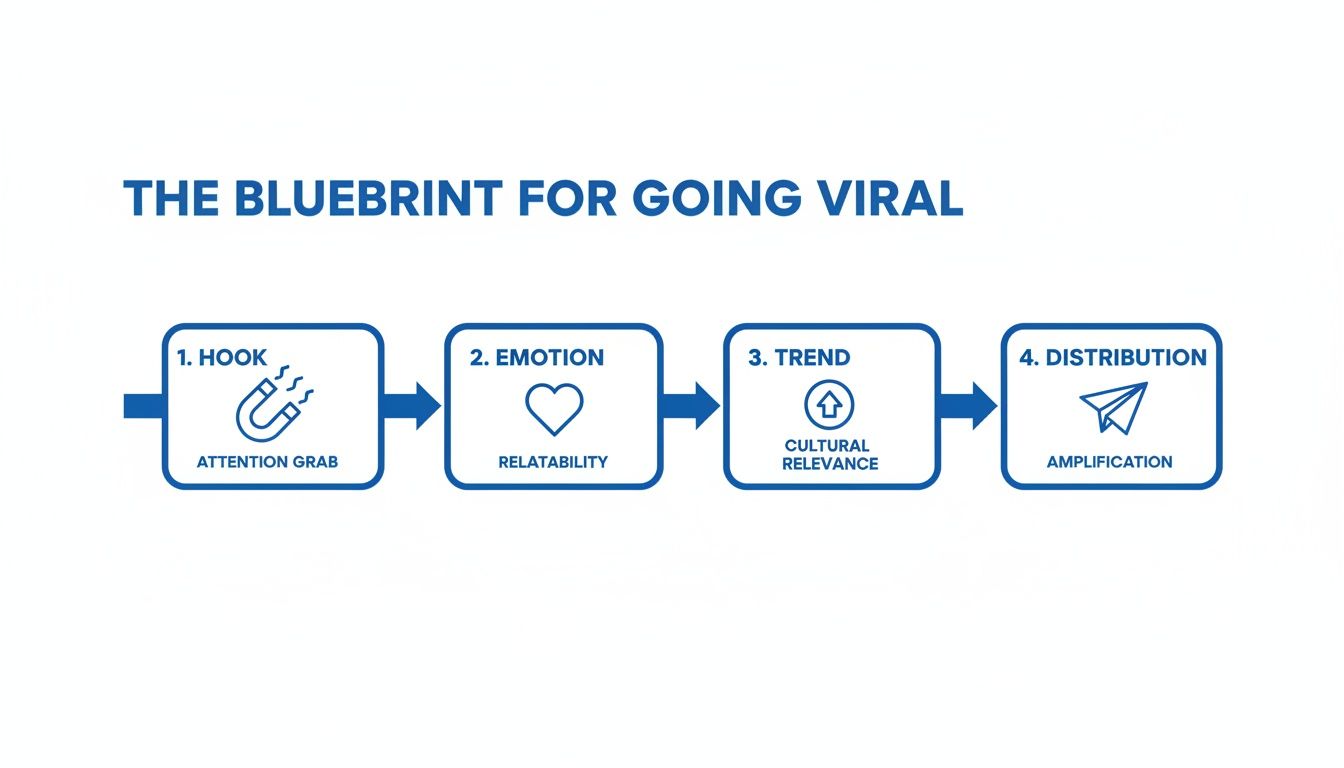
The blueprint is simple: it all starts with a hook, gets supercharged by emotion and trends, and finally explodes with smart distribution. If you want to go deeper, there are some great strategies to create viral content that actually works that break this down even further.
At the end of the day, a video goes viral because it connects with someone on a personal level. That connection comes from a few key ingredients working in harmony.
- It has to be relatable. The video reflects a thought, problem, or feeling that makes viewers think, "That's so true."
- It has to be emotional. It needs to spark a strong feeling—joy, surprise, inspiration, or even a little bit of anger.
- It has to be simple. The core idea is so easy to grasp that sharing it with a caption like "this is so me" is a no-brainer.
To truly understand what it takes, let's break down these pillars into a quick-reference table.
The Core Pillars of a Viral Video
This table summarizes the essential components needed to engineer a viral video. Think of it as your cheat sheet for creating content with massive reach.
| Pillar | What It Is | Why It Matters for Virality |
|---|---|---|
| Hook | The first 1-3 seconds of your video. | It's your one shot to stop the scroll. A weak hook means no one sees the rest of your amazing content. |
| Emotion | The core feeling your video evokes (e.g., humor, awe, inspiration). | Emotion is the fuel for sharing. People share content that makes them feel something. |
| Trend | A popular format, sound, or topic currently circulating. | Tapping into a trend gives you a built-in audience and tells the algorithm your content is relevant right now. |
| Distribution | Your strategy for posting, captioning, and promoting the video. | This is how you give your video its initial push. The right hashtags, timing, and CTA can make all the difference. |
By mastering these four areas, you shift from hoping for a viral hit to actively building one.
Key Takeaway: Algorithms don't make videos viral—people do. The algorithm's job is to find what people already love and show it to more of them. Always create for a human, not a machine.
Ready to put this into action? We'll break down each of these pillars with tactical steps in the sections ahead. And for an even deeper dive, check out our guide on what makes a video viral and why some content just takes off.
Finding and Validating Your Next Viral Idea
Let’s be honest: a viral video rarely starts with a random thought in the shower. It almost always begins with a concept that's already primed to connect with a massive audience. The best ideas aren't just found by accident—they're uncovered through smart research and a little bit of validation.
This means we need to move past just copying what's popular. The real secret is what I call trend-embedding. You're not just chasing trends; you're weaving them into your own unique content style. It's the difference between being a copycat and being a savvy creator who knows how to ride the wave of a current conversation without losing your channel's soul.
Uncovering Ideas with Platform-Native Tools
Believe it or not, your best research assistants are already built into the apps you use every day. TikTok, Instagram, and YouTube Shorts are absolute goldmines for spotting emerging patterns before they get oversaturated—if you know where to look.
Stop mindlessly scrolling the "For You" page and start searching with intent. You're on the hunt for sounds, formats, and topics that are just starting to bubble up in your niche.
Here’s a simple workflow I use all the time:
- Get Specific with Keywords: Search for terms your audience actually uses. Think "AI tools for creators," "skincare hacks," or "faceless video ideas."
- Filter for Now: This is crucial. Filter your search results to show videos posted in the last week or month. You want to see what's working right now, not what was a hit three months ago.
- Deconstruct the Winners: Pull up the top 5-10 videos. Don't just watch them—break them down. What's the hook? What's the core emotion they're tapping into? Is there a specific sound or format they all share?
When you do this, patterns jump out at you. You might notice three different creators in your space all using the same trending audio to explain a tricky concept. That’s no coincidence. That's a validated idea you can now adapt for your own audience.
Pro Tip: The comment section is your secret weapon. When you see comments on top videos like, "Can you do one about X?" or "I wish someone would explain Y," that's literally your audience handing you video ideas on a silver platter. It's free market research.
Validating Your Concept Before You Hit Record
Got a few ideas buzzing? Great. The next step is to make sure people actually want to see it before you pour hours into creating the video. This single step can dramatically boost your odds of going viral.
A quick and dirty way to do this is with some simple competitor analysis. Find 5-10 creators in your niche (or a similar one) and dissect their best-performing content from the last 90 days.
Look for these tell-tale signs of a strong concept:
- High Share-to-Like Ratio: When a video has a ton of shares compared to its likes, it means the idea is incredibly relatable or useful. People are hitting "send" to a friend, which is a powerful signal.
- Rapid View Velocity: Did a video explode with views in the first 48 hours? The algorithm loved it and pushed it out fast. That's a sign of high-impact content.
- Repetitive Formats: If a creator keeps returning to the same video format or series and it keeps working, they've struck gold. That format has proven appeal.
For example, a faceless history channel might realize their short, animated map videos explaining historical battles get 10x the engagement of anything else they post. That validates the format—animated maps—as a home run for their niche. Your job is to find a new story to tell using that proven format.
This whole process takes the guesswork out of creation. You're no longer just throwing spaghetti at the wall. You’re making smart, data-informed decisions, building your video on a foundation you already know works. This is how you turn viral potential from a matter of luck into a reliable, repeatable process.
Crafting Hooks That Stop the Scroll
You have less than three seconds. No, that’s not a dramatic exaggeration—it’s the brutal reality of the short-form video feed.
If the first few moments of your video don’t physically stop someone's thumb mid-scroll, all your hard work is for nothing. Mastering the hook isn't just a "good idea"; it's the single most critical skill you need to learn if you want your video to have any shot at going viral.
A great hook shatters the hypnotic trance of endless scrolling. It’s a pattern interrupt—something that jolts the viewer’s brain and makes them pay attention. This isn’t about cheap clickbait; it's about making an instant, powerful promise that their next 30 seconds will be worth it.
Four Proven Hook Formulas
There are a million ways to grab attention, but the best hooks almost always tap into a few core psychological triggers. Instead of trying to reinvent the wheel, you can just adapt these proven formulas to your own content. It’s a shortcut to making your videos instantly more magnetic.
These formulas just work because they play on fundamental human drivers: our curiosity, our desire for value, and our love for the unexpected.
-
The Curiosity Gap: This one is a classic for a reason. You open with a statement that creates an immediate, nagging question in the viewer’s mind. Think, "This is the one mistake 99% of people make when..." or "I stopped doing this one thing, and my life changed forever." People have an almost physical need to stick around and find out the answer.
-
The Controversial Statement: Starting with a bold, even polarizing, opinion is like throwing a spark into a dry field. It ignites debate and engagement instantly. A hook like, "Hot take: cardio is a complete waste of time for fat loss" or "You've been using your air fryer all wrong" makes people stop, whether it's to agree, argue, or learn why you'd say something so audacious.
-
The Unexpected Visual: Sometimes, the most powerful hook isn't what you say—it's what you show. A visual that's bizarre, incredibly satisfying, or just plain shocking forces people to figure out what's going on. It could be a clip that starts right in the middle of the action or shows an object somewhere it clearly doesn't belong.
-
The Direct Value Proposition: This is the no-fluff approach. You tell people exactly what they're going to get by watching. A hook like, "Here are three AI tools that feel illegal to know" or "This is how I make viral videos without ever showing my face" makes a clear, immediate promise of valuable information.
A great hook is a promise. A great video is keeping that promise. If your hook teases a mind-blowing reveal, the rest of the video better deliver. Break that trust, and you'll lose that viewer for good.
Maintaining Momentum With Story Loops
A killer hook gets their attention. But keeping it is a whole different ballgame. This is where story loops come in.
A story loop is a simple narrative trick where you constantly open new questions right as you’re answering the old ones. It prevents the viewer from ever finding a comfortable "exit point" to scroll away.
Think of them as a series of mini-cliffhangers. You introduce a problem, hint at the solution, but just before you reveal it, you introduce a new wrinkle or a related, even more interesting question. This layering of intrigue keeps the tension high from the first second to the last. Having a well-structured script for your YouTube video is the key to building these loops effectively.
For example, a video hook might be, "Here's the real reason your plants are dying." The first loop answers a common problem (overwatering) but immediately opens a new one: "But what if you know you're not overwatering? It could be this hidden pest." You're pulling the viewer deeper and deeper, which is exactly how you rack up the insane watch times that the algorithms love.
Engaging Viewers Without a Face
For faceless creators, holding attention is even more of a challenge. You can't rely on your facial expressions or body language, so you have to master every other visual tool in your arsenal. This is where things like dynamic captions and sharp editing become your superpowers.
Using a tool like ClipShort, your captions can do so much more than just display words—they become part of the story.
- Emphasize key phrases with a sudden color change or a pop-up animation.
- Time your subtitles to land perfectly with a sound effect or the beat of the music.
- Use emojis and overlays to add personality and emotional flavor to your voiceover.
These aren't just decorative touches. They guide the viewer’s eye, reinforce your message, and make the content incredibly easy to follow—especially for the 85% of people who watch videos on mute.
For a faceless channel, your captions are your on-screen personality. They can turn a basic voiceover into a visual experience that keeps people glued to their screen until the very end.
Editing for Maximum Emotional Impact

You can have a brilliant idea and a killer hook, but it can all fall apart in the edit. Bad execution sinks great concepts. This is where you separate the amateurs from the pros.
Great editing isn't just about slapping clips together. It's the invisible hand guiding the viewer's emotions and attention. It’s how you turn a bunch of raw clips or AI-generated scenes into a slick, professional story that actually makes people feel something.
Think of it like music. The clips are just notes. The editing—the rhythm, the tempo, the cuts—is what creates the melody that gets stuck in someone's head. High-energy videos demand quick, punchy cuts. A suspenseful story needs to breathe, using a deliberate pause to build tension before the big reveal.
For faceless creators, this is non-negotiable. Without a person on screen to connect with, your editing has to pull all the weight. It's what gives your content personality and separates a forgettable clip from one that commands attention and gets shared.
Pacing Is Everything
The rhythm of your cuts sets the video's entire mood. In the blink-and-you'll-miss-it world of short-form video, you have to keep things moving. The single biggest mistake I see is letting a scene hang for even half a second too long. That's all it takes for someone to lose interest and swipe away.
For most viral-style content, you’re aiming for a dynamic, almost breathless pace. We're talking about techniques like J-cuts and L-cuts, where the audio of the next clip starts a moment before the visual does (or vice-versa). This simple trick creates a buttery-smooth flow that pulls the viewer along effortlessly.
- Fast Cuts for Energy: For explainers or list-style videos, aim for quick cuts every 1-2 seconds. It perfectly matches the goldfish attention spans we're all dealing with.
- Strategic Pauses for Impact: Never underestimate the power of silence. A sudden audio cut right before a shocking reveal creates a vacuum of tension that makes the payoff hit so much harder.
- Vary Your Shots: Even if you're working with stock footage or AI visuals, mix it up. Don’t just show the same type of shot over and over. Cut from a wide shot to a close-up to keep things visually interesting.
This relentless forward momentum means there’s never a dull moment. Every single second feels intentional.
Your video's pace should match the emotional journey you want your audience to take. Speed up the cuts to build excitement; slow them down to let a powerful moment land. Pacing is the director's tool for controlling the viewer's heartbeat.
Sound Design Beyond the Trending Audio
Sure, jumping on a trending sound is great for getting seen, but it’s the unique soundscape of your video that makes it feel immersive and high-quality. Sound design goes way beyond just picking a background track. It's about the little audio cues that add depth and texture.
Think about the sounds that can bring your visuals to life. If you show a clock, add a faint "tick-tock" sound effect. A quick "whoosh" can make a transition feel snappier. A little "ding" can emphasize a key takeaway on screen.
These tiny details add up to a massive impact. They instantly elevate the production value and make your video feel like it was crafted with care. For faceless creators using a tool like ClipShort, layering in these effects is dead simple and can make a world of difference.
Here’s a quick-and-dirty checklist for your audio:
- Pick a Core Music Track: Find a track that nails the mood you're going for. Is it epic? Suspenseful? Fun?
- Layer in SFX for Emphasis: Use sound effects (whooshes, dings, clicks) to punctuate on-screen actions or text reveals.
- Balance Your Levels: This is crucial. Your voiceover must be crisp and clear, with music and SFX sitting in the background. Muffled or competing audio screams "amateur."
Assembling Polished Visuals
The final layer is making sure your video looks professional and clean. This has nothing to do with having a massive budget and everything to do with being deliberate.
First, lock in a cohesive visual style. If you’re generating AI visuals, pick an aesthetic—cinematic, anime, photorealistic—and stick with it. Consistency makes your content feel branded and intentional, not random.
Next, pay serious attention to your captions and on-screen text. They need to be readable, perfectly timed, and consistent in font and color. Animated captions are a cheat code for holding attention because the constant motion gives the viewer's eyes something to track.
Every visual element, from the footage to the text, should work together to tell a single, engaging story. Every frame counts.
Mastering Distribution for Explosive Reach
Let's be real. You can create the most incredible video in the world, but if nobody sees it, it’s just taking up space on your hard drive. A brilliant video is only half the job. The other half—the part that actually gets you views—is distribution.
This is where you turn a great piece of content into a viral hit. It’s about getting your video in front of the right eyeballs at exactly the right time and giving the algorithm every reason to push it to a massive audience.
Writing Captions That Feed the Algorithm
Think of your caption as more than just a clever one-liner; it's a direct line of communication with the platform's algorithm. A well-written caption is pure SEO fuel, telling TikTok or Instagram exactly what your video is about and who needs to see it.
The trick is to weave in keywords naturally. If your video is about "AI tools for productivity," don't just dump keywords. Phrase it compellingly, maybe something like, "These AI tools will completely change how you work. Here are my top automation tips to help you work smarter."
Hashtags are the next piece of the puzzle. A balanced strategy works best, so don't just copy and paste whatever's trending. I've found a mix like this works wonders:
- Broad Tags (1-2): Hit the big topics like #AI or #Tech.
- Niche-Specific Tags (2-3): Get specific to find your core audience. Think #AIToolsforBusiness or #ProductivityHacks.
- Branded Tag (1): Create a unique tag for your channel or a specific series to build a community around your content.
This strategy gives the algorithm a crystal-clear roadmap, ensuring your video gets a strong start with the right viewers.
Finding Your Golden Hour for Posting
Forget everything you've read about a universal "best time to post." It’s a complete myth. Your audience is unique, and your "golden hour" is all about when they are glued to their phones. You'll have to do a little experimenting to find it.
Instead of posting at random, test it methodically. Try posting at 9 AM for a week. The next week, shift to 1 PM. The week after that, try 6 PM. The key is to track how each video performs within the first 1-3 hours.
Key Takeaway: You're looking for initial velocity. A video that racks up views and likes right out of the gate sends a powerful signal to the algorithm that you've got a winner on your hands, prompting it to push your content even further.
After just a few weeks of testing, you’ll have hard data pointing to the time slots that give your videos the biggest initial boost. That’s your golden hour. Stick to it.
Smart Tactics Beyond the Initial Upload
Your work isn't over when you hit publish. The first hour is arguably the most important for building momentum. When you're trying to engineer explosive reach, especially on a fast-moving platform like TikTok, knowing what's buzzing is non-negotiable. Using a TikTok Story Viewer can be a sneaky way to see what popular accounts are doing and how viewers are reacting in real-time.
As soon as your video is live, jump into the comments. Reply to every single one. This isn’t just good community management; each reply counts as another engagement signal to the algorithm. It shows that your content is sparking a real conversation.
Finally, don't let your video exist on just one platform. Cross-promote it everywhere. Tease your new YouTube Short on X, or share your latest TikTok to your Instagram Stories. This drives your existing audience to the new video, giving it that crucial initial surge of engagement that can ignite the viral flywheel. For a deeper dive on this, our guide on how to grow on YouTube Shorts is packed with more platform-specific tactics.
Common Questions About Making Videos Viral

Even with a perfect game plan, a few questions always seem to pop up on the road to that next viral hit. It’s only natural. The small details often make the biggest difference in how your video performs, so let's clear the air on some of the most common ones.
Think of this as your quick-reference guide to get over those common hurdles. These are the practical, no-fluff answers you need to tighten up your strategy and hit "post" with confidence.
How Long Should a Video Be to Go Viral?
This is the million-dollar question, isn't it? While there’s no single magic number, the data points to a very clear trend. Your goal should always be to tell your story in the shortest amount of time possible without losing the punch.
For the most part, videos between 30 and 90 seconds absolutely crush it. This range is the sweet spot for modern attention spans and for algorithms that reward high completion rates like nothing else. It gives you just enough time to land a powerful hook, build a quick narrative, and deliver a payoff that feels satisfying.
A 45-second video just has a much better shot of being watched all the way through than a three-minute epic. That high completion rate is a massive signal to the algorithm that your content is a winner, triggering the viral snowball effect you're looking for.
Can a Video Go Viral Without Showing Your Face?
Absolutely. In fact, building a faceless channel is one of the smartest and most sustainable ways to grow a massive audience right now. Virality isn't about your face; it's about the value, emotion, and story you deliver.
People are drawn to great storytelling, useful info, and satisfying visuals. The focus shifts entirely to the content itself, which is why niches like these are exploding:
- History Explainers: Think animated maps and cool archival footage.
- Motivational Clips: Inspiring quotes layered over cinematic B-roll.
- Product Demos: Just showing the item in action with a clear voiceover.
- Recipe Tutorials: Those satisfying, top-down cooking shots we all love.
The trick to making faceless content feel personal is to lean into the other senses. A crisp, engaging voiceover, high-quality visuals, and thoughtful sound design create an incredibly powerful connection. A well-produced faceless video can feel just as authoritative as one with a creator on camera.
Key Insight: Going faceless lets you put 100% of your energy into the story and production quality. You stop worrying about your on-camera performance and get obsessed with creating the most compelling experience possible.
This shift can be incredibly freeing. It allows for a level of consistency and quality that's tough to match when you have to be "on" for every single video.
What Type of Content Goes Viral Most Often?
While trends come and go in a flash, certain types of content seem to have evergreen viral potential. It all boils down to videos that are highly entertaining, educational, or emotionally resonant. Your video needs to make someone feel something strong enough to hit the share button.
Data actually shows that 73% of social media users want to see entertaining videos that feature real products. This highlights a huge demand for content that's fun but also offers tangible value.
Just think about the videos you share yourself. Chances are, they fall into one of these buckets:
- Humor: Memes, skits, and relatable comedy are the lifeblood of virality.
- Awe and Surprise: Stunning visuals, shocking facts, or an ending nobody saw coming.
- Inspiration: Motivational stories and feel-good moments that connect on a human level.
- Education: Quick tutorials, life hacks, and "things you didn't know" content that provides immediate value.
Storytelling is the thread that ties all of these together. Whether it's a personal story or a simple product review, a well-told story is the most powerful engine for going viral. Find the emotional core of your idea and build your video around that.
Ready to stop chasing trends and start creating viral-worthy videos on autopilot? ClipShort is the AI-powered video generator that lets you create stunning, faceless short-form content in minutes. From script to final edit with animated captions and lifelike voiceovers, you have everything you need to scale your production and dominate the feed.