
How to Create Engaging Social Media Content That Resonates
If you want to create social media content that actually gets noticed, you have to stop thinking like a broadcaster and start acting like a conversationalist. It's about tuning into your audience's real-world problems and aspirations, which is the only way to create something that feels personal and genuinely worth their time.
The Unspoken Rules of Social Media Engagement Today
With over 5 billion active social media users scrolling through their feeds, just showing up isn't a strategy anymore. The real challenge isn’t just getting seen; it's being remembered. Too many brands treat their social channels like a one-way street, just pushing out product updates and announcements without ever pausing to listen.
Content that actually performs, on the other hand, is built on a solid foundation of audience insight. It sees every like, share, and comment as a signal. The goal is to ditch the generic advice and adopt a framework that connects what your audience truly cares about with tactics that work on each specific platform.
This guide will walk you through creating social media content that genuinely engages by focusing on what really matters: building a community, not just racking up followers.
The Foundation of Real Connection
Before you even think about scripting a viral video or crafting a witty caption, you have to know who you’re talking to. This isn't about making assumptions; it's about digging in with active listening and research. You want to build such a clear picture of your ideal viewer that your content feels like it was made just for them.
Here's how to make that happen:
- Solve a Specific Problem: Forget broad advice. Address a niche pain point that keeps your audience up at night. A fitness coach could create a Reel on "3 Stretches to Fix Your Awful Desk Posture" instead of another generic workout clip.
- Tap into an Aspiration: Your content should be a stepping stone, helping your audience get closer to who they want to become. A financial advisor might share tips on "How to Finally Save Your First $1,000," speaking directly to a tangible goal.
- Reflect Their Language and Humor: Pay close attention to the slang, memes, and conversational quirks of your target demographic. When you can use their language authentically, your brand instantly becomes more relatable.
"The thing that will make you great at customer empathy is also going to make you great at brand marketing and positioning and content strategy." – Rand Fishkin
Ultimately, a winning content strategy is a dialogue. It starts by understanding your audience's world and then finding creative, valuable ways to become a part of it. This mindset transforms your social media presence from a simple marketing channel into a community hub where people feel seen, heard, and understood. Forget broadcasting; it's time to build real connections that drive real results.
To get started, let's break down the essential components of content that consistently performs well.
Core Pillars of Engaging Social Content
This table summarizes the key ingredients for creating social media content that people actually want to watch and share.
| Pillar | Description | Key Action |
|---|---|---|
| Authenticity | Content that feels genuine and transparent, reflecting real human experiences rather than a corporate script. | Share behind-the-scenes moments, admit mistakes, and speak in a natural, conversational tone. |
| Value | Provides tangible benefit to the viewer, whether it's educational, entertaining, or inspirational. | Teach a skill, answer a common question, or share a story that evokes a strong emotion. |
| Relatability | Content that mirrors the audience's own thoughts, struggles, or desires, making them feel understood. | Use "you" language, address common pain points, and leverage universally understood humor. |
| Timeliness | Taps into current trends, conversations, or cultural moments to stay relevant and capture attention. | Participate in trending audio or video formats, and connect your content to current events. |
Mastering these four pillars is the secret to moving beyond random posts and building a content engine that consistently captures attention and builds a loyal audience.
Crafting Hooks That Stop the Scroll
In the lightning-fast world of short-form video, your chance to grab someone's attention is brutally short. You have, at most, three seconds to give a viewer a reason to stop their thumb mid-scroll and watch your content. That opening moment, the hook, isn't just a friendly hello—it's the single most important factor that decides if your video flies or flops.
Mastering the art of the hook is the bedrock of creating killer social media content. It's a mix of psychology, creative thinking, and just plain knowing what works on the platform. A great opener makes people curious, asks a question they can't ignore, or hits them with a problem they desperately want to see you solve.
This isn’t just a feeling; the numbers back it up. Since late 2021, we've seen a massive shift in how people use these apps. There’s been a 71% surge in users following or researching brands on TikTok alone, proving that video is now the king of product discovery and building connections. People are actively looking for authentic, timely videos that teach or entertain them, leaving old-school ads in the dust.
The Psychology Behind a Great Hook
So, what makes a hook work? It hijacks the viewer's brain by creating something called an "open loop"—an itch they feel an overwhelming need to scratch by watching the rest of your video.
This is done by tapping into a few key psychological triggers. It's why knowing your audience inside and out is so critical. A hook that lands perfectly with one group might completely miss the mark with another. Your goal is to plug into their existing frustrations, curiosities, or desires to make watching feel less like a choice and more like a necessity.
Take a simple example. A video that kicks off with, "You've been cooking chicken wrong your whole life," instantly plants a seed of doubt. Anyone who's ever cooked chicken (so, most people) now feels a sudden urge to find out what they're doing wrong. That's the open loop in action.
Proven Hook Formulas You Can Use Today
The good news is you don't have to invent a masterpiece from scratch every single time. Most viral videos are built on a handful of proven formulas that can be tweaked for any niche. Having these in your back pocket is the secret to creating consistently great content without burning out.
Here are a few formulas you can steal right now:
- The "Controversial Statement" Hook: Kick things off with a bold, maybe even slightly polarizing, opinion about your industry. A marketing pro could say, "Stop wasting your money on Facebook ads in 2024." It immediately grabs attention and makes people stick around to hear your argument.
- The "Relatable Problem" Hook: Start with a frustration you know your target audience deals with constantly. A productivity coach might open with, "If your to-do list has more than three items on it, you're setting yourself up to fail." Viewers immediately feel like you get them.
- The "Secret Revealed" Hook: Position your content as exclusive or little-known info. A travel creator could try, "Here's a travel hack that airlines don't want you to know about." The promise of insider knowledge is an incredibly powerful pull.
A great hook doesn't just tell the viewer what the video is about; it makes them feel like they need to know what happens next. It’s the difference between a passive view and active engagement.
Combining Visual and Auditory Hooks
Your words are only half the battle. What your video looks and sounds like in those first few seconds can be just as powerful as your script.
Visual Hooks
- Unexpected Movement: A sudden camera whip, a quick zoom, or something flying toward the lens can physically jolt a viewer out of their scrolling hypnosis.
- Intriguing Scenery: Starting your video somewhere visually stunning or just plain weird creates instant curiosity.
- Text Overlay: A bold, punchy text overlay summarizing your hook is a must. It works even when the sound is off. Think: "This AI tool will save you 10 hours a week."
Auditory Hooks
- Trending Sounds: Jumping on a popular sound immediately connects your video to a larger conversation, making it feel instantly familiar and relevant.
- Abrupt Silence: In a feed filled with noise, starting with a moment of dead silence can be surprisingly effective. It's a pattern interrupt that makes people look up.
When you layer these elements together, you create a multi-sensory experience that's far more effective at stopping the scroll. While many things contribute to a video's success, nailing the hook is the first and most critical step. For a deeper look, check out our full guide on how to make a video go viral.
Producing Videos That Hold Attention and Inspire Action
A killer hook gets someone to stop scrolling, but keeping them glued to the screen is the real battle. Once you've earned that initial attention, the body of your video has to deliver on the promise you made in those first three seconds. This is your chance to build trust, offer genuine value, and nudge your audience toward taking the next step.
Don't mistake great production for a Hollywood budget. I've seen simple, well-executed videos run circles around flashy content that lacks focus. It really just comes down to mastering the fundamentals: clear audio, decent lighting, and snappy editing that keeps the energy up.
Think of it as a sensory experience. You're combining what people see, what they hear, and how it makes them feel.
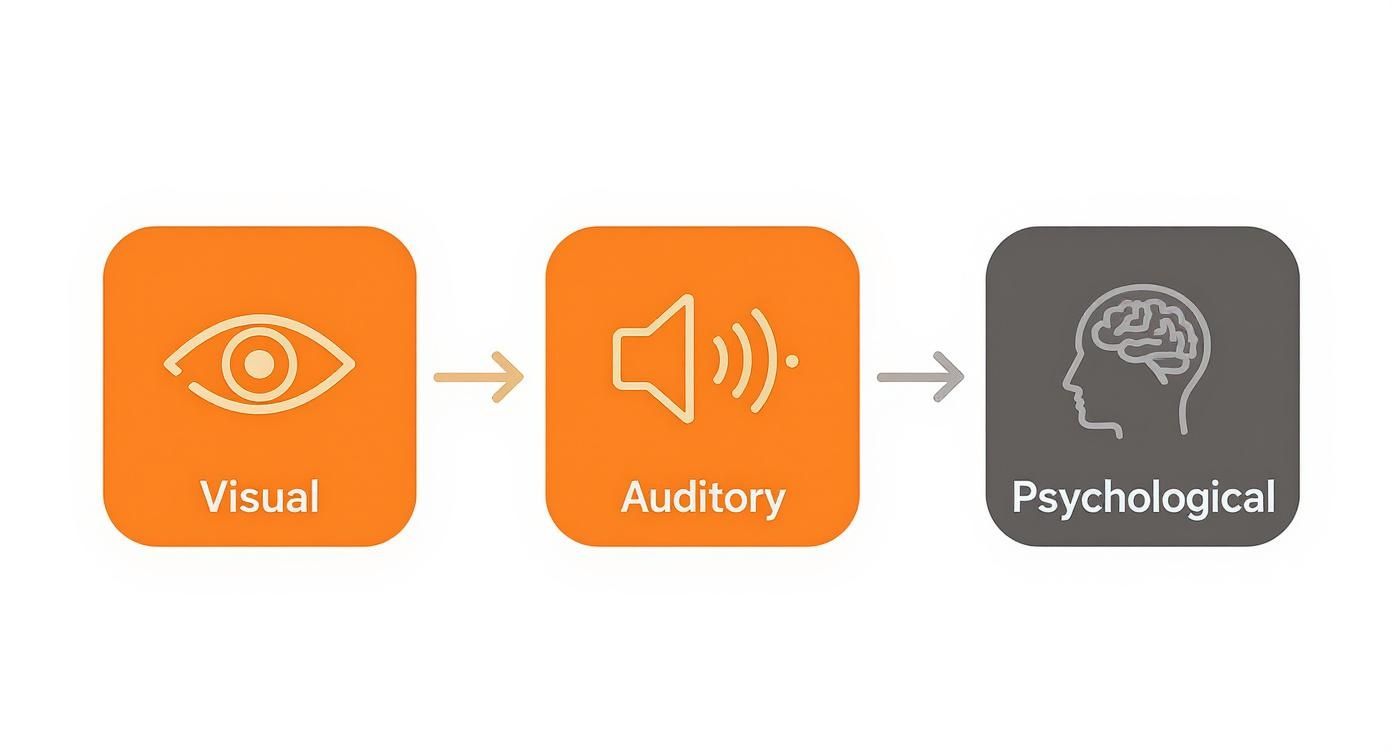
When you hit all three of these notes, you create something that doesn't just get watched—it gets remembered.
Scripting for Engagement, Not Just Information
The middle of your video is where the magic happens. Whether you're telling a story, teaching a new skill, or just sharing your two cents, the script needs a backbone to keep people from swiping away. One of the most effective structures I've seen is the Problem-Agitate-Solve (PAS) framework. It’s simple, but it works.
- Problem: Call out the specific pain point your audience deals with. (e.g., "You spend hours just trying to edit one 30-second video.")
- Agitate: Pour a little salt on the wound. Really dig into the frustration. (e.g., "It's tedious, it kills your creative vibe, and you're still not even happy with how it turns out.")
- Solve: Present your solution as the way out. (e.g., "But what if you could knock out five polished videos in the time it usually takes to make one?")
This approach creates a mini-narrative that keeps people hooked. They see their own struggles, feel the tension build, and they’ll stick around to see how it all gets resolved.
Mastering Production Basics Without Fancy Gear
Seriously, you don't need a professional studio. Your smartphone is a powerhouse, as long as you nail two key things: lighting and audio.
Lighting: Natural light is your best friend and it's free. Just film facing a window to get that soft, even light on your face. If you're shooting after dark, a basic ring light is a game-changer. It gets rid of those harsh shadows and gives your video a crisp, clean look.
Audio: People will forgive so-so video quality, but bad audio is a dealbreaker. If they can't hear you, they're gone. An external microphone—even a cheap lavalier mic that clips onto your shirt—is one of the best investments you can make. It instantly makes your content feel more professional.
Viewers are surprisingly forgiving of visual imperfections, but poor audio is an instant scroll-trigger. If they can't hear you clearly, they won't stick around to understand your message.
Dynamic Editing and Visual Style
Editing is where you inject the energy. To keep a thumb from swiping, your visuals need to change every 2-4 seconds. This sounds intense, but it's easier than you think. For a deeper dive, check out these essential video editing tips for beginners.
Here are a few simple tricks to keep things moving:
- Jump Cuts: Quick cuts between takes that give your video a fast, high-energy feel.
- Zoom Effects: Subtle zooms to emphasize key points and add a bit of visual flair.
- B-Roll: Overlay footage that shows what you're talking about. Discussing coffee? Show a clip of it being poured. Simple.
- Text and Captions: Animated captions are non-negotiable. So many people watch with the sound off, and good captions make your content accessible while also boosting watch time.
Over time, developing a consistent visual style—using the same fonts, brand colors, and editing rhythm—will make your content instantly recognizable in a sea of sameness.
Choosing the Right Video Length
While platforms like TikTok were built on hyper-short clips, we're seeing a shift. People are craving more substance, and the data backs it up. The ideal length isn't always "shorter is better." You need to match the video's length to the platform's culture and what your audience expects there.
Here's a quick look at how video length plays out across different platforms.
Video Length and Platform Engagement
| Platform | Optimal Video Length | Content Focus |
|---|---|---|
| TikTok | 21-34 seconds | Quick trends, entertainment, hooks |
| Instagram Reels | Under 90 seconds | Aesthetically pleasing, educational, inspiring |
| YouTube Shorts | 50-60 seconds | Value-driven, educational, storytelling |
Finding the sweet spot for your content often requires a bit of testing. Longer videos between 90 and 120 seconds can actually perform incredibly well if the value is there, sometimes hitting an average engagement rate of 7.2%.
If you're already creating longer videos for platforms like YouTube, don't let that effort go to waste. You can easily and efficiently create YouTube Shorts from existing video, which is a fantastic way to maximize your reach with minimal extra work.
Finally, every single video needs to end with a clear Call-to-Action (CTA). Don't leave your viewers hanging. Tell them exactly what to do next: "Follow for more tips," "Drop your thoughts in the comments," or "Hit the link in my bio." A strong CTA is what turns passive viewers into an active, engaged community.
Getting Your Content the Reach It Deserves
Making a video that stops someone mid-scroll is a huge win. But honestly, that’s only half the battle. If nobody sees your masterpiece, it’s just a missed opportunity. This is where a sharp strategy comes into play, making sure all your hard work gets in front of the right eyeballs at the right time.
Success on social media means you have to understand what the algorithms actually want. They aren't some mysterious black box; they’re designed to do one thing: keep people on the platform. To do that, they amplify content that signals value—things like watch time, shares, saves, and especially a flurry of early comments. Your job is to give them exactly those signals.
Cracking the Code on Smart Distribution
Think of the first hour after you post as your video's big audition. The platform pushes it out to a small test audience. If that group eats it up, the algorithm widens the circle. This happens over and over, and it's how content goes viral. Your entire goal is to nail that initial push.
This is way more than just hitting "publish" and crossing your fingers. It’s about a deliberate approach to every single element around your video, from the caption and hashtags right down to the exact minute you post. These are the details that separate a video that fizzles out from one that blows up.
A big piece of the puzzle is knowing where to focus your energy. Looking at recent data, you can see how different platforms reward content. LinkedIn, with its professional audience, actually leads the pack with a 6.50% median engagement rate. But right behind it is TikTok, where the short-form video format drives a powerful 4.86% engagement. Knowing this helps you decide where your time is best spent.
The Art of Hashtags and Timing
Hashtags aren't just a finishing touch; they're one of the most powerful discovery tools you have. The trick is to use a tiered strategy that mixes broad, niche, and community-specific tags for the best results.
- Broad Hashtags (1-2): Think high-volume tags like
#socialmediamarketingor#contentcreator. They have massive reach but also a ton of competition. - Niche Hashtags (3-5): Now you're getting specific with tags like
#shortformvideoor#videomarketingtips. You'll connect with a much more targeted, interested audience. - Community Hashtags (2-3): These are hyper-focused on your ideal viewer. Something like
#smallbusinessownersofigor#tiktokforrealtorshelps build a loyal, relevant following.
Just as crucial is when you post. Please, don't follow generic advice like "post at 9 AM on Tuesdays." That's a shot in the dark. Dive straight into your platform's analytics. Most of them will show you the exact days and hours your specific followers are most active. Posting in those peak windows gives your video the best possible chance to catch that critical early wave of engagement.
Don't just post when it's convenient for you. Post when your audience is listening. Analyzing your follower activity is one of the simplest yet most effective ways to boost your content's initial velocity.
A Simple Framework for Testing and Improving
You'll never truly know what connects with your audience until you start testing. Instead of guessing, you can use A/B testing (or split testing) to let the data guide your decisions. It’s a systematic way to figure out what actually works.
Here’s a simple testing plan to get you started:
- Isolate One Variable: For one week, change only one thing at a time. For instance, test two different hook styles while keeping everything else (caption, visuals, audio) exactly the same.
- Test Different Captions: The next week, stick with your winning hook style but try a short, punchy caption against a longer, more story-driven one.
- Experiment with CTAs: Try ending your videos with different calls-to-action. Does "Comment your thoughts below" get more action than "Follow for more tips"?
- Track Key Metrics: Keep a close eye on watch time, shares, and comment volume for each test. After just a few experiments, you'll start to see clear patterns emerge.
And of course, making sure your video looks crisp and professional is non-negotiable. To get maximum visibility on a platform like Instagram, knowing the optimal Instagram post size for Reels, Stories, and posts is absolutely crucial.
This cycle of analyzing, learning, and tweaking is how you turn good content into great content. When you pair smart distribution with a commitment to data-driven improvement, you build a powerful engine for maximizing your reach and creating content that consistently hits the mark.
Scaling Your Content Creation Without Burning Out

We all know consistency is the secret sauce for social media growth. The algorithms love it, and your audience craves it. But let's be real—the daily grind of scripting, shooting, and editing high-quality short-form video is a recipe for creative burnout.
The pressure is immense. You're expected to be a non-stop idea machine. This is exactly where the smartest creators pivot from just working harder to working smarter. They don't try to reinvent the wheel every single day. Instead, they build a sustainable system that pumps out content without draining their sanity.
Embrace the Power of Repurposing
Your best ideas deserve more than just one shot. Repurposing isn't just a tactic; it's the single most effective strategy for staying consistent without losing your mind. The whole game is about taking one big, valuable piece of content and slicing it into dozens of smaller, platform-ready clips.
Just think about it: one 20-minute podcast, webinar, or YouTube deep-dive holds a goldmine of content. Every key insight, powerful story, or actionable tip is a potential standalone Reel or TikTok waiting to be unleashed.
This approach is a triple threat:
- It's a huge time-saver. You do the heavy lifting—the research, the scripting—just once. Then you get to cash in on that effort over and over.
- The quality is baked in. You’re pulling from your best, most valuable material, so you already know the core idea resonates.
- You expand your reach. It lets you meet different parts of your audience where they hang out, speaking their language on their favorite platform.
Stop thinking in terms of one-off posts. Start building a content ecosystem. That’s how you create a workflow that’s both efficient and genuinely effective.
Let AI Become Your Production Assistant
The biggest bottleneck in repurposing has always been the manual labor. Sifting through a long video to find the best moments, then tediously adding captions and reformatting for a vertical screen? It’s a total time-suck.
This is where AI tools have completely changed the game.
AI video editors like ClipShort can watch your long-form video, automatically pinpoint the most viral-worthy segments, and do the dirty work for you. In minutes, they can pull clips, add dynamic captions that pop, and reframe everything perfectly for a 9:16 screen. A task that once took hours is now done before your coffee gets cold.
This isn't about replacing your creativity; it's about amplifying it. The AI handles the grunt work, freeing you up to focus on the stuff that actually matters—strategy and new ideas.
By automating the most repetitive parts of video production, you unlock the mental bandwidth needed to test more ideas, analyze performance, and double down on what truly connects with your audience.
If you're serious about building an efficient content machine, exploring the best AI tools for content creators is a no-brainer. You just drop in your link, let the AI do its thing, and give the final clips a quick review.
Building a Scalable Content Engine
To truly scale without burning out, you need a repeatable system. When you combine smart repurposing with AI automation, you build a powerful engine that can fuel your social channels indefinitely.
Here’s what that looks like in the real world:
- Create One "Pillar" Piece Weekly. Go deep on one topic. This could be a YouTube video, a podcast interview, or a live stream. Your only job here is to deliver massive value.
- Feed it to Your AI Assistant. Take that pillar content and upload it to a tool like ClipShort. Let the software work its magic and generate 10-15 short-form clips from the best moments.
- Quick Review and Polish. Spend a few minutes making small tweaks. Maybe you punch up a caption, change a background, or trim a second off the start to make the hook hit harder.
- Schedule Everything. Now you have a batch of ready-to-go clips. Schedule them out for the entire week across TikTok, Reels, and Shorts.
This simple workflow transforms content creation from a frantic daily scramble into a calm, focused weekly task. You'll always have a pipeline of great content ready to go, giving you the space to actually engage with your community and plan your next big move.
Your Top Content Creation Questions, Answered
Even with a killer strategy, the day-to-day of creating content can throw some curveballs. Questions pop up all the time about platform quirks, weird trends, and what your audience really wants to see. It can get confusing fast.
Let's cut through the noise. Think of this as your go-to guide for those "am I doing this right?" moments. We're tackling the most common questions creators have, from dealing with haters to figuring out just how often you need to be posting.
How Often Should I Actually Post on Social Media?
This is probably the single most debated question in the social media game. The real answer? It's all about the platform you're on and what your audience can handle. Chasing volume over value is a surefire way to burn out.
Forget the gurus who say you have to post five times a day. Your goal is a sustainable schedule that you can actually stick to. Consistency is king.
- TikTok: The algorithm here loves fresh content. Aiming for 3-5 times per week is a great pace to stay relevant and grow without your quality taking a nosedive.
- Instagram Reels: Try to post 3-4 times per week. The vibe on Reels is often a bit more polished and aesthetic, so that extra production time is expected.
- YouTube Shorts: A rhythm of 2-3 times per week works really well. Since Shorts are often the appetizers to your main-course long-form videos, this keeps your channel buzzing between bigger uploads.
The best posting schedule is the one you can maintain week in, week out. It’s far better to drop three amazing videos every single week than to spam ten mediocre ones and then vanish for a month.
What's the Best Way to Find Trending Audio?
Jumping on a trending sound is one of the easiest ways to get your content in front of new eyeballs. The algorithm is already pushing it, so you're just hitching a ride. But don't just grab whatever's at the top of the charts. You need to find sounds that genuinely fit your niche.
Make a habit of spending 10-15 minutes every morning just scrolling your "For You" page or Reels feed. Don't just watch—listen. When you hear the same sound popping up again and again, especially from other creators in your space, you've found gold.
The platforms themselves also have great built-in discovery tools. On TikTok, just tap the "Add sound" button to see what's hot. Instagram has a similar feature. Get into the habit of saving sounds you like to a dedicated folder. That way, when inspiration strikes, you've got a whole library of audio ready to go.
How Should I Handle Negative Comments or Trolls?
Look, if you're putting content out there, negative comments are going to happen. It's just part of the deal. How you respond, though, tells your entire audience what you're all about. Deleting everything might be tempting, but a smart approach can actually work in your favor.
First, take a breath and figure out what you're dealing with. Is this actual criticism or just someone trying to get a rise out of you?
- Legitimate Criticism: Don't hide from it. Reply publicly and politely. Thank them for the feedback, address the point, and move on. It shows everyone else that you're mature, you listen, and you're not afraid of a real conversation.
- Trolls & Haters: Do not feed the trolls. Seriously. They're not there to debate; they're there for a reaction. Don't give them one. Just delete the comment, block the user, and get on with your day.
Your comment section is your space. You get to decide the vibe. By engaging with real feedback and shutting down the hate, you build a stronger, more positive community around your brand.
Ready to stop guessing and start creating? ClipShort is an AI-powered video generator that turns your ideas into polished, scroll-stopping videos in minutes. It handles everything from the script to the final edit, so you can build a content engine that actually works. Try ClipShort for free and see just how easy it is to scale your video production.