
how do i make a video go viral: 7 proven steps for massive views
Making a video go viral isn't just about luck; it's a mix of great content and knowing how the algorithms work. The real secret is creating something that grabs attention in the first three seconds, tells a compelling story, and practically begs viewers to hit that share button. Forget about total views for a second and focus on view velocity and share rate—those are the metrics that truly matter.
Understanding What Makes a Video Go Viral Today

Before you even think about creating your next video, you have to get past the outdated idea that virality is just about racking up millions of views. Today, it’s far less about random chance and much more about understanding what the social media algorithms are built to reward. They’re hunting for very specific signals that tell them your video is worth showing to more people, and this all happens in the blink of an eye.
Think of the algorithm as a bouncer at the hottest club in town. Your video is waiting in line, and that bouncer is watching how the crowd reacts. If people immediately stop scrolling, watch the whole thing, and tell their friends about it (share), you're getting waved right through the velvet rope. If they just glance and keep walking, your video is stuck outside.
Key Metrics That Define Virality
Let's cut through the noise and ditch the vanity metrics for a moment. If you genuinely want to know how to make a video go viral, you need to obsess over the data that platforms actually care about. These are the real indicators of a video's potential for explosive growth.
- View Velocity: This is all about speed. How quickly are views piling up right after you post? A video that hits 10,000 views in the first hour has a much better shot at going viral than one that takes a full week to get there. High velocity tells the algorithm your content is hot right now.
- Share Rate: This might be the single most powerful metric of them all. When someone shares your video, they're putting their own social reputation on the line to vouch for it. A high share rate (shares divided by views) is a massive green light for the algorithm, signaling that your content is exceptional.
- Watch Time & Completion Rate: It's simple: how long are people actually watching? A high average watch time and a solid completion rate prove your content holds attention, which is the ultimate goal of any platform.
A common mistake is thinking virality is just a numbers game. It's not. It’s a speed and engagement game. I’ve seen countless times how a video’s performance in the first 60 minutes basically decides its fate.
The Modern Definition of a Viral Video
"Viral" means something different depending on where you are. On TikTok, for instance, a video often needs to smash 1 million views in 72 hours to earn the "viral" label, with the real blockbusters hitting 3 to 5 million in a week. Over on Instagram, a Reel could be considered viral with "only" 500,000 views if it also pulled in a staggering 50,000 shares, proving just how critical shareability is.
The data is clear: virality is all about rapid, intense engagement. It confirms that 80% of a video's potential is determined almost instantly after you hit "post." For a deeper dive, you can explore more about what makes a video go viral and see how these benchmarks vary.
At the end of the day, virality isn't a fluke; it's a measurable result. It happens when you create content that connects with people so deeply and so quickly that they feel an almost primal urge to watch, engage, and share. Nailing this foundation is everything as we move into the actual strategies for crafting your next hit.
Crafting a Hook That Stops the Scroll

In the brutal arena of short-form video, you don’t get a second shot at a first impression. Your video's entire fate—whether it’s a viral hit or another ghost in the feed—is sealed in the first one to three seconds. That’s not an exaggeration. It’s the simple reality when the next video is just a thumb-flick away.
Think of your hook as a promise you make to the viewer. It’s a silent pact that screams, "Hold on, what you're about to see is worth your time." If that promise isn't immediate and undeniable, you've already lost. The algorithm sees that quick scroll-away and instantly demotes your content.
Proven Formulas for Irresistible Hooks
You don't need to reinvent the wheel to create a killer hook. It's all about tapping into basic human psychology: curiosity, shock, and the ever-present fear of missing out. A few tried-and-true formulas work wonders at stopping the scroll dead in its tracks.
Here are a few hook types you can start using today:
- The Shocking Result: Kick things off by showing the incredible final outcome. A faceless creator building a miniature model could start with a shot of the finished, impossibly detailed piece before revealing how it was made. This immediately answers the viewer's silent question: "Why should I care?"
- The Controversial Statement: Open with a bold, maybe even unpopular, opinion that rattles your niche. A productivity video could begin with, "The 5 AM club is the worst advice I've ever heard." It creates instant tension and makes people stick around to hear your justification.
- The Intense Curiosity Gap: Pose a question or make a statement that leaves the viewer desperate for the answer. Text on the screen saying, "This one mistake is costing you 90% of your views" creates an open loop they'll feel an urgent need to close.
Your hook needs to be more than just interesting—it needs to be violent in its ability to command attention. It has to jolt someone out of their passive scrolling trance and force them to engage.
Structuring Your Video to Maintain Momentum
A great hook gets them through the door, but it's a solid structure that keeps them from leaving. So many creators blow all their best stuff in the first few seconds and then let the energy completely die out. To go viral, you have to maintain that initial momentum from start to finish.
This is where storytelling frameworks and pattern interrupts become your secret weapons. These aren't just for Hollywood screenwriters; they're vital for keeping eyes glued to a 30-second clip.
The Problem-Agitation-Solution Framework
One of the most powerful structures is the classic Problem-Agitation-Solution (PAS) framework. It’s a simple, three-act play that just works.
- Problem: State a pain point your audience knows all too well. (e.g., "Your videos are stuck at 200 views.")
- Agitation: Twist the knife. Remind them just how frustrating that problem is. (e.g., "You spend hours editing, and the algorithm just ignores you.")
- Solution: Present your tip as the ultimate answer to their prayers. (e.g., "But what if I told you this one caption trick could change all that?")
This framework masterfully builds and releases tension, which makes for an incredibly satisfying watch and skyrockets your completion rates.
Another critical technique is the pattern interrupt. These are tiny, unexpected changes you sprinkle throughout your video to reset a viewer's wandering attention. Think of a sudden zoom, a quirky sound effect, a quick B-roll cut, or a new text animation flying onto the screen. These little jolts prevent the viewing experience from becoming predictable. For a more technical breakdown, our guide on YouTube Shorts editing dives deep into using cuts and effects to keep viewers locked in.
When you combine a powerful hook with a deliberate structure, you’re not just making a clip anymore. You’re crafting a micro-story that people will not only finish but will feel compelled to share.
Jumping on Trends Without Selling Out
Riding a trend is like catching a massive wave—it's one of the fastest ways to get your video in front of a huge audience. The algorithm already loves this stuff, so you're not starting from scratch. It knows there's a hungry audience waiting for that sound or format, which gives you a massive leg up.
But here's where most people get it wrong. They just copy what's popular. The real skill is in adapting it. Forcing a trend onto your content when it doesn't fit feels clumsy and inauthentic, and your audience will see right through it. The goal is to find that sweet spot where a popular trend overlaps with your brand's unique voice. That's the secret to going viral without losing your soul.
How to Spot and Pounce on Trends Early
If you want to catch a trend before everyone else does, you need to become a student of the platform. I don't mean mindless doom-scrolling. I mean scrolling with purpose—looking for patterns and using the platform's own tools to your advantage.
Here are a few ways I stay ahead of the curve:
- Dive into the TikTok Creative Center: This place is an absolute goldmine. It literally shows you the top-trending hashtags, songs, and videos in your region. You can even filter by industry to see what's gaining steam right now, not what was hot last week.
- Look for Repetition: As you're flicking through your "For You" page, keep your eyes peeled. The moment you see the same sound or video format pop up three or four times from completely different creators, you've probably just spotted the next big thing.
- Follow the Trend Spotters: Some creators have built their entire platform around identifying and breaking down new trends. Follow a few of them. It's like having an early warning system for what’s about to blow up.
The best trends aren't rigid rules; they're flexible frameworks. They give you a popular sound or a familiar setup but leave you plenty of room to inject your own personality and expertise. That’s where the magic happens.
Once you’ve found a trend with potential, don’t just copy it. Ask yourself, "How can I put my own spin on this?" If you run a faceless history channel, maybe you use a trending meme sound to explain a bizarre historical fact. It's that unexpected contrast—the modern, viral audio paired with a niche topic—that gets people to stop, watch, and share.
The Psychology Behind Viral Audio and Edits
Ever wonder why a specific 15-second sound clip suddenly takes over the internet? It’s almost never random. Trending audio usually taps into a shared emotion, a bit of nostalgia, or a universally relatable moment. A high-energy track can make a simple tutorial feel exciting, while a dramatic sound can turn a boring clip into something epic. The right audio does the heavy emotional lifting for you.
So when you're picking a sound, don't just grab whatever's at the top of the trending list. Listen to it. How does it make you feel? Does that feeling match your video's message? A funny sound on a serious topic can be jarring, but using that same sound to poke fun at a common frustration in your niche? That creates an instant connection.
The data backs this up, too. A whopping 47% of marketers say short-form is the most viral medium out there, generating 2.5 times more engagement than longer videos. And with ad spending projected to hit nearly $146 billion by 2028, it's clear where the money and attention are going. To learn more, you can explore the short-form video statistics and see just how powerful this format has become.
Beyond the audio, the editing style itself has become a language. Viral videos today often share a few key traits:
- Fast Cuts: Quick, snappy cuts every 1-2 seconds keep the viewer's brain hooked. This is non-negotiable for faceless content where you rely on visuals to drive the pace.
- Dynamic Captions: Animated, eye-catching captions are no longer a "nice-to-have." They make your content accessible for sound-off viewers and add another layer of visual energy that holds attention.
- The "One-Word" Hook: Watch closely—many viral videos kick off with a single, bold word flashing on screen. It’s a dead-simple trick, but it’s incredibly effective at creating an instant curiosity gap that stops the scroll.
Building a Smart Distribution and Engagement Strategy
Making a video with viral potential is really only half the job. Even the most amazing piece of content can just fizzle out without a smart launch plan. Your distribution and engagement strategy is what gives your video that first push it needs to get noticed by the algorithm and begin its journey to huge viewership.
This is about more than just hitting "post." You need to know when your audience is scrolling, how to write captions that make people want to comment, and how to use hashtags as discovery tools, not just labels. This is how you engineer a viral hit instead of just hoping for one.
Timing, Captions, and Hashtags
The first hour after you post is make-or-break for your video. A burst of early engagement tells the algorithm that people are loving your content, which makes it push your video out to a much wider audience. This makes your posting schedule a massive piece of the puzzle.
Your platform's analytics are your best friend here. Seriously, dig into your audience insights to pinpoint the exact days and hours your followers are most active. If you post just before that peak time, you give your video the best possible shot at catching that initial wave.
Once your timing is sorted, turn your attention to the caption. A great caption does two things: it adds context and it starts a conversation. Don't just explain what's happening in the video. Ask a question, drop a controversial opinion, or throw in a clear call-to-action like "Tag someone who does this." This is a direct invitation for the kind of engagement algorithms are built to find.
When it comes to hashtags, think in layers:
- Broad: Use 1-2 high-volume, general hashtags for your topic (like #LifeHacks).
- Niche: Add 2-3 hashtags that are specific to your community (think #FacelessCreatorTips).
- Video-Specific: Toss in 1-2 unique hashtags that describe exactly what's in the video (e.g., #ViralHookFormula).
This layered approach helps your video get found by huge, general audiences and smaller, more passionate communities at the same time.
A common mistake is thinking of distribution as a passive step. It's not. You aren't just putting content out there; you're strategically placing it in front of the right eyeballs at the exact moment they're most likely to interact.
Igniting the Initial Engagement Spark
The algorithm is watching. It pays close attention to how people react in the first few minutes after you post. A sudden flood of likes, comments, and shares is a massive green light. The good news is, you can create this initial spark yourself by getting your existing community involved.
Before you post, tease the video on your other platforms or in a previous post. Let your most loyal fans know when it’s dropping so they can be ready to jump on it. If you have an email list or a private community, share the link there the second it goes live.
This flow chart breaks down the viral video process, leading right up to this crucial distribution phase.
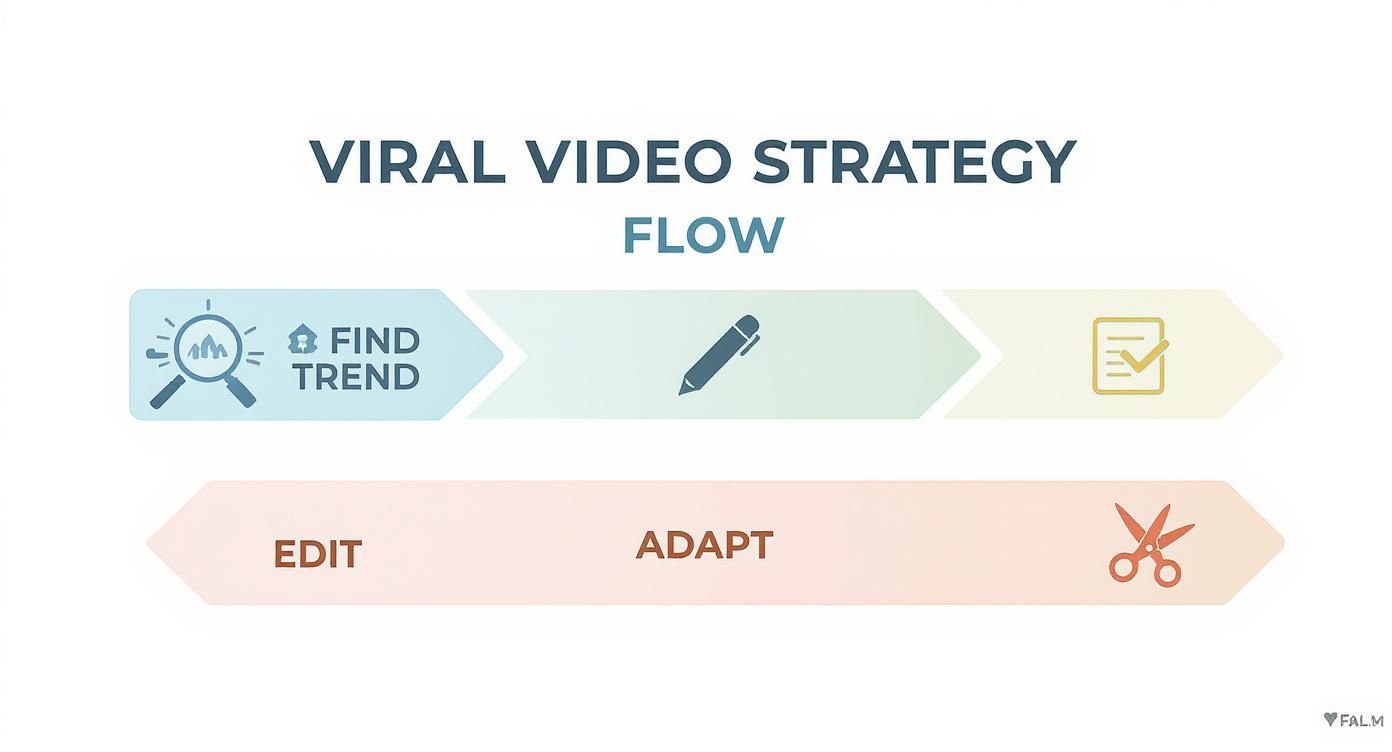
The biggest takeaway here is that finding a trend and making it your own is just the start. The final edit and the strategic release are what turn that potential into actual performance. To take your distribution game even further, think about using some of the top AI marketing software to help you optimize your campaigns and maximize your reach.
This next part is critical: you absolutely must be active in the comments for at least the first hour after posting. When those first comments roll in, reply to them instantly. This one simple action accomplishes several things:
- It immediately doubles your comment count.
- It signals to the algorithm that your post is a hub for conversation.
- It makes your early viewers feel seen and appreciated, which keeps them coming back.
Think of it like you're hosting a party. You wouldn't invite a bunch of people over and then lock yourself in a room. By engaging with every single early comment, you're telling both your audience and the algorithm that this is an event worth paying attention to.
Using AI Tools to Accelerate Video Creation

When you're chasing a viral hit, speed and volume are everything. The more high-quality videos you can put out and test, the faster you’ll figure out what actually connects with your audience. This is where AI stops being some sci-fi concept and becomes a real, practical tool for creators aiming to blow up.
AI isn't here to replace your creative spark; it’s here to amplify it. Think of it as an assistant that handles all the tedious, repetitive tasks that cause burnout. This frees you up to focus on big-picture strategy and the unique human touch that makes your content yours. For faceless creators, AI is an absolute game-changer.
Generating Endless Viral Video Ideas
We've all been there: staring at a blank screen, wondering, "What should I even post today?" That creative block can kill your momentum before you even start. Instead of struggling, you can use AI as a brainstorming partner to spitball dozens of ideas perfectly suited for your niche.
The secret is in the instructions you give it. A specific, well-crafted prompt can unlock a wave of great ideas.
Try something like this:
"Act as a viral video strategist for a faceless TikTok account about ancient history. Generate 10 video ideas based on the 'shocking result' hook formula. Each idea should present a little-known historical fact in a surprising way. Format as a list."
This prompt gives the AI a clear role, a specific audience, a content framework, and a desired output. What you get back is a list of ready-to-go concepts, saving you hours of painful brainstorming.
Crafting Scripts with Powerful Hooks
Got an idea? Great. Now you need a script that grabs people in the first second and doesn't let go. An AI scriptwriter can help you build your story for maximum impact, making sure you have a scroll-stopping hook, a valuable middle, and a strong call to action that gets people to share.
For instance, you could ask your AI tool to write a script following the classic Problem-Agitation-Solution framework. It’s an incredibly reliable structure for creating relatable content that people find genuinely useful.
The video world is moving fast. 75% of video marketers are already using AI tools in their creation process, and that number is only going up. With video expected to make up 82% of all internet traffic by 2025, using AI isn't just a clever shortcut—it's essential for keeping pace.
Automating Production for Faceless Creators
This is where AI really shines, especially if you don't want to be on camera. Tools like ClipShort can take your script and turn it into a slick, professional-looking video in just a few minutes. You pick a realistic AI voiceover, choose a visual style, and the platform automatically pulls in relevant stock footage and adds animated captions.
The workflow is unbelievably simple:
- Drop in your script or generate one right inside the tool.
- Pick a voice that fits your brand’s personality.
- Choose a visual theme, whether you want cinematic, anime, or realistic.
- Layer in trending audio and customize the captions.
This process completely removes the biggest hurdles: filming, recording audio, and wrestling with complicated editing software. For anyone wondering how to make a video go viral, this kind of rapid production lets you test ideas at a scale that was previously impossible.
You can check out our guide on the best AI video generators to see how different tools stack up. And to give your video that extra push, a good TikTok Caption Generator can help you write text that boosts engagement even further.
To make this even more practical, here are some copy-and-paste prompts you can use to generate the core elements of your next video.
AI Prompt Templates for Viral Video Elements
| Video Element | Example AI Prompt | Expected Output |
|---|---|---|
| Scroll-Stopping Hook | "Generate 5 hooks for a video about a productivity hack. Use the 'You're doing it wrong' angle to create curiosity and urgency." | A list of hooks like: "Stop organizing your to-do list like this, it's killing your focus. Here's a better way." |
| Engaging Storytelling | "Write a 60-second video script about the 'imposter syndrome' felt by new entrepreneurs. Follow a relatable story arc: struggle, discovery, resolution." | A short, compelling narrative script that connects with the target audience on an emotional level. |
| Click-Worthy Title | "Create 10 click-worthy titles for a YouTube Short about a surprising historical fact. The titles should be under 70 characters and create intrigue." | A list of short, punchy titles optimized for clicks, such as: "This Famous Quote is a Lie" or "History's Biggest Secret." |
| Call to Action (CTA) | "Write 3 different CTAs for a video teaching a new skill. One should encourage follows, one should ask a question, and one should direct to a link in bio." | Varied CTAs like: "If you found this useful, follow for more tips!" or "What's the #1 skill you want to learn next? Let me know below." |
Using prompts like these gives you a massive head start, letting you focus less on the grunt work and more on creating content that truly connects.
Common Questions About Going Viral
Even with a solid strategy, the path to a viral video is full of questions. Creators get the big picture—hooks, trends, distribution—but often get tripped up on the smaller details. Let's clear up some of the most common questions and bust a few myths.
Is There a Perfect Time to Post?
This is probably the biggest one. The short answer is yes, but it's not a universal secret. The perfect time to post is whenever your audience is most active, and the only place to find that information is in your analytics.
Forget the generic advice you see everywhere. Dig into your own platform data on TikTok, Instagram, or YouTube. Find the specific hours where your followers are scrolling. Posting just before that peak time gives your video the best shot at catching that critical first wave of engagement, which signals to the algorithm that you've got something good.
Finding the Ideal Video Length
Another constant debate is over video length. Everyone knows shorter is usually better for grabbing attention, but how short is too short?
For platforms like TikTok and Instagram Reels, the sweet spot tends to be between 15 and 30 seconds. This is usually long enough to tell a quick, compelling story but short enough to keep completion rates high—a metric the algorithm absolutely loves.
But don't get obsessed with the number. The real rule is simple: make your video as long as it needs to be, but not one second longer. If you can deliver your point with impact in 12 seconds, do it. Stretching it to 25 with filler just to hit a certain length will kill your watch time and sink your video.
So many creators get caught up in formulas and checklists, but virality is really about human connection. The videos that explode are the ones that feel genuine and relatable, even when they’re strategically planned. Authenticity isn't just a buzzword; it’s a core ingredient.
Does Production Quality Really Matter?
This leads right into the next big question. Do you need a fancy camera and a professional studio to go viral? Absolutely not. In fact, raw authenticity often crushes polished production value. Viewers connect with content that feels real, not like a slick TV commercial.
Your smartphone is more than enough. Instead of worrying about expensive gear, focus your energy on these three things:
- Clear Audio: Muffled, hard-to-hear audio is an instant deal-breaker. People will scroll away immediately. A cheap external mic or even the one on your headphones can make your voice sound crisp and clear.
- Good Lighting: You don't need a pro setup. Just film near a window. Natural light is your best friend and will make your video look bright and professional enough.
- Stable Footage: Nobody wants to watch shaky, jarring video. A basic tripod is a great investment, but even propping your phone against a stack of books works wonders.
How Often Should I Post to Go Viral?
Creators often burn themselves out trying to post multiple times a day, thinking more is always better. It isn't. Quality will always beat quantity. One thoughtful, well-edited video will do more for you than three rushed, low-effort clips ever will.
The algorithm rewards consistency, not just raw frequency. Find a posting schedule you can actually stick to, whether that's three times a week or once a day. This builds momentum, lets your audience know when to expect new content, and trains the algorithm to keep an eye on your account.
What if My Video Doesn't Go Viral?
First, don't delete it! This is a classic mistake. A video can have a "slow burn," getting picked up by the algorithm days or even weeks after you post it. Deleting it guarantees it gets zero views.
Instead of deleting, analyze.
Dive into the analytics for that specific video. Pinpoint the exact second where viewers dropped off. Did the hook not land? Was the middle boring? Every video, whether it gets 100 views or 1 million, is a data point. Use it to learn what works and what doesn't. This cycle of creating, analyzing, and refining is the real secret to cracking the viral code.
Ready to create scroll-stopping videos without the hassle? ClipShort uses AI to turn your ideas into polished, viral-ready Shorts, Reels, and TikToks in minutes. Generate scripts, add lifelike voiceovers, and get perfectly timed animated captions automatically. Start creating for free at ClipShort.