
A Practical Guide on How to Make Your TikToks Go Viral
If you want your TikToks to go viral, you need to master one thing above all else: winning the first three seconds. That’s it. A powerful, scroll-stopping hook is the single biggest factor that separates a video that flies from one that flops.
Winning the First 3 Seconds on TikTok
You have a tiny, almost impossibly small window to grab someone's attention before they swipe away. The fate of your video—viral hit or forgotten dud—is often decided before the four-second mark even hits.
Forget about complex algorithms for a minute and focus on this one truth: your opening line is everything. It's the gatekeeper to the rest of your content.
This is where the "hook" becomes your most valuable weapon. A good hook isn't just a catchy phrase; it's a psychological trigger. It's designed to make a viewer instantly invested by making a promise, sparking a question, or presenting a problem they suddenly need to see solved.
Crafting Unskippable Hooks
The best hooks tap into raw human emotions and curiosities. They don't just tell you what the video is about; they create an immediate need to know what happens next. This is where so many creators go wrong, starting with slow, boring intros or vague statements that don't land.
Try thinking about it in these powerful ways:
- The Problem-Solution Hook: Hit them with a pain point they know all too well. A finance creator could open with, "If your savings account is still at zero, you're making one of these three mistakes." It instantly qualifies the audience and promises a clear fix.
- The Bold Statement Hook: Say something controversial or surprising that forces people to react. A tech reviewer might say, "This isn't the best new phone of the year, and I'm about to show you why." People will stick around just to see if you can back it up.
- The Curiosity Gap Hook: This is probably the most powerful technique of them all. You give a piece of information but leave out a critical detail, making the viewer desperate for the reveal. For example: "There's a secret feature on your iPhone that Apple doesn't want you to know about."
It's not just a hunch, either. The data shows this stuff works. In fact, videos using strong curiosity hooks go viral 22% more often. That's a huge edge, proving that psychological triggers like mystery and promised value are exactly what the algorithm—and the viewers—want to see.
High-Impact Hook Formulas for Instant Engagement
To make this super practical, here’s a quick-reference table showing how you can adapt these powerful hook formulas for different niches. The core psychology is the same, but the execution is tailored to the audience's specific interests and problems.
| Hook Type | Psychological Trigger | Example Script (Tech Niche) | Example Script (E-commerce) |
|---|---|---|---|
| Problem-Solution | Relief & Aspiration | "Your laptop is slow for a reason, and the fix takes 30 seconds." | "Stop guessing your size. This is the only way to get the perfect fit online." |
| Bold Statement | Intrigue & Disruption | "AI won't take your job, but people using AI will. Here’s how to start." | "This viral product is a waste of money. Buy this cheaper alternative instead." |
| Curiosity Gap | Mystery & Exclusivity | "There’s a hidden setting that doubles your phone's battery life." | "I found a dupe for the $500 jacket that’s even better than the original." |
| "You" Statement | Personalization | "You're using ChatGPT all wrong if you're not using this prompt." | "You've been applying your skincare in the wrong order." |
These formulas are a fantastic starting point. Mix them, match them, and find what feels authentic to your brand.
The goal of a hook isn’t to summarize your video; it's to sell the next five seconds of your video. If you can keep doing that repeatedly, you'll hold their attention until the end.
This shift in mindset is everything. Every single word in your opening line has to fight for its place. When you focus on creating that immediate emotional or intellectual connection, you dramatically boost your chances of getting watched, shared, and pushed out to the For You Page.
If you really want to get this down to a science, you might be interested in our guide on how to create engaging social media content.
Finding and Adapting Trends for Your Niche
Jumping on a trend is one of the fastest ways to get your content in front of new audiences. But there's a huge difference between just participating and actually capitalizing on one. The secret isn't just to copy what's popular; it's to adapt it so perfectly to your niche that it feels both fresh and familiar to your ideal viewer.
Going viral means you need to get a feel for the platform's constantly shifting culture. You have to become a student of what’s working right now, and that research starts with your own For You Page (FYP). Start treating your FYP less like entertainment and more like your personal, algorithm-fed research tool.
Using Your FYP for Trend Spotting
Your FYP is an absolute goldmine. As you scroll, start looking for patterns. Are you seeing a bunch of videos using the same audio clip? Is a certain video format or storytelling style popping up over and over again?
Don't just watch passively. When you spot something with potential, ask yourself a few key questions:
- Is the sound new? Tap the audio and see how many videos have been made with it. If it’s under 10,000, you might be early enough to ride the wave as it builds.
- What's the format? Is it a "point of view" (POV) video? A "get ready with me"? A day-in-the-life? Pinpoint the exact structure.
- Why does it work? Is it making you laugh? Is it super relatable, shocking, or genuinely helpful? Deconstruct the core emotion or value the trend is delivering.
This kind of active analysis trains your brain to see trends not as random viral moments, but as repeatable formulas. For a more data-backed approach, check out TikTok’s own Creative Center. It’s a free tool that shows you the top-performing songs, hashtags, and videos, and you can often filter by industry. It’s like getting an official cheat sheet from TikTok itself.
Your goal isn't just to find what's popular, but to find what's popular and can be authentically filtered through your unique perspective or niche. Forced trends feel like a bad advertisement.
Adapting Trends to Feel Authentic
Once you've identified a promising trend, the real work begins. Blindly copying a dance or a joke rarely works if it has nothing to do with what you normally post. The magic happens when you connect the trend's format to your niche's core topics.
Let’s say you’re a personal finance creator and a trending sound features a dramatic reveal. You could adapt it by showing "The one money mistake that's keeping you broke is..." followed by the big reveal. A skincare influencer could use that same sound for "The one ingredient that cleared my acne..."
This framework makes the trend a vehicle for your expertise, not a distraction from it.
Building an Idea Bank for Original Content
Trends are fantastic for reach, but it’s your original, evergreen content that builds a loyal community. You should always have a bank of ideas ready to go that don't depend on what’s popular today. These ideas usually fall into a few timeless categories that consistently perform well.
Consider building your content around these powerful pillars:
- Personal Stories: Share a struggle, a win, or a lesson you learned. Authenticity and vulnerability are how you build deep connections with an audience.
- Helpful Tutorials: Teach your audience something valuable. This positions you as an expert and provides real utility, which encourages saves and shares.
- Behind-the-Scenes: People are naturally curious. Show them your process, your workspace, or how your product is made. It builds trust and makes your brand feel more human.
By blending timely trend adaptations with timeless original content, you create a powerful one-two punch. Trends bring in new eyeballs, and your core content is what convinces them to stick around. This is a fundamental step in learning how to make your TikToks go viral consistently, rather than just getting lucky once.
Editing Techniques That Maximize Watch Time
Once you’ve nailed your hook, the next battle is holding that attention. Great editing isn’t just about making your video look clean; it's a powerful tool for controlling the viewer's experience and maximizing your watch time. For faceless content, editing is the performance.
The modern viewer's attention span is incredibly short, so your editing has to be even faster. Every single second of your video needs to justify its existence with fresh visual information. This is where rapid pacing becomes non-negotiable for anyone trying to figure out how to make your TikToks go viral.
Embrace Rapid Pacing and Jump Cuts
A static shot is the enemy of retention. Our eyes are instinctively drawn to movement and change, which means your edit needs to provide a constant stream of visual stimulation. The golden rule? Give the viewer something new to look at every one to two seconds.
This doesn't mean your entire video needs to be pure chaos, but it absolutely must be dynamic. Here are a few ways to pull this off:
- Use frequent jump cuts: A jump cut is an abrupt transition that cuts out dead air and speeds up the pace. It makes your storytelling feel way more energetic and keeps things moving.
- Incorporate dynamic B-roll: Don't just talk over a single, boring clip. Layer in relevant B-roll footage that actually illustrates your points. If you’re talking about a new app, show screen recordings of it in action.
- Add subtle zooms: Even a slow, subtle zoom-in on a static image (often called a "Ken Burns effect") creates a sense of movement and holds attention far longer than a completely still frame.
The data backs this up. Videos that use jump cuts to break up longer sequences can see completion rates jump by 26%. The message is clear—speed and conciseness win.
Make Your Captions a Visual Guide
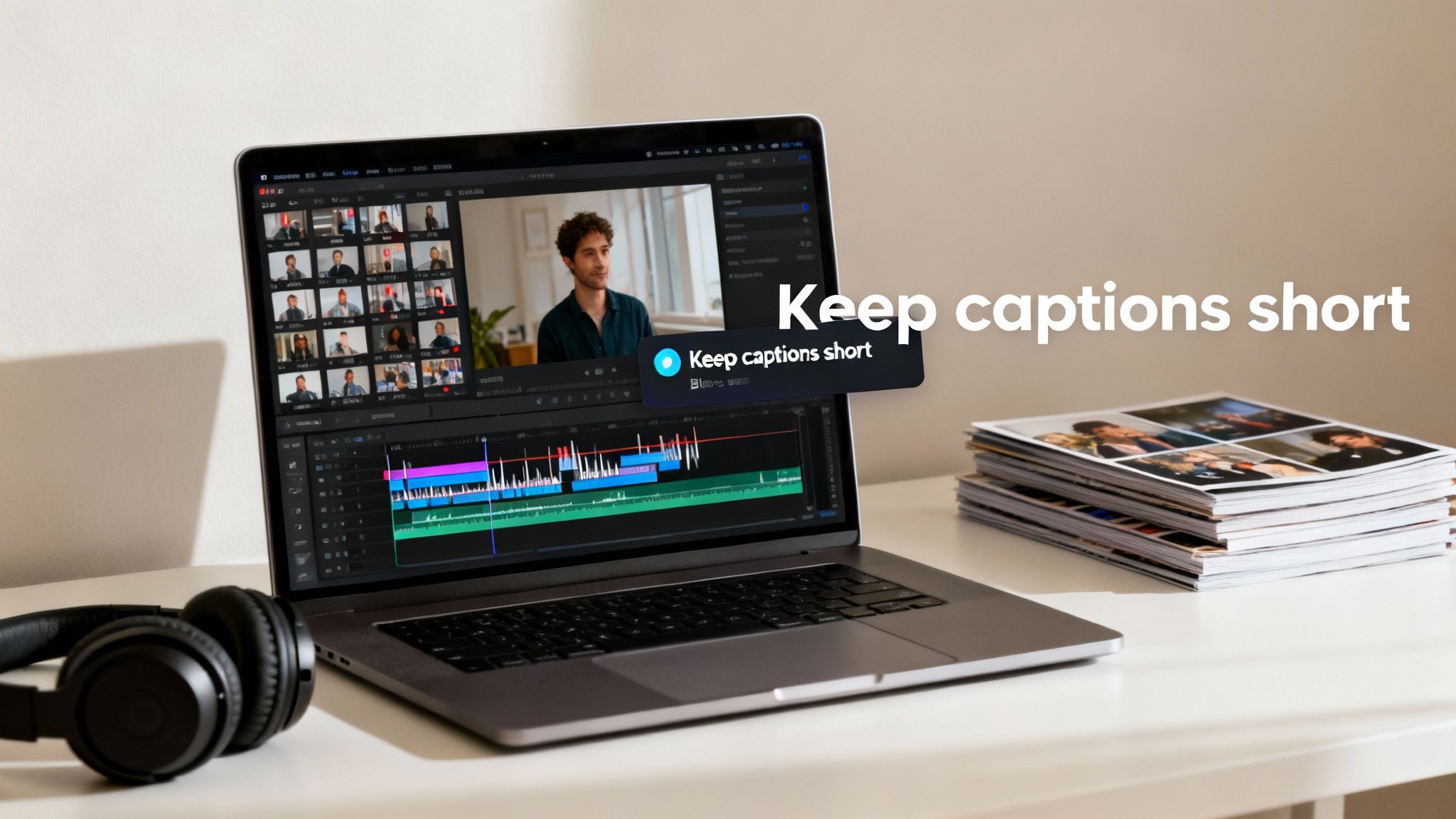
On-screen captions are no longer just an accessibility feature; they’re a core part of the viewing experience. Tons of people watch with the sound off, but even for those with audio on, animated text acts as a visual anchor that guides their focus through your video.
Your captions should do more than just transcribe your words. They should emphasize emotion, highlight key takeaways, and create a visual rhythm that keeps people engaged.
Think of your text as another layer of B-roll. Instead of just plopping static subtitles at the bottom, use captioning tools to bring them to life. Animate words to pop on screen as you say them, change the color to highlight a critical point, or toss in an emoji right after a punchline for extra impact.
Polishing Your Edit for Maximum Impact
Once your pacing and captions are dialed in, a few final touches can elevate your video from good to unforgettable. These small details signal high production value and make your content feel more professional and engaging.
Here are a few polishing techniques to add to your toolkit:
- Strategic Sound Design: Don't just rely on the trending audio. Add subtle sound effects like whooshes for transitions, a "ding" for a new idea, or keyboard typing sounds for tech-focused content. Sound design adds an immersive layer that most creators totally overlook.
- Concise On-Screen Text: Keep any text overlays short and punchy. You should aim for no more than 5-7 words on the screen at a time. This ensures your message is easily digestible before the next visual element appears.
- Use Color for Emotion: Subtitle color can subconsciously influence the viewer's mood. A sudden switch to red can signal urgency or a mistake, while green can emphasize a positive outcome or a correct answer.
Mastering these techniques is a huge step in learning how to make your TikToks go viral. They transform a simple recording into a compelling visual story that’s hard to look away from. For those just starting out, check out our guide on essential video editing tips for beginners for more foundational advice.
Optimizing Your Posts for the Algorithm
Making a killer video is really only half the job. If you want to know how to make your TikToks go viral, you need a smart publishing strategy that gives the algorithm exactly what it’s looking for.
This is where the details really matter. Things like your caption, hashtags, and even when you post can turn a good video into one that gets seen by millions.
Writing Captions That Spark Conversation
Your caption is some seriously valuable real estate. So many creators just treat it as an afterthought, maybe throwing in a quick description of the video. Don't do that. Instead, think of your caption as the start of a conversation. A great one doesn't just inform; it engages.
The whole point of your caption should be to get people to comment, share, and save your video. These are huge signals to the TikTok algorithm that people are loving your content, which makes it push it out to even more people.
You can do this by framing your captions to get a specific reaction. Try ending with a question that’s super easy to answer or asks for an opinion. For instance, instead of just saying "My new favorite coffee shop," you could write, "Is this the best coffee in the city or do you have a better spot? Let me know 👇".
Another killer move is to use a clear call-to-action (CTA). CTAs aren't just for selling stuff; they're for guiding what you want your viewers to do next.
- "Save this for your next trip!" is perfect for a travel video.
- "Share this with someone who needs to hear it" gets more shares on motivational content.
- "Comment your score at the end!" drives a ton of comments for a quiz-style video.
These small tweaks in how you write can completely change the viewing experience from passive to active, directly feeding the metrics the algorithm cares about most.
A caption should act as a conversation starter, not a conclusion. Your video gets their attention; your caption keeps it by inviting them to participate.
This approach makes sure your content does more than just get views—it builds a real community around your posts, and that’s a much stronger sign of quality.
Using a Tiered Hashtag Strategy
Hashtags are basically signposts for your video. They help the algorithm figure out what your content is about and who to show it to. A super common mistake is either using only massive hashtags like #fyp (where you'll get lost in the noise) or really obscure ones that nobody is searching for.
The secret is a balanced, tiered strategy. For the best possible reach, you’ll want to mix tags from three different categories.
- Broad Hashtags (1-2): These are the big ones related to your general topic, like
#booktok,#fitness, or#techtips. They get your video in front of a massive audience. - Niche Hashtags (2-3): These get more specific and target your ideal audience, like
#fantasybookrecs,#bodyweightworkout, or#iphonehacks. This is how you connect with a super-engaged community. - Trending Hashtags (1): If you're hopping on a relevant trend or using a popular sound, definitely include its hashtag. This can give your video a quick, timely boost right out of the gate.
This mix lets you compete for broad eyeballs while also locking in views from a niche audience that's much more likely to engage. Beyond just organic reach, learning how to optimize PPC campaigns on Amazon and TikTok can give you an even faster path to getting seen.
Finding Your Golden Posting Hours
On TikTok, consistency is everything. Posting regularly tells the algorithm that you're an active creator it can count on. But being consistent at the wrong time can kill your reach. You've got to find your "golden hours"—those specific times when your followers are scrolling the most.
Don't just follow generic advice you read somewhere. Your audience is unique. The only way to find your best posting times is to look at your own data.
Head over to your TikTok Analytics (you'll need a Pro or Business account) and click on the "Followers" tab. Scroll down to the "Follower activity" section, and you’ll see a chart showing the days and hours your audience was most active last week. See those peaks? Those are your golden hours.
For a deeper dive into planning your posts, our guide on how to schedule a TikTok post breaks down the whole process.
By pulling together compelling captions, a smart hashtag mix, and data-backed posting times, you’re giving your content the best possible chance to get picked up and pushed out by the algorithm.
Using Analytics to Fuel Your Viral Growth
Flying blind is a terrible content strategy. The creators you see going viral over and over aren't just lucky—they're treating their analytics like a treasure map, letting the data guide every single video they make.
TikTok Analytics can look like a wall of numbers at first, but you really only need to watch a few key metrics to get incredibly powerful feedback. These numbers tell the real story of what your audience actually enjoys, not just what you think they do. This is the big leap: moving past gut feelings and into data-driven decisions. It’s how you start going viral on purpose.
Unlocking the Story in Your Numbers
If you're chasing viral potential, two metrics matter more than anything else: Average Watch Time and Completion Rate.
These two numbers tell the algorithm one simple, crucial thing: people are sticking around to watch your stuff. A high completion rate, especially on a shorter video, is a massive green flag for the algorithm, telling it to push your content out to more and more people.
Average watch time is just as telling. It shows you exactly how long someone watches before they get bored and swipe away. If your video is 30 seconds long but your average watch time is just 5 seconds, you know you’re losing people right after the hook. But if that average watch time is 28 seconds? You’ve got a winner.
The real secret to viral growth isn’t a single hit video. It's the process of analyzing what worked, coming up with a theory about why it worked, and immediately applying that lesson to your next video.
This cycle—analyze, hypothesize, create, repeat—is how you build real, sustainable momentum. You start to see patterns emerge from the noise. Maybe every video where you used a question as a hook performed 20% better. Or maybe a specific trending sound consistently leads to more shares. These aren't just coincidences; they're clear signals telling you exactly what to do next.
Mastering the Audience Retention Graph
Honestly, the audience retention graph might be the most powerful tool you have inside TikTok Analytics. It’s a simple line graph showing the percentage of viewers still watching at any given second of your video. Think of it as a play-by-play of your video's strengths and weaknesses.
What you're looking for are the sharp dips. A big drop-off at the 4-second mark tells you the hook did its job, but the very next thing you said or showed didn't deliver on the promise. A slow, gradual decline? That suggests your overall pacing might be dragging. These dips are free, direct feedback on the exact moments you're losing your audience's attention.
By pinpointing these drop-off points, you can make hyper-specific adjustments. Was the on-screen text too wordy? Did a visual feel out of place? Was there a half-second of dead air? Nailing down these weak spots gives you a concrete checklist of things to fix or avoid in your next video. This is the kind of detailed analysis that separates the amateurs from the creators building massive followings.
Key TikTok Metrics and What They Really Mean
To really turn these numbers into a solid strategy, you need to know what you’re looking at. Here's a quick breakdown of the essential metrics and how to use them to make smarter content.
| Metric | What It Measures | Actionable Insight for Growth |
|---|---|---|
| Video Completion Rate | The percentage of viewers who watched your entire video from start to finish. | A high rate means your content is incredibly engaging. Analyze these videos to replicate their structure, pacing, and topic. |
| Average Watch Time | The average duration a viewer spent watching your video. | Compare this to your video's total length. If it's low, your hook might be strong but the middle of your video is weak. |
| New Followers | The number of people who followed you after watching a specific video. | This shows which content is effectively converting casual viewers into actual fans. Double down on these topics. |
| Shares and Saves | How many users shared your video or saved it to their favorites. | High shares and saves mean your content is valuable or highly relatable. This is prime material for repurposing. |
Getting comfortable with these numbers is a game-changer. Instead of guessing what might work, you'll start making content you know has a better chance of performing well because the data is pointing you in the right direction.
Answering Your Top TikTok Growth Questions
Even when you have a solid game plan, hitting a wall on TikTok is part of the process. It's incredibly easy to get stuck wondering why a great video idea fell flat or what to do when your follower count just stops moving. This section breaks down the most common questions I hear from creators, with clear, no-fluff answers to get you back on track.
First off, one of the biggest hurdles is figuring out what to do with your analytics. The data is useless unless you know how to act on it. I use a simple three-step loop: review the numbers, pinpoint what's actually working, and then bake those insights into the next video.
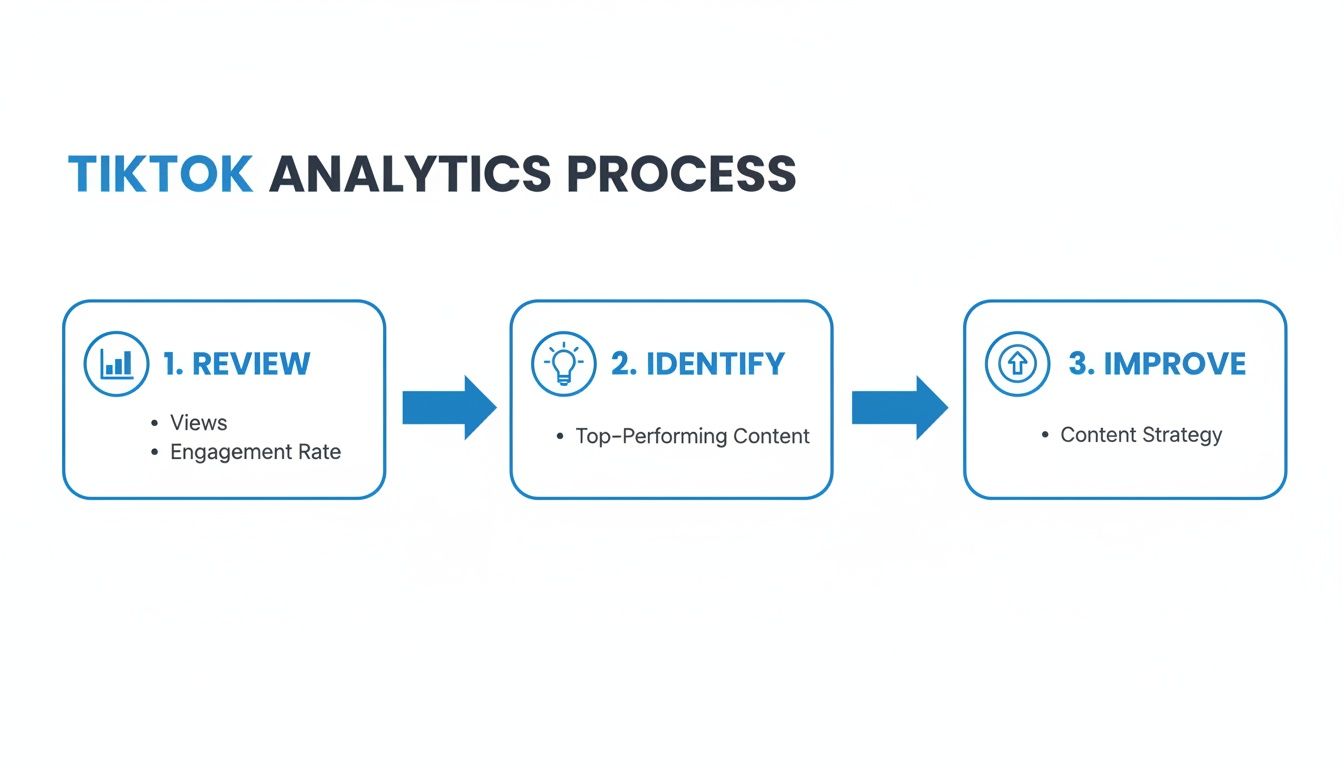
Think of this workflow as turning raw data into a real-world roadmap for creating better, more engaging content every single time.
Why Did My Video Flop Even Though I Followed a Trend?
This one is a classic—and it's beyond frustrating. You spot a hot trend, jump on it fast, and... crickets. What gives?
Nine times out of ten, it’s a mismatch between the trend and your niche. If your take on the trend feels forced or doesn't deliver the kind of value your audience follows you for, they'll scroll right past. It has to feel authentic to you.
Timing is also everything. A TikTok trend has the lifespan of a mayfly. Jumping on it even a day or two late means you’ve already missed the biggest wave of views. Always check the TikTok Creative Center to see if a sound is still climbing or if you're late to the party.
Finally, don't forget the fundamentals. A trend isn't a magic bullet. If you have a weak hook, bad lighting, or confusing text on the screen, people will swipe away. The algorithm sees that low watch time and buries your video, trend or not.
How Often Should I Be Posting on TikTok?
Consistency is king. It's one of the strongest signals you can send to the algorithm. While there isn't a single magic number that works for everyone, most top creators aim to post at least once per day. This keeps your content constantly circulating on the For You Page and gives you way more data to work with.
But let me be clear: quality beats quantity, always.
Posting three killer, well-thought-out videos a week will do infinitely more for your account than posting seven rushed, low-effort clips. If you're just starting out, find a schedule you can actually stick to, whether that's three, five, or seven times a week. Burnout is the enemy.
A consistent posting schedule does more than just feed the algorithm; it trains your audience to expect content from you, which builds anticipation and loyalty over time.
Once you find your rhythm, let your analytics be your guide. If you see engagement start to dip across your videos, it might be a sign to pull back on volume and double down on quality.
Does Deleting a Poorly Performing Video Hurt My Account?
This question sparks a lot of debate, but the consensus among pros is no, it doesn't really hurt your account. The TikTok algorithm judges each video on its own merits. One flop isn't going to tank your future uploads.
That said, I almost never recommend deleting a video. A video that gets only a handful of views today could randomly get picked up by the algorithm weeks or even months from now. We call this a "delayed explosion," and it happens more often than you'd think.
Instead of hitting delete, try one of these moves:
- Set it to private. If you truly can't stand looking at it, just make it private. This hides it from public view without scrubbing the data from your account.
- Leave it up and learn from it. Treat it as a data point. Why did it fail? Was the hook weak? Did the topic miss the mark? Use it as a free lesson for what not to do next time.
Deleting videos erases valuable intel you could have learned from. Unless the video has a major error or something you no longer stand behind, it’s usually best to just let it be. Every post—good or bad—is a clue.
Ready to scale your content creation without spending hours editing? With ClipShort, you can generate dozens of viral-style faceless videos in minutes. Our AI-powered platform automates everything from script to final edit, complete with lifelike voiceovers, dynamic visuals, and animated captions designed to stop the scroll. Start creating faster and smarter at https://www.clipshort.co.