
How to Make TikTok Videos That Actually Go Viral
Trying to make a TikTok go viral often feels like a shot in the dark, but it's more science than magic. It really boils down to a simple, repeatable process: plan an idea that stops the scroll, shoot it with decent light and clear audio, and then edit it with fast cuts and punchy captions. The absolute key is grabbing someone's attention in the first three seconds and giving them a reason to stick around.
Deconstructing the Anatomy of a Viral Video
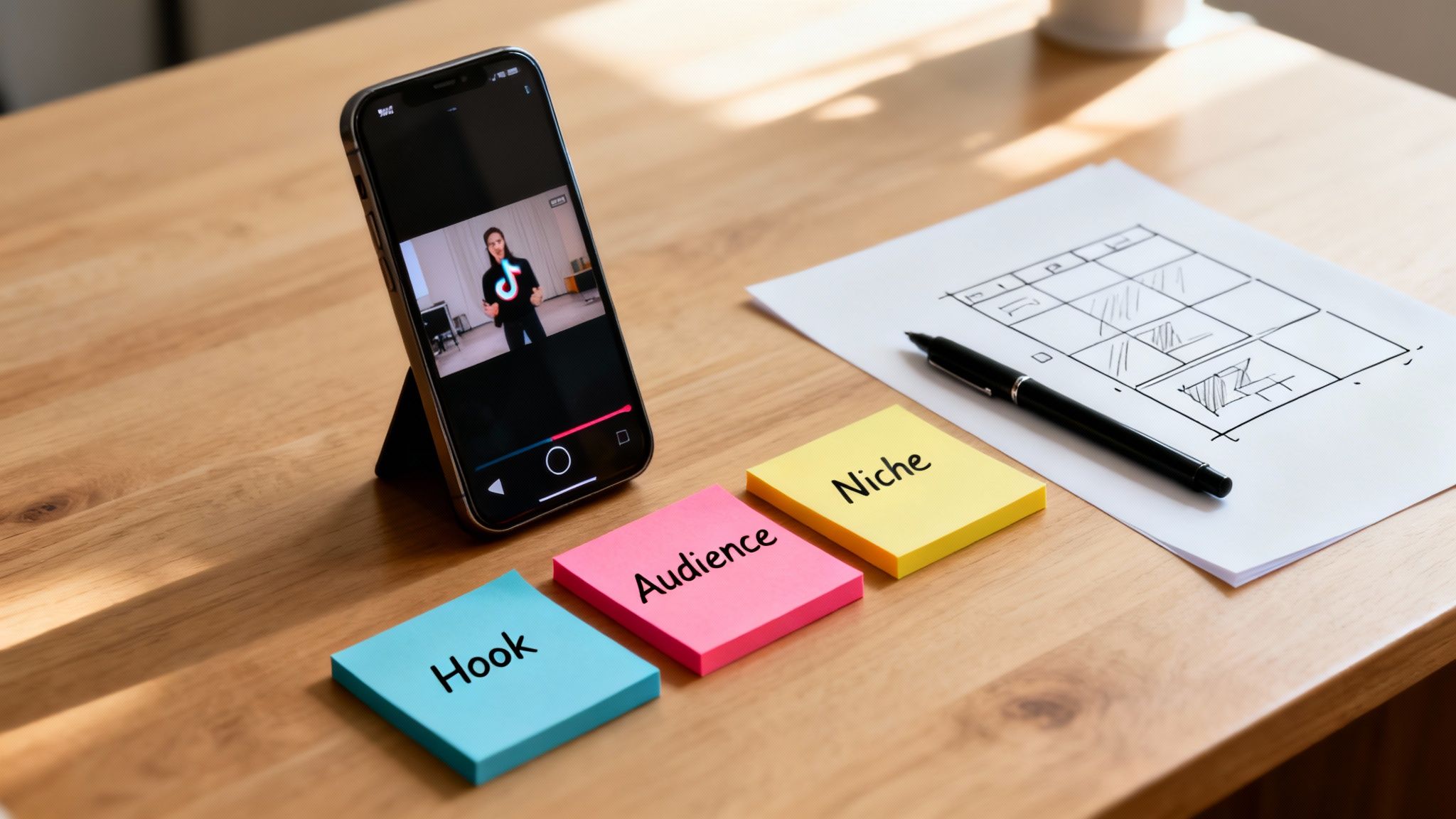
Before you even think about hitting that red record button, the real work begins. Going viral isn't about getting lucky; it's about being strategic. So many creators get caught up chasing trends without a solid plan, which just leads to inconsistent views and, eventually, total burnout.
The secret to making TikToks that actually perform is to figure out what’s already working and break it down. You have to look past the surface and get into the guts of what makes a video so addictive people can't help but share it.
Identifying Your Niche and Audience
First things first, you need to define your playground. A niche isn't just a topic—it’s a whole community with its own inside jokes, language, and problems. Are you making content for #BookTok, #CleanTok, or the ever-growing #DIY crowd? Each one has its own unique vibe.
Once you know your niche, you have to get inside the head of your audience. What do they want? What are they afraid of? What questions keep them up at night? When you get this right, your content feels like it was made just for them, and that's how you turn a casual viewer into a dedicated follower.
A great way to start is by becoming a student of your niche. Don't just scroll—analyze. Dive into the comment sections of popular videos. What are people asking? What jokes are landing? This is literally free market research.
Reverse-Engineering Successful Content
Viral videos always leave clues. Your job is to play detective and reverse-engineer the top videos in your space. Look for patterns in these areas:
- The Hook: What do they do in the first 1-3 seconds to make you stop? Is it a controversial question, a wild visual, or a super relatable problem?
- The Storytelling Arc: Even a 15-second clip needs a beginning, middle, and end. Find the setup, the problem or transformation, and the final payoff.
- Emotional Triggers: Does the video make you feel surprised, happy, satisfied, or seen? Strong emotions are what fuel shares and comments.
- Pacing and Edits: Pay attention to the speed of the cuts. Note how they use text on the screen and the timing of sound effects. Quick, dynamic edits are essential for keeping eyes glued to the screen.
By breaking down popular videos into these fundamental parts, you stop guessing what might work and start building a repeatable formula based on proven success. You'll begin to understand what truly makes a viral video and how to apply those principles to your own ideas.
A perfect example of this is the most-viewed TikTok of all time. Zach King’s 'Magic Ride' from 2019 has over 2.3 billion views. It got there with incredible editing and a mind-bending illusion, not by relying on a personal brand or a trending dance. It's a faceless video that proves virality is often just a brilliant concept executed flawlessly.
To help structure your brainstorming, I use a simple framework. It forces you to think through every critical element before you start filming.
The Viral Video Idea Blueprint
This quick-start framework will help you structure your TikTok video ideas for maximum impact, ensuring each video has a clear hook, story, and call to action.
| Component | Description | Example Idea (History Niche) |
|---|---|---|
| The Hook | The first 3 seconds. An intriguing question, bold statement, or shocking visual. | "You won't believe what Abraham Lincoln's voice actually sounded like." |
| The Core Value | The main "meat" of the video. The solution, the story, the transformation. | Show historical accounts describing his high-pitched voice, contrasting it with the deep, booming voice people imagine. |
| The Payoff | The satisfying conclusion or "aha!" moment. | Play an AI-generated audio clip attempting to recreate his real voice based on historical descriptions. |
| Call to Action | What you want the viewer to do next. | "Follow for more weird history facts you weren't taught in school." |
Using a simple blueprint like this ensures you're not just creating content, you're engineering a video with a purpose.
Building Your Content Pillars
Finally, to avoid being a one-hit wonder, you need to set up content pillars. These are 3-5 core themes or video formats that your account will become known for. This strategy gives you structure and lets your audience know exactly what to expect, which is what makes them hit that follow button.
For example, if you ran a history account, your pillars could be:
- "On This Day" historical facts.
- Debunking common historical myths.
- Recreating historical recipes.
Pillars give your content a clear direction and make brainstorming a hundred times easier. Instead of staring at a blank screen, you're just filling in a structured plan designed for consistent growth.
Crafting Hooks and Scripts That Stop the Scroll
On TikTok, you have less than three seconds to earn someone's attention. If the very first frame of your video doesn't immediately stop their thumb from swiping, they're gone. This is exactly why the hook—that first sentence or visual—is the single most important part of any video that gets views.
A powerful hook shatters a user's mindless scrolling pattern. It works by creating an instant information gap, sparking intense curiosity, or even challenging a belief they hold. Without a killer opening, even the most valuable, well-produced video is dead on arrival.
Mastering the Art of the Hook
Your hook is a promise. It needs to tell the viewer exactly what they’re going to get by sticking around for the next 15 to 60 seconds. Think of it as the headline for your video; it has to be compelling.
Here are a few tried-and-true hook formulas that kill it in almost any niche:
- The "You're Doing It Wrong" Hook: "You've been peeling garlic wrong your whole life." This instantly challenges a common behavior and promises a smarter way.
- The "Secret" Hook: "Here's a website that feels illegal to know." This creates immediate intrigue by offering up exclusive, almost forbidden information.
- The Provocative Question Hook: "What if everything you learned about ancient Rome was a lie?" This forces a hard pause, making the viewer reconsider what they know.
- The "Top X" Hook: "These are the top 3 mistakes new homeowners make." Lists are incredibly satisfying to the human brain and promise clear, easy-to-digest value.
The goal is to trigger an immediate emotional response—curiosity, surprise, maybe even a little disagreement. Anything is better than indifference.
An effective hook doesn't just grab attention; it qualifies your audience. A hook like "Three signs your marketing strategy is failing" instantly filters for viewers who care about marketing, ensuring higher watch time from the right people.
Writing Scripts That Maintain Momentum
Once you've hooked them, your script has one job: deliver on that promise fast and keep the energy up. Scripts for short-form video aren't essays. They are lean, conversational roadmaps built for speed. Every single word has to count.
A simple but incredibly effective structure is the Hook-Value-CTA framework:
- Hook (1-3 seconds): Grab their attention with one of the formulas we just covered.
- Value (10-40 seconds): Deliver the goods. Use simple language, short sentences, and get straight to the point. This is where you solve the problem or tell the story you promised.
- Call-to-Action (CTA) (1-3 seconds): Tell them exactly what to do next. "Follow for more daily tips," or "Comment your favorite tool below."
Always write like you talk. Stiff, formal language feels completely out of place on TikTok and builds a wall between you and the viewer. A great trick is to read your script out loud. If it sounds clunky or unnatural, rewrite it until it flows. To learn more about building a solid narrative, our guide on how to create engaging social media content offers some deeper insights.
Overcoming Writer’s Block with AI
We've all been there—staring at a blank page, waiting for inspiration. Luckily, modern tools can eliminate that struggle completely. If you're stuck, AI script generators can be a powerful creative partner. Just feed it a simple prompt like, "a 30-second video script about the surprising benefits of cold showers," and it can spit out multiple hooks, script structures, and CTA ideas in seconds.
For that cold shower idea, an AI might suggest hooks like:
- "Stop drinking coffee in the morning. Do this instead."
- "The weirdest productivity hack I've ever tried actually works."
- "Here's what happens to your body when you take a cold shower for 30 days."
This isn't about replacing your creativity; it's about amplifying it. You take the foundation the AI gives you and inject your own unique voice, personal stories, and specific examples. This workflow turns the intimidating task of scripting into a much faster process of just editing and refining. It frees you up to focus on making the best content possible for your audience.
Your Guide to Filming and Effortless Editing
With your script ready, it's time to bring your idea to life. This is where the magic happens, but don't let the word "production" scare you off. You don't need a Hollywood studio or a bag full of expensive gear—your smartphone is more than powerful enough to shoot a video that gets millions of views.
Honestly, learning how to make TikTok videos that look amazing comes down to just three fundamentals: lighting, audio, and composition. Get these right, and you’re already miles ahead of 90% of other creators.
Nailing the Basics with Just Your Phone
Great content almost always starts with simple, effective techniques. Before you even think about hitting record, take a minute to set up your shot.
- Lighting is Everything: Natural light is your absolute best friend. Seriously, just face a window. It creates soft, even lighting that gets rid of all those harsh shadows. Filming at night? A cheap ring light will completely change your game.
- Composition Matters: Ever heard of the rule of thirds? Just imagine a 3x3 grid on your screen. Try to place your subject along those lines or where they cross. It's a simple trick that makes your shots feel way more balanced and professional.
- Clear Audio is Non-Negotiable: People will forgive so-so video quality, but they will click away instantly if the audio is bad. Find a quiet spot to film, or even just use the mic on your headphones. It's a huge step up from your phone's built-in microphone. For really crisp audio, you can't go wrong with one of the best budget USB microphones.
This whole process starts way before you film, back at the scripting stage.
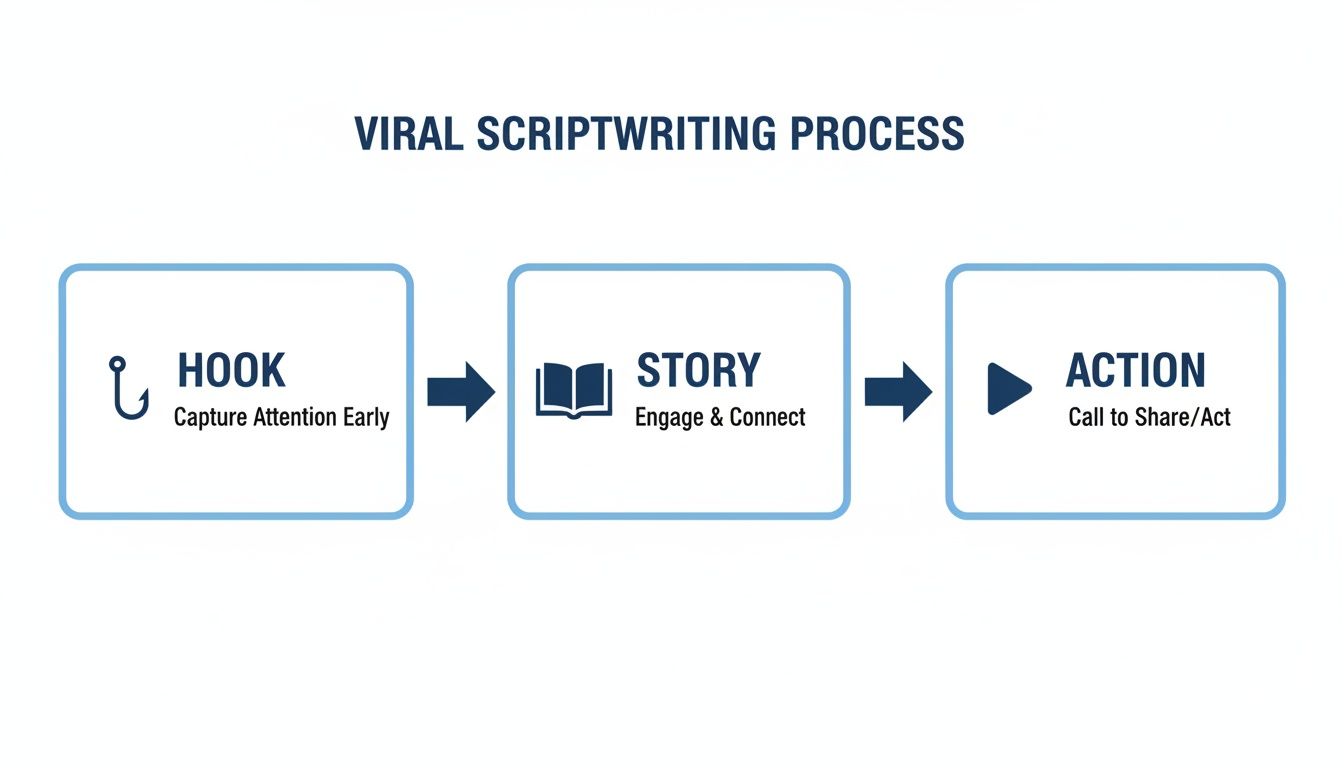
As you can see, a killer hook, a good story, and a clear action are the pillars that hold up any great video.
The Rise of Faceless and AI-Generated Content
One of the biggest trends right now is the move away from having to be on camera. Faceless content is absolutely blowing up because it lets you focus 100% on the story and the value you're providing, without any pressure to perform.
This opens up a ton of new possibilities. You can talk about sensitive topics, keep your privacy, or just churn out content at a scale that would be impossible if you had to be in every single shot.
The real power of faceless content is its scalability. When you take yourself out of the equation, you can batch-produce dozens of high-quality videos in the time it used to take to film and edit just one or two.
Modern tools have made this workflow insanely efficient. Platforms like ClipShort were literally built for this. You can generate entire video scenes just by typing a text prompt, choosing visual styles like cinematic, anime, or hyper-realistic to perfectly match your vibe.
This automates all the tedious parts of video production. You can pick an AI voice from dozens of languages and accents, pop in some dynamic, animated captions that keep people watching, and sync it all to music without ever touching a complicated editing timeline.
Core Editing Skills for a Professional Feel
Whether you're piecing together AI clips or editing footage you shot yourself, a few simple techniques can make your video look polished and professional. You don't need to be a video wizard; you just need to get good at the basics that work for short-form video.
Zero in on these key skills:
- The Jump Cut: This is the signature edit of TikTok. By cutting out every little pause and breath, you create a fast, high-energy pace that keeps people locked in.
- Text Overlays: Use text on the screen to hit your key points, ask questions, or just add some context. It’s a lifesaver for people watching with the sound off.
- Dynamic Transitions: A simple, hard cut works fine most of the time. But a well-placed zoom, swipe, or spin can add a bit of professional flair and keep the energy from dipping.
The entire point of editing is to keep the momentum going. Every single cut, caption, and sound should push the story forward and keep the viewer glued to the screen until the very end. If you're brand new to this, there are tons of great video editing tips for beginners that can get you up to speed fast. At the end of the day, a clean, fast-paced edit is what turns a good idea into a great TikTok.
How to Optimize Your Post for the TikTok Algorithm
Making a great video is really just the first step. Now comes the hard part: getting people to actually see it. The TikTok algorithm can feel like a complete mystery, but it’s just a system trying to give users more of what they enjoy. Your goal is to send it all the right signals to prove your video is worth showing to a bigger audience.
It's not about finding some secret hack. It's about understanding what TikTok really values—like how long people watch and how they interact—and then fine-tuning every part of your post to max out those signals.
Decoding the Most Important Ranking Signals
The algorithm is watching closely from the second your video lands on someone's "For You" Page. The stronger those initial signals are, the wider your reach will be.
Here are the metrics that matter most:
- Watch Time & Completion Rate: This is the big one. If someone watches your video all the way through, it’s a massive sign that your content is compelling. For shorter videos (7-15 seconds), a high completion rate is everything.
- Shares: When someone shares your video, they're vouching for it. This tells the algorithm your content is so good that it's worth recommending to friends.
- Comments: Comments get conversations started and build a community around your video. A high number of comments and replies signals deep engagement.
- Likes: While not as heavy-hitting as shares or comments, likes are still a clear, positive signal that people are enjoying what they see.
Think of the algorithm like a snowball. Strong early engagement from a small test audience gives it momentum. TikTok then pushes it to a larger crowd, which generates even more engagement, and the snowball just keeps growing. Your job is to give it a solid first push.
Crafting Captions That Spark Conversation
Your caption is prime real estate for boosting engagement. Don’t just describe the video; use it to start a conversation. One of the easiest and most effective ways to do this is to end your caption with a question.
For instance, instead of a flat caption like "My morning routine," try to pull the viewer in:
- "My 5 AM morning routine. What’s the one habit you can’t start your day without?"
- "This is my secret to a productive morning. Am I missing anything?"
This simple tweak turns passive viewers into active participants, driving comments that the algorithm loves to see.
Using Hashtags and Audio to Amplify Reach
Think of hashtags and trending audio as your discoverability tools. They help the algorithm understand what your video is about and show it to people who are already interested in that topic. A strategic mix is key here.
A solid hashtag strategy usually looks like this:
- Broad, High-Volume Tags: Use 1-2 popular hashtags like
#DIYprojector#booktokto tap into huge, established audiences. - Niche-Specific Tags: Add 2-3 more targeted tags like
#woodworkingtipsor#fantasybookrecsto connect with a passionate, highly engaged community. - A Branded Tag: Creating a unique tag for your series or brand, like
#BensBuilds, makes it easy for followers to binge all your related content.
Likewise, jumping on a trending audio can give your video an immediate lift. The algorithm often favors content using popular sounds because it knows users are already engaging with them. Keep an eye on your FYP to see what's trending and think of creative ways to make those sounds work for you.
Finding Your Perfect Posting Time and Frequency
When you post is just as important as what you post. Dropping your video when your audience is most active gives it the best shot at getting that crucial initial traction. To find your "golden hours," you'll need to dig into your TikTok Analytics.
Just head to your Creator Tools, then Analytics, and check out the Followers tab. You'll find a detailed breakdown of the days and hours your followers are scrolling the most. Use that data to schedule your posts for peak impact.
Consistency also sends a powerful signal. While some brands get by posting around 1.7 times per week, the top-performing accounts are often dropping at least 5 videos weekly. This keeps your account fresh in the eyes of the algorithm and gives your audience something to look forward to. For a deeper dive into these numbers, check out the insights from Rival IQ’s 2023 report.
TikTok Posting Frequency vs. Potential Engagement
Deciding how often to post can feel like a guessing game, but there's a clear correlation between content velocity and growth. This table breaks down what you can generally expect at different posting frequencies.
| Posting Frequency | Typical Engagement Level | Best For | AI Tool Advantage (e.g., ClipShort) |
|---|---|---|---|
| 1-3 Videos/Week | Low to Moderate | Beginners testing their niche or brands with limited resources. | Easily create a small batch of high-quality videos to maintain a presence. |
| 4-6 Videos/Week | Moderate to High | Creators looking for steady growth and building a loyal community. | Automate production to hit a consistent daily schedule without burnout. |
| 7+ Videos/Week (Daily) | High to Viral | Serious creators and brands aiming for rapid growth and virality. | Rapidly generate multiple video variations from a single script to test what works. |
Ultimately, learning how to make TikTok videos that pop is a cycle of testing, learning, and refining. The more you post and analyze, the better you'll get at giving the algorithm exactly what it wants to see.
Using Analytics to Refine Your Content Strategy
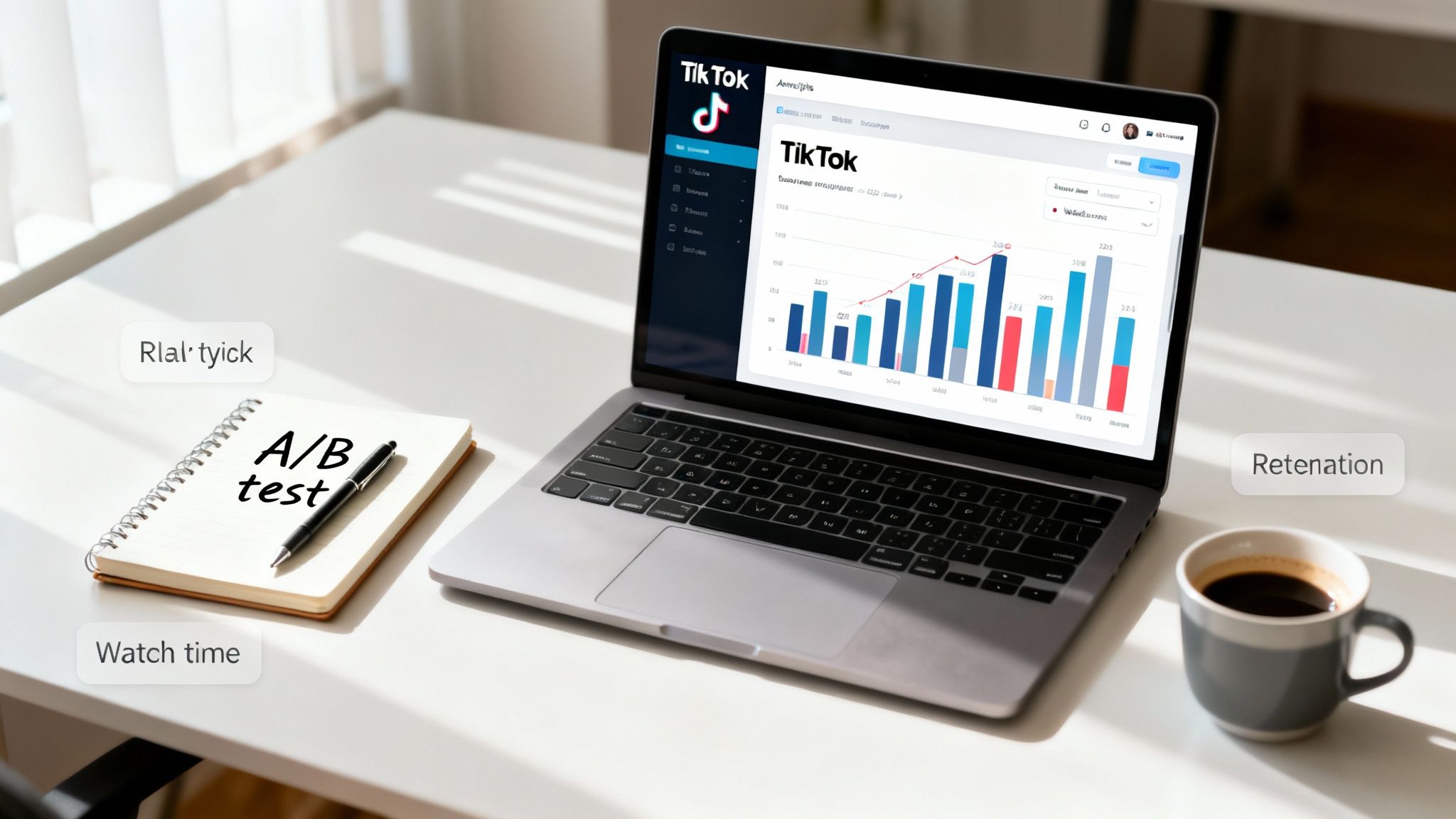
Going viral isn't just luck or pure creative genius; it's a science. Once you start posting content, TikTok hands you a powerful lab to work in: your analytics dashboard. This is where you stop guessing what your audience wants and start listening to what their actions are telling you.
It's easy to get hung up on vanity metrics like likes and follower counts. While they feel good, they don’t tell the whole story. The real gold is buried in the data that shows why people are watching—and more importantly, why they swipe away.
Looking Beyond the Vanity Metrics
To really get a grip on your performance, you have to dig deeper. Your Creator Tools dashboard is packed with actionable data that can completely change how you approach making videos. Instead of just celebrating a video that got a ton of views, ask yourself what made it different.
Start by focusing on these three core metrics:
- Average Watch Time: This is one of the most powerful signals you can send the algorithm. A high average watch time tells TikTok your content is sticky and engaging, making it worthy of a push to a much wider audience.
- Full Video Watches: This metric shows the percentage of people who watched your video from the very beginning to the very end. For shorter videos (under 15 seconds), a high completion rate is absolutely critical for success.
- Traffic Sources: Where are your views actually coming from? A big slice of the pie from the "For You" page means the algorithm is picking up your video and serving it to new audiences. That’s the key to explosive growth.
The most successful creators treat their content like a series of experiments. They don't just post and pray; they analyze, learn, and iterate. This data-driven feedback loop is what separates amateurs from professionals.
For a next-level analysis of your performance, learning how to visualize your TikTok Shop data with a heat map can turn raw numbers into clear, actionable insights for optimizing your next video.
The Power of A/B Testing Your Content
A/B testing sounds like something for data scientists, but it's a simple concept. You just create two similar videos but change one single element to see which version performs better. This is how you systematically figure out what really resonates with your audience.
You can test just about anything, but here are some high-impact elements to start with:
- Hooks: Film the exact same video but record two different opening lines. Does a question work better than a bold, controversial statement?
- Audio: Post the same video twice, once with a trending sound and once with another popular track. See which one gets more traction from the algorithm.
- Video Style: Create two videos on the same topic. Make one with fast, aggressive jump cuts and another with a smoother, more cinematic flow.
- Captions: Try a short, punchy caption against a longer, more descriptive one that includes a question to spark conversation in the comments.
By isolating just one variable at a time, you get crystal-clear feedback on what your audience actually responds to. No more guesswork.
Turning Insights into Action
Your analytics are only useful if you do something with them. Make it a weekly habit to review your top-performing videos. Hunt for the patterns. Did all your hits use a similar hook structure? Did they all feature a specific type of trending audio?
Once you find a winning formula, double down on it. That doesn't mean you should make the exact same video over and over. It means taking the successful elements—the structure, the tone, the topic—and applying them to fresh ideas. This strategic process turns your content creation from a game of chance into a predictable engine for growth.
Common Questions About Making TikTok Videos
Jumping into TikTok for the first time always kicks up a bunch of questions. How long should my videos be? Do I really have to be on camera? How often do I need to post? It can feel like a lot.
Let's cut through the noise. Here are the real answers to the questions every new creator asks.
What Is the Best Length for a TikTok Video?
While TikTok keeps pushing for longer videos, the magic number for anyone starting out is 7 to 15 seconds. Seriously.
Shorter videos make it incredibly easy for people to watch the whole thing. A full watch-through is one of the strongest signals you can send to the algorithm, telling it your content is worth pushing to more people.
Once you have a bit of a following, you can start to stretch things out to 30 or even 60 seconds for more in-depth stories. The secret is to live in your analytics. Your "Average Watch Time" will show you the exact moment people get bored and scroll away, so you can trim the fat and keep your content tight.
Can You Go Viral Without Showing Your Face?
Absolutely. Not only can you, but "faceless" content is one of the biggest and fastest-growing styles on the platform right now. Success here has zero to do with your face and everything to do with your storytelling, visuals, and audio quality.
You have a ton of options for creating killer faceless videos:
- Use high-quality stock footage or screen recordings.
- Create slick animations or text-on-screen videos.
- Let AI-generated visuals build entire worlds for you from scratch.
The biggest unlock with faceless content is how scalable it is. When you're not the bottleneck—needing to be perfectly lit and on-camera for every shoot—you can batch-produce a massive amount of high-quality content. It’s the ultimate hack for staying consistent.
How Often Should I Post for Growth?
Consistency beats frequency every single time. A good starting point is to post 3 to 5 times per week. The algorithm definitely seems to reward accounts that show up regularly.
But let's be clear: one well-made, strategic video will do more for you than five rushed, sloppy ones. If that schedule sounds impossible, batch-producing your videos with content creation tools is a game-changer. It helps you keep a steady flow of posts without sacrificing quality. For context, most top-tier accounts are posting at least daily.
Do I Need an Expensive Camera for TikTok?
Nope. Not at all. The smartphone in your pocket is more than enough to create a viral hit. The gear doesn't matter nearly as much as two other things: good lighting and clear audio.
Get the fundamentals right, and you'll be ahead of 90% of creators.
Film facing a window for soft, natural light—it’s free and looks better than most ring lights. For audio, grab the earbuds that came with your phone. The little microphone on them is a massive step up from your phone’s built-in mic. At the end of the day, your creativity and your story are what people connect with, not the resolution of your camera.
Ready to create scroll-stopping faceless videos without the hassle of filming or complex editing? ClipShort is an AI video generator that turns your ideas into polished, viral-ready TikToks in minutes. Generate scenes, add lifelike voiceovers, and apply dynamic captions to automate your content production and scale your growth.