
How to Make a Video That Goes Viral A Practical Guide
Making a video go viral isn't an accident; it's a science. The most successful creators have a repeatable framework that boils down to three core pillars: jumping on cultural trends, mastering psychological hooks, and optimizing for platform algorithms. I like to call this 'engineered virality'—a strategic approach that gives any piece of content explosive potential.
The Blueprint for Engineering Viral Videos
Forget about luck. The world's top creators don't just hope for virality, they build systems to achieve it.
Going viral isn't about some magic trick. It's about a repeatable process that lines up perfectly with human psychology and what the platform's algorithm wants to see. The goal is to stop being a passive creator and start acting like an active architect of engagement. This means you have to shift your mindset.
Instead of just making what you think is good, you start creating what the data proves will perform. It's about dissecting what makes people stop scrolling, watch to the end, and hit that share button. You learn to spot trends before they hit their peak, write hooks that are impossible to skip, and edit your videos to maximize watch time—the ultimate signal to any algorithm that your content is gold.
The Three Pillars of Viral Success
At its heart, this blueprint is built on three simple, yet powerful, components. Nail each one, and you dramatically stack the odds in your favor. They all work together, creating a feedback loop that can turn a simple clip into a cultural moment.
- Capitalizing on Trends: This is your jet fuel. Tapping into a trending sound, format, or topic is the fastest way to get your content in front of a massive audience that's already looking for it.
- Mastering Psychological Hooks: This is what stops the scroll. A strong hook grabs a viewer's attention in the first 1-3 seconds by sparking curiosity, triggering an emotion, or highlighting a relatable problem.
- Optimizing for Platform Algorithms: This is how you sustain momentum. Your video has to feed the algorithm what it craves—high watch time, shares, comments, and saves—so it gets pushed to wider and wider circles of viewers.
This simple flow shows how these three elements work in a sequence to drive real results.
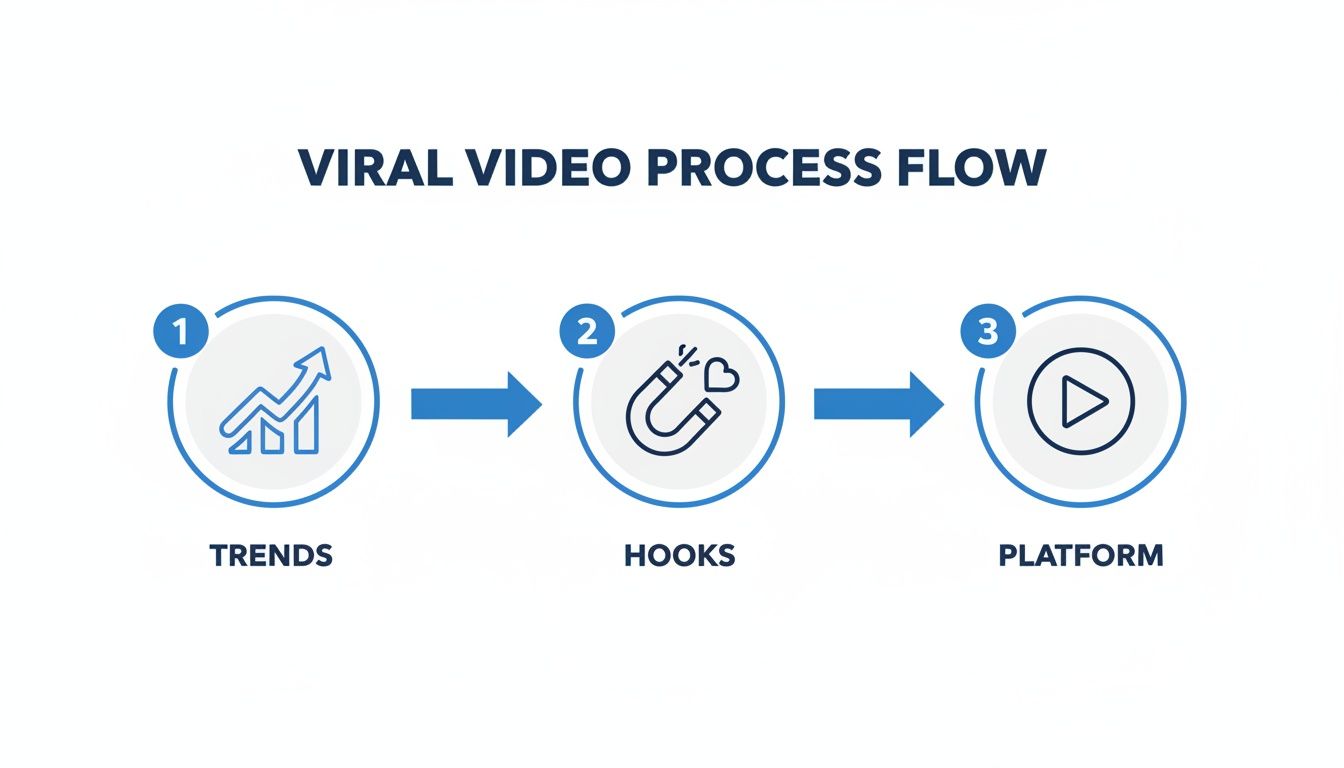
The big takeaway here is that virality starts with relevance (trends), is captured by engagement (hooks), and is ultimately scaled by the platform itself. Weaving in authentic engagement drivers like User-Generated Content (UGC) can also supercharge this entire process.
To put it simply, here’s how these pillars work together.
The Three Pillars of Engineered Virality
| Pillar | Why It Works | Key Tactics |
|---|---|---|
| Trends | Taps into existing conversations and high-volume interest, giving you an instant audience. | Using trending audio, mimicking popular video formats, and covering relevant news or topics. |
| Hooks | Captures attention in the first critical seconds before a viewer swipes away. | Posing a question, making a bold statement, or showing the end result first. |
| Algorithms | Feeds the platform positive signals (watch time, shares) to trigger wider distribution. | Fast-paced editing, clear captions, strong call-to-actions, and strategic posting times. |
Each pillar builds on the last, creating a powerful formula for predictable growth.
The biggest mistake I see creators make is trying to invent something completely new. The smarter path is to innovate within a proven framework. Use what's already working as your launchpad, then add your unique spin.
By really understanding these fundamentals, you can start to systematically create videos that have a genuine shot at going viral. For a deeper look into these core principles, you can learn more about what makes a video go viral in our detailed guide. Now, let’s break down the exact tactics for each of these pillars.
Want to know the secret to going viral? Stop trying to invent something from scratch and start riding the waves the algorithm is already creating. The fastest way to get millions of new eyes on your content is to tap into an emerging trend.
Think of trends as algorithmic cheat codes. The platform is already looking for content that fits a certain format or uses a specific sound. Viewers are already primed to watch and engage.
But here’s the catch: you can't just copy what everyone else is doing. The real magic is in spotting the right trends just before they hit their peak. Jump on a trend too late, and your video is just another drop in a massive ocean of look-alike content. Catch it early, though, and the algorithm will literally use your video to popularize the trend.
This means you need to shift from being a passive scroller to an active analyst. You have to become a trend-spotter.
Your Trend-Spotting Toolkit
Becoming a trend hunter isn't about luck; it's about knowing where to look and what to look for. Your "For You" page is a decent starting point, but if you really want to get ahead of the curve, you need to use more precise tools. Set aside a little time each day to actively research, not just mindlessly scroll.
Here are the best places to find trends before they completely blow up:
- TikTok Creative Center: This is an absolute goldmine. Head straight to the "Trend Intelligence" section to see breakout songs, hashtags, and videos. The trick is to filter by your industry and region, then look for trends that show a sharp upward spike but still have a relatively low number of total videos. That's the sweet spot.
- YouTube's Trending Music Chart: Audio is everything on YouTube Shorts. This chart shows you exactly which songs are picking up steam. You're looking for sounds that are climbing the charts but haven't totally saturated the platform yet.
- Analyze Competitors and Niche Leaders: Find 5-10 creators in your niche (or a related one) who are always on the cutting edge. Watch the new formats and sounds they're experimenting with. They often do the initial legwork, and you can see what starts getting traction on their pages before it goes mainstream.
The goal isn't just to find a popular sound. It's to find a sound or format that is just starting its climb. Hopping on a trend that already has 500,000 videos is like showing up to a party after everyone’s already gone home.
By keeping a close eye on these sources, you can build a running list of potential trends. This gives you a critical 24-48 hour window to jump on the momentum before it becomes yesterday's news.
Deconstructing a Trend for Your Niche
Okay, so you've spotted a promising trend. Don't just copy it. The videos that truly go viral adapt a trend to their specific audience. You need to break it down and figure out why it's working.
Ask yourself a few key questions:
- Is it the sound? Is the audio the main driver of the emotion, whether it's funny, nostalgic, or suspenseful? If it is, your visuals can be pretty simple.
- Is it the format? Is the trend all about a specific editing style, like a fast cut, a big reveal, or a certain text overlay?
- Is it a shared experience? Is it tapping into something universally relatable, like those "the feeling when..." or "things that just make sense" videos?
Think about the 'Nothing Beats a Jet2 Holiday' sound. It exploded to 30.1 billion views across nearly 400,000 videos. Creators who jumped on that sound within the first 24-48 hours saw way higher initial views because the algorithm was actively pushing new content to test its potential. If you want to dive deeper, you can read more about the power of audio in social video trends for 2025.
Understanding the trend's core appeal is what separates the pros from the amateurs. If a trend is based on a funny work-from-home joke, a fitness creator could easily adapt it to "relatable moments at the gym" using the exact same sound and pacing. This makes the trend feel new and tailored to their audience, which is what drives shares and saves.
This is how a simple, faceless video about a relatable life moment can get massive reach. You're combining perfect timing with authentic, niche-specific content. This analytical approach is what it takes to actually make a video go viral.
Crafting an Unskippable First Three Seconds
Let's be brutally honest: if you don't stop the scroll in the first three seconds, your video is already dead. That’s the reality of short-form content.
You could have the most incredible story or a mind-blowing reveal later on, but it means absolutely nothing if nobody sticks around to see it. This is where the art of the hook comes into play. It’s the single most critical element in your mission to go viral.
A powerful hook isn't just about being loud or shocking. It's about triggering an immediate, gut-level response in the viewer. You need to create an itch they have to scratch by watching the rest of your video.
Think of it as making a promise. You present a problem, spark intense curiosity, or challenge a common belief right out of the gate. The rest of your video is simply fulfilling that promise. The stronger the initial promise, the more likely a viewer is to stay.
The Psychology Behind a Perfect Hook
The best hooks tap into fundamental human emotions and cognitive biases. They bypass rational thought and aim straight for a gut reaction. Nailing these techniques is what separates content that fizzles out with a few hundred views from content that explodes to millions.
The science behind this is undeniable: emotional hooks are the secret sauce. By 2025, it's estimated that a staggering 92.3% of global internet users will watch online videos weekly. The content that grabs them instantly—like viral clips and quick tutorials—will dominate.
This is why marketers are seeing videos with strong openings outperform other formats by 1200% in shares. That initial emotional jolt makes the content feel more impactful and worth sharing. You can discover more about these video marketing statistics to really see how crucial that opening is.
To build a hook that actually works, focus on one of these core psychological triggers:
- Curiosity Gap: Present a piece of information but leave out the crucial context. The human brain hates an open loop and will stick around to close it.
- Controversy or Challenge: State an opinion that goes directly against a widely held belief. This instantly makes people want to see how you could possibly justify it.
- Relatability: Start with a problem or situation that your target audience has absolutely experienced. That immediate "that's so me" reaction is incredibly powerful.
- Visual Shock: Show something unexpected, weird, or visually jarring right away. This could be the incredible final result of a project or a surprising transformation.
A great hook makes the viewer feel like they're about to discover a secret. It turns passive scrolling into active anticipation. If you can make someone think, "Wait, what?" in that first second, you've already won half the battle.
Actionable Hook Formulas You Can Steal
Alright, let's get practical. You need specific, adaptable formulas you can plug your own ideas into. These aren't just generic templates; they are proven structures for grabbing and holding attention.
The "You're Doing It Wrong" Hook This hook immediately positions you as an expert with a valuable secret to share.
- Example: "Stop making your coffee like this. Here's the one ingredient you're missing for a perfect brew."
- Why It Works: It creates a tiny bit of insecurity and a strong desire to learn the "right" way.
The "Unbelievable Result First" Hook Show the amazing final outcome before you explain how you got there.
- Example: A video starts with a shot of a perfectly organized, beautiful pantry. The text overlay reads: "This chaotic mess became this in just one hour."
- Why It Works: The viewer sees the incredible result and is instantly invested in learning the process.
The "Controversial Statement" Hook This one challenges the viewer's worldview and forces them to pay attention.
- Example: "Cardio is actually the worst way to lose fat. Let me explain."
- Why It Works: It’s bold and counterintuitive, making people stop just to hear your argument.
Crafting the perfect opening lines is crucial, and it works hand-in-hand with your overall video structure. For more guidance on structuring your entire message, check out our comprehensive guide on how to write a compelling script for a YouTube video.
Amplify Your Hook with Visuals and Sound
Your words are only one part of the equation. To make a hook truly unskippable, you need to layer it with the right visual and auditory cues. This is where a tool like ClipShort becomes a huge asset, allowing you to engineer these moments with precision.
- Dynamic Captions: Don't just slap plain text on the screen. Use animated captions that pop in, change color, or have a slight bounce. Highlighting the one or two most important "trigger" words in your hook with a different color is a pro move that immediately draws the eye.
- Perfectly Timed Voiceover: The tone of your voiceover is everything. A hook delivered with urgency, excitement, or a sense of mystery will land much harder than one with a flat, robotic delivery.
- Sound Effects: A simple "swoosh," "ding," or even a dramatic gasp sound effect timed perfectly with your hook can make all the difference. It’s an auditory cue that tells the viewer's brain: pay attention, something important is happening.
By combining a psychologically powerful written hook with engaging visuals and sound, you create an opening that’s nearly impossible to scroll past. This is the foundation every viral video is built on.
Editing Techniques for Maximum Watch Time
A great hook buys you the first three seconds. Strategic editing is what keeps people watching until the end, hitting replay, and sharing it with their friends.
Editing isn't just for cleaning up mistakes—it's your best weapon for manipulating watch time and sending all the right signals to the algorithm. This is where you transform a solid idea into an addictive, can't-look-away piece of content.
Think of editing as the heartbeat of your video. A slow, plodding rhythm puts people to sleep. You need a fast, dynamic pace that keeps their brain firing and their thumb far away from the swipe. This whole process is often called 'retention hacking,' and it's the science of keeping eyes locked on the screen.

Pacing Your Video for Dopamine Hits
Let's face it, the modern attention span is shot. To keep anyone locked in, your video has to deliver a constant stream of tiny dopamine hits. What does that mean in practice? You need to change something on the screen every 1-2 seconds.
This doesn't always mean a hard cut to a new scene. It can be a subtle zoom, a text overlay that pops up, or a well-placed emoji. This rapid-fire pacing keeps the video feeling like it's constantly moving forward, preventing the viewer's brain from getting bored. The biggest creators do this because it just plain works.
Here’s a quick breakdown of visual changes to mix in:
- Scene Changes: The most obvious one. Cut between different B-roll clips or camera angles.
- Zooms and Pans: Add a bit of "Ken Burns" style motion to static images or do subtle zooms on your video clips to create a feeling of movement.
- Text and Emoji Pop-ups: Layering animated text or relevant emojis on screen adds a fresh visual element without changing the underlying footage.
- Sound Effects: A perfectly timed "swoosh," "ding," or "pop" gives an audio cue that reinforces a visual change, making it way more impactful.
This constant stimulation is your secret to holding attention, which directly inflates your average watch time—the one metric that every platform's algorithm absolutely obsesses over.
Why Dynamic Captions Are Non-Negotiable
We live in a silent-scroll world. Dynamic subtitles are no longer a nice-to-have; they're essential. A massive chunk of your audience watches with the sound off, but even for those with the volume up, captions are a powerful retention tool. They reinforce your message and give the viewer's eyes an anchor point.
But please, don't just slap on some plain, static text. You need captions that are part of the show.
The best viral videos treat captions as a primary visual element, not an afterthought. They use color, animation, and emojis to emphasize key points and guide the viewer's attention exactly where they want it.
Think of your captions as another layer of visual storytelling. They can inject personality, clarify what you're saying, and make your content accessible to everyone. If you're looking for ideas, our deep dive on YouTube Shorts editing shows exactly how top creators use captions to hook viewers.
Engineering the Perfect Video Loop
This might be the most powerful—and most overlooked—editing trick for going viral: the seamless loop. When a video ends and immediately restarts without a jarring cut, you can trick people into watching it two or three times before they even notice.
This tactic is an absolute game-changer for your average watch time. If your 10-second video loops perfectly and someone watches it twice, your watch time for that session is 20 seconds. That's a 200% retention rate. The algorithm sees that and immediately thinks, "Wow, people LOVE this video."
Here’s how to pull off a perfect loop:
- Match the Start and End: Make sure the very first frame of your video flows naturally from the very last frame. You could end with the same visual you started with, or cut the audio so the last word flows right back into the first.
- Cut the Audio Precisely: The background music or your voiceover has to loop without a hitch. Trim the audio track so the end of the musical phrase transitions smoothly back to the beginning.
- End on a High Note: Your video should end at a moment of peak curiosity or satisfaction. This makes the viewer want to experience that little rush again.
This simple editing trick is a masterclass in how to go viral by playing the platform's game. It's a tiny technical detail that can have an absolutely massive impact on your video's reach. Your editing software is where you turn a simple clip into a viral machine.
Your Distribution and Rapid Testing Strategy
A killer video is just a video file if no one ever sees it. You've done the hard part—coming up with the idea, scripting it, and making it look amazing—but that's only half the battle. Now you have to get it in front of the right eyeballs.
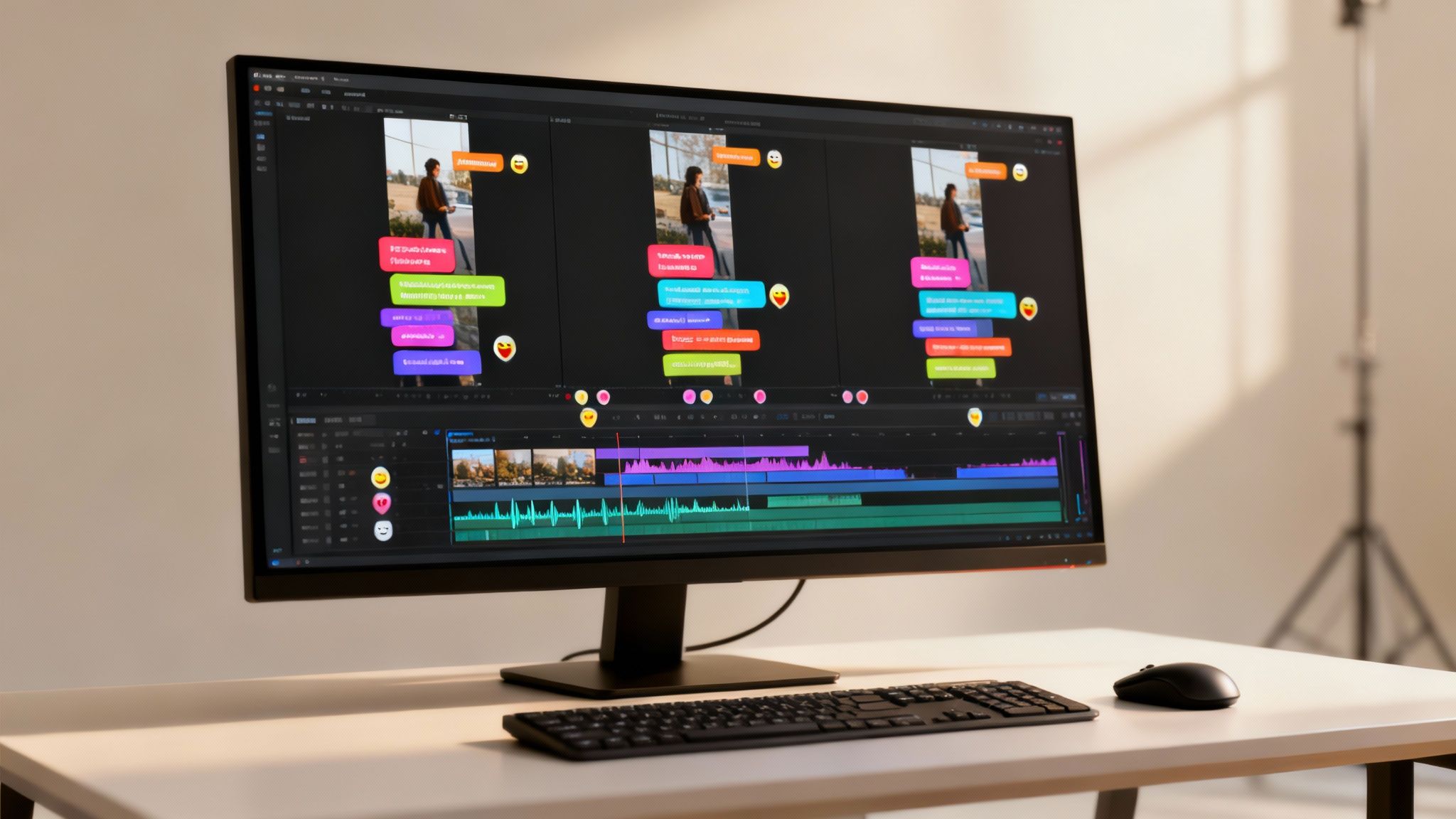
This is where a smart distribution and rapid testing plan comes in. It's not about just hitting "post" and hoping for the best. You need a deliberate process to teach the platform's algorithm exactly who your video is for. That means nailing your posting times, using the right hashtags, and optimizing your keywords to signal what your content is all about.
The Power of Volume and Speed
Let's get one thing straight: the secret to going viral isn't about creating one single, perfect masterpiece. It's about constant, rapid experimentation. You need to figure out what works, then do more of that. The algorithm feeds on data, and your job is to give it as much data as you can, as fast as you can.
This is why posting consistently is so non-negotiable, especially when you're just starting out and testing the waters. Aiming for 3-5 posts a day might sound like a lot, but you're not trying to spam people. You're trying to quickly collect enough data to spot a winning pattern. Think of each video as a tiny experiment.
This high-volume approach lets you learn what the algorithm wants to push. You might find that one style of hook gets a 20% higher watch time, or that a specific trending audio gives you a huge initial boost. You only find these gold nuggets by putting in the reps.
A Mini-Case Study: The 10-Video Test
Imagine you want to test ten different video ideas this afternoon. With traditional filming, that's a non-starter. The setup, shooting, and editing alone would take days.
But with an AI-powered, faceless workflow, it’s not just possible—it’s easy. Using a tool like ClipShort, you can take one core idea and spin it into multiple variations in minutes.
- Variable 1: The Hook: Test three different opening lines. Maybe one is a question, another is a bold, controversial statement, and the third starts by showing the final result.
- Variable 2: The Visuals: Generate the same script with different visual styles. You could pit a realistic, cinematic look against a punchy anime or comic book style to see what holds attention better.
- Variable 3: The Voiceover: Try out a few voiceover tones. One could be super high-energy, while another is calm and authoritative.
By creating and scheduling these ten variations, you can get crystal-clear data within 24 hours. You might discover that your controversial hook combined with anime visuals gets the most shares. Boom. You now have a proven formula you can replicate and scale.
Rapid experimentation isn't about throwing spaghetti at the wall to see what sticks. It's about throwing it with purpose, measuring where it lands, and then aiming your next throw with precision.
Maximize Reach Beyond a Single Platform
Your job isn't done after you post to one platform. A video that pops off on TikTok has a great chance of doing well on Instagram Reels and YouTube Shorts, but you can't just copy and paste. Each platform has its own vibe and audience expectations.
To really squeeze every drop of viral potential out of your content, you need to be thinking about actionable content repurposing strategies. That might mean editing a slightly longer, more detailed version for YouTube, creating an Instagram carousel that breaks down the key takeaways, or even writing up a summary for a blog post.
This multi-platform approach creates more doors for people to discover your content. You’ve already done the heavy lifting to create an awesome video; now make it work for you everywhere.
Your Top Questions About Going Viral, Answered

As you start chasing that viral hit, you’ll inevitably run into the same questions and roadblocks that every creator faces. I've been there. So, let's cut through the noise and get straight to the practical answers you're looking for.
How Long Should My Video Be to Go Viral?
Even though platforms are pushing for longer videos, the undisputed champion for virality on TikTok, Reels, and Shorts is still the 7 to 15-second clip. It's just long enough to tell a mini-story but short enough to loop seamlessly.
This forces you to be ruthless with your editing—delivering a killer hook and a satisfying payoff with zero fluff. Every single second has to earn its place. Your real goal is to get viewers to watch it more than once, which skyrockets your average watch time and signals to the algorithm that you've got a winner.
Can I Go Viral Without Showing My Face?
Absolutely. In fact, "faceless" content is one of the biggest and fastest-growing spaces online. Virality hinges on the story, emotion, and value you deliver, not who is on camera.
This is where AI video generators completely change the game. You can pump out incredibly compelling videos using high-quality stock footage, realistic voiceovers, and slick captions. It's the perfect setup for rapid-fire testing and finding what works, all without ever stepping in front of a camera. The idea is king.
At its core, a viral video connects with someone on an emotional level. Whether that spark comes from a person's expression or a perfectly timed visual paired with a relatable voiceover, the impact is the same.
How Many Videos Should I Post a Day?
If you're just starting or trying to find your groove with a new content style, aiming for 3-5 high-quality videos a day is a solid strategy. This isn't about spamming people's feeds. It’s about feeding the algorithm enough data points to figure out what your audience actually wants to see.
Think of it this way: more posts mean more chances to catch a trending sound at the right moment or for one video to finally get picked up by the "For You" page. You'll need efficient creation tools to keep this pace without sacrificing quality.
What Are the Key Metrics for a Viral Video?
Forget about the vanity metrics for a second. These are the three early signs that a video has real viral potential.
- View Velocity: How many views are you getting in the first hour? A sudden, strong surge is a fantastic sign that the algorithm is showing your video to a much wider audience.
- Average Watch Time: This is the big one. Are people watching over 80% of your video? Even better, are they watching it again? A high watch time is the most powerful signal you can send.
- Shares and Saves: Don't just look at likes. Pay close attention to the ratio of shares and saves. These actions carry more weight because they tell the algorithm your content is so valuable or entertaining that people want to keep it or show it to others.
Ready to stop guessing and start engineering viral videos at scale? ClipShort uses AI to automate the entire creation process—from script to voiceover to final edit—so you can produce dozens of high-retention, faceless videos in minutes. Start creating for free on ClipShort and see how quickly you can grow.