
How to Make a Viral YouTube Video for Faceless Creators
Making a YouTube video go viral without showing your face isn’t about luck—it's about a repeatable formula. It all comes down to understanding what makes people tick, mastering quick-fire storytelling, and packaging it all for the YouTube algorithm. Your goal is simple: create a video that begs to be watched and shared.
The Blueprint for Faceless YouTube Virality
Let’s cut right to it. Going viral as a faceless creator has nothing to do with expensive gear or a fancy studio. It's about a specific blueprint the top channels use to pull in millions of views, especially in the lightning-fast world of YouTube Shorts. This strategy is built on three core pillars: an inescapable hook, a story that delivers, and sound that pulls you in.
Think of it as reverse-engineering the scroll-stop. You have three seconds—max—to convince someone your content is worth their time. For faceless creators, this means your opening audio, on-screen text, and visuals have to slam together to create an irresistible first impression.
This flow breaks down the core components of a faceless viral video.
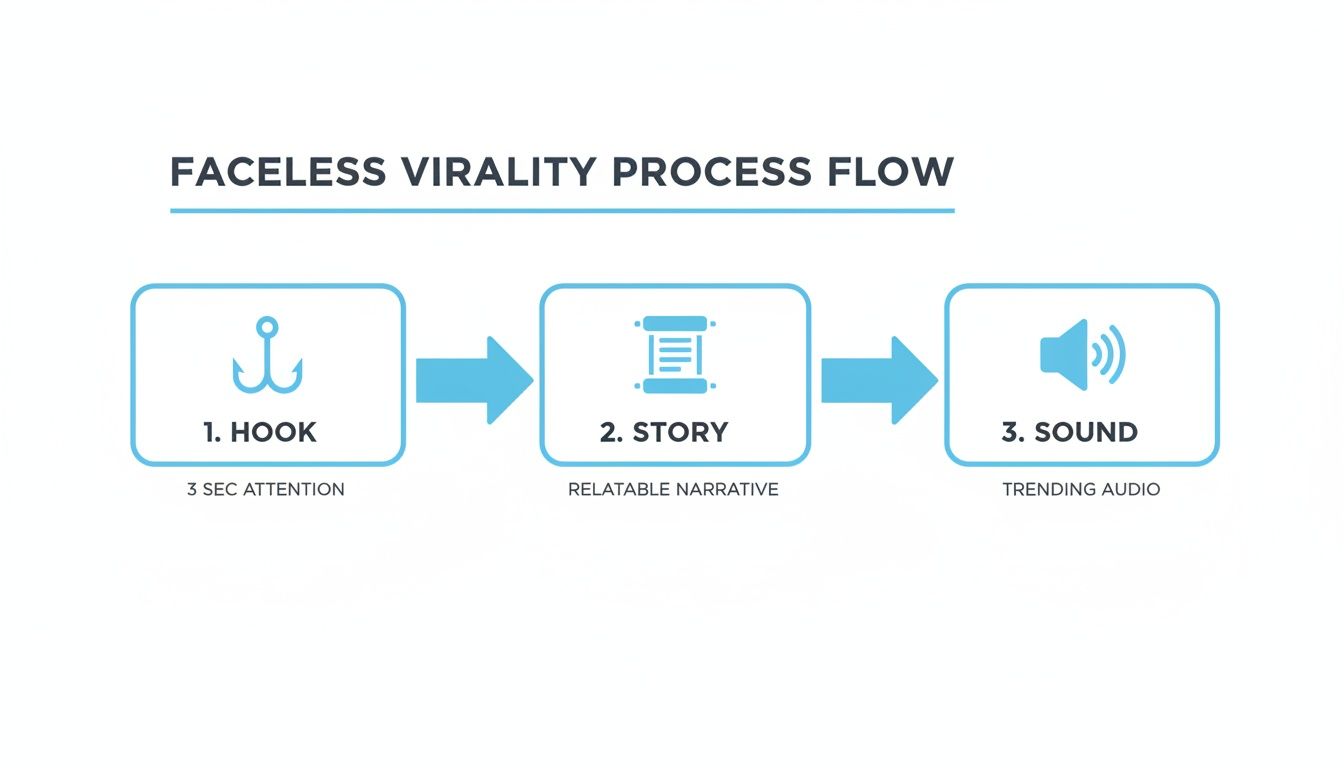
As you can see, the journey from a passive viewer to an active share starts with that instant hook. It then has to transition into a satisfying story, all held together by sound that makes it feel immersive.
Why Shorts Are Your Fastest Path to Virality
For any faceless channel trying to get off the ground, YouTube Shorts is the single fastest way to get traction. The algorithm is literally built for discovery, pushing content to new eyeballs far more aggressively than it does with long-form videos.
When you design your content specifically for the Shorts format, you get a few massive advantages:
- Lower Production Barrier: You can create high-impact Shorts with simple tools. The focus is on the story and the hook, not on complicated edits.
- Algorithm Favorability: YouTube is all-in on short-form video right now. That means the algorithm is often ready to reward good Shorts with a ton of reach.
- Rapid Testing Ground: You can throw ideas at the wall and see what sticks without sinking days into a single video. Test hooks, styles, and topics to find what your audience craves.
To help you keep these moving parts straight, here’s a quick-glance table breaking down the virality formula.
The Virality Formula At a Glance
| Component | Key Objective | Faceless Creator Tactic |
|---|---|---|
| The Hook | Stop the scroll in 3 seconds | Use a controversial statement, a bold text overlay, or an intriguing sound effect. |
| The Story | Deliver on the hook's promise | Tell a concise story with a clear beginning, middle, and end. Keep it punchy. |
| The Sound | Create an immersive experience | Use trending audio, layered sound effects, and a clear voiceover to drive the pace. |
This framework is your starting point. Master these three components, and you’ll have a repeatable process for creating content with viral potential.
Key Takeaway: Going viral as a faceless creator isn't about hiding. It's about amplifying your message with smart, psychological triggers that work perfectly without ever showing your face.
Of course, as your content starts to take off, it’s crucial to know how to protect it. Understanding the basics of protecting your intellectual property is a non-negotiable step to ensure your viral creations stay yours.
Crafting a Powerful Hook in the First Three Seconds
You have exactly three seconds to stop the scroll. That's it. In the firehose of content that is a user's feed, those first few moments are everything. It’s where you win or lose.
For faceless creators, this is even more critical. You don't have a charismatic smile or expressive face to build an instant connection. Your audio and visuals have to do all the heavy lifting to demand attention. The goal isn't just to be seen—it's to spark such intense curiosity that scrolling past feels like a mistake.
The Anatomy of a Scroll-Stopping Opener
So what makes a great hook? It's really just applied psychology. You need to hit a trigger—curiosity, shock, controversy, or a deep sense of relatability—that shatters a viewer's passive scrolling trance. Faceless content is perfect for this because it gets straight to the point without distraction.
Effective hooks usually fall into a few buckets:
- The Provocative Question: Kick things off by challenging a common belief. A simple text overlay asking, "Is your 9-to-5 secretly ruining your life?" forces an immediate moment of self-reflection. They have to stick around for the answer.
- The Bold Statement: Drop a controversial or totally unexpected declaration right at the start. Picture a simple screen recording of a spreadsheet while a voiceover says, "I quit my six-figure job to do this instead." The intrigue is instant.
- The Sensory Shock: This one is fun. Combine a weird sound with simple B-roll. Imagine a peaceful nature scene suddenly interrupted by a loud, cartoonish "bonk" sound effect as your text pops up. That pattern interrupt is often all it takes to make someone pause.
A quick look at what's currently trending on YouTube often reveals these same patterns. Top videos use questions, bold claims, or surprising visuals to lock in viewers from the very first frame.
Proven Hook Formulas for Faceless Videos
Theory is nice, but let's get practical. You don't need a massive budget for this. Simple stock clips, screen recordings, or even a static image can be ridiculously effective when you pair them with the right audio and text.
Let's break down a few formulas you can steal and adapt for your own niche right now.
A great hook doesn't give away the story. It opens a "curiosity gap"—the space between what someone knows and what they desperately want to know. Your video's job is to close that gap.
Here are a few hook structures that just flat-out work for faceless channels:
- "You've Been Doing [Common Task] Wrong": This one is a classic for a reason. It immediately frames you as the expert who holds a valuable secret. A cooking channel could show a 2-second clip of someone awkwardly chopping an onion with the text: "You've been chopping onions wrong your whole life."
- "This One [Tool/Habit/Fact] Changed Everything": This hook is all about promising a transformation. A finance channel might show a stock chart nose-diving while the voiceover declares, "This one mindset shift saved me from going completely broke."
- The "Before and After" Tease: This builds instant anticipation. Flash the stunning "after" result on screen for just one second—a perfectly organized room, a finished website—before cutting to the chaotic "before" shot where the video actually starts. Viewers will stick around just to see how you got there.
The trick is to front-load the value or the mystery. Give them an undeniable reason to invest their next 30-60 seconds with you. Master these hooks, and you've already won the most important battle for their attention.
Scripting Stories That Maximize Audience Retention
A killer hook gets you 3 seconds. A brilliant story gets you the whole video.
Getting viewers to watch until the end—and even hit replay—is the most powerful signal you can send the YouTube algorithm. It’s what separates a one-off view spike from a video that genuinely goes viral. For faceless creators, your script is everything. It has to be sharp, engaging, and paced to perfection.
A great short-form video isn't just a random assortment of clips. It's a full, satisfying story, even if it's crammed into 30 seconds. You need a clear beginning (the hook), a middle (where the tension builds), and an end (the payoff). Without that structure, viewers get bored and swipe away. The real skill is squeezing classic storytelling frameworks into the breakneck speed of YouTube Shorts.
This kind of visual storytelling, when paired with a tight script, is what keeps viewers absolutely glued to the screen.
The Problem-Agitate-Solve Framework for Shorts
One of the most powerful scripting formulas out there is Problem-Agitate-Solve (PAS). It's an old-school copywriting trick that feels like it was made for short-form video because it taps directly into human psychology. For faceless creators, this is your secret weapon.
Here’s how you can make it work in a 30-second format:
- Problem (Seconds 1-5): Hit them with the problem right away. Make it relatable. For instance: "You're trying to save money, but your grocery bill just keeps climbing."
- Agitate (Seconds 6-20): Now, pour some salt in the wound. Describe the frustration and make the problem feel even bigger. You could say: "You feel guilty every time you check out, and those 'budgeting' apps are just one more thing you have to manage."
- Solve (Seconds 21-30): Finally, deliver the sweet relief—the solution. This is the value bomb. "But what if you could slash your bill by 30% with one dead-simple shopping trick? Here's how..."
This structure creates a narrative arc that feels complete. It gives people a reason to stick around because they need to see the resolution.
Key Insight: A viral script doesn't just list facts; it takes the viewer on a mini emotional rollercoaster. The PAS model creates that journey in under a minute, building a powerful loop of tension and release that's hard to look away from.
Engineer Your Script for Re-Watches
The holy grail of YouTube Shorts is the "loop." When someone watches your video again, it screams "this is amazing" to the algorithm. You can actually engineer your scripts to make this happen.
A perfect loop is when the end of the video flows seamlessly back to the beginning, making the viewer question if it even ended.
For example, a video could end with a line like, "...and that's why you should never start your day this way," while the video starts with, "Is your morning routine secretly sabotaging your entire day?" The end directly tees up the beginning, making the loop feel natural and clever. This one little trick can send your audience retention through the roof.
For a deeper dive on this, check out our full guide on crafting a compelling YouTube video script.
Write for the Ear, Not the Eye
Remember, as a faceless creator, your voice is one of your main tools. That means your script needs to sound good when spoken, not just look good on paper.
Keep it simple and conversational. Ditch the complex sentences and jargon. A great acid test is to read your script out loud. If you trip over a phrase or it feels awkward, rewrite it until it flows naturally.
Your delivery is just as critical as the words themselves. Keep these tips in mind when scripting your voiceover:
- Use Punchy Language: Think short, impactful sentences.
- Vary Your Pace: Speed up to build excitement, then slow down to let a key point sink in.
- Embrace the Pause: A well-timed pause is your best friend. It builds suspense and gives the viewer a second to process what you just said.
Ultimately, your script is the backbone of your entire viral video strategy. It’s what turns a fleeting hook into a memorable story that people can't help but finish, re-watch, and share.
Unlocking Explosive Growth with YouTube Shorts
Forget long-form content for a minute. If you're launching a new faceless channel, YouTube Shorts isn't just another feature—it's your single biggest opportunity for growth.
Think of Shorts as a direct pipeline to the YouTube discovery algorithm. It's a space where a brilliant idea is rewarded with immediate, massive reach, and best of all, the algorithm doesn't care who you are.
For faceless creators, this is a total game-changer. You don't need a pre-existing brand or a charismatic personality on screen to get views. The Shorts feed is built for binge-watching, and the algorithm is constantly pushing new videos to fresh audiences to see what sticks. A single, well-made Short can pull in more views in 24 hours than a traditional video might get in an entire year.

And this isn't just a feeling; the numbers are staggering. Tapping into Shorts means you're competing in an arena with over 70-90 billion daily views globally. That figure has more than doubled since 2021. For a deeper dive into these numbers, you can discover additional insights about YouTube's viewership on Awisee.com.
Capitalizing On Trending Audio and Silent Viewing
Two of the most powerful levers you can pull to make your Shorts go viral are trending audio and designing for silent viewing. These aren't just minor tweaks; they're fundamental to how people consume content today.
Using trending audio is like sending a direct signal to the algorithm that your content is relevant right now. It gives your video an instant visibility boost by associating it with a proven, popular sound.
Pro Tip: Even if you're using a voiceover, you can still leverage trending sounds. Just add the popular audio track to your edit and drop its volume down to 1-5%. It'll be barely audible under your narration, but the algorithm will still pick it up and give you the associated discovery benefit.
At the same time, you have to assume a huge chunk of your audience is watching with the sound off. If your story only makes sense with audio, you're alienating a massive number of potential viewers.
This is where bold, animated text overlays become your secret weapon. They ensure your message lands, even in total silence.
- Choose a large, easy-to-read font.
- Animate the text to appear word-by-word, guiding the viewer's eye.
- Emphasize key words with different colors or font styles to add impact.
By optimizing for both sound-on and sound-off viewers, you make your content accessible to everyone, everywhere. To get this right, check out our complete guide on how to make viral YouTube Shorts.
Before you export, run through this quick checklist. Making sure these elements are in place can be the difference between a few hundred views and a few million.
Shorts Optimization Checklist
| Element | Best Practice | Impact on Virality |
|---|---|---|
| The Hook (First 3 Sec) | Strong visual or audio cue, bold text, or a provocative question. | High: Determines if a viewer swipes away. |
| Pacing & Edits | Quick cuts every 1-3 seconds, zooms, and motion graphics. | High: Maintains viewer attention and loop-watch potential. |
| Captions/Text Overlay | Large, animated, and easy-to-read text for silent viewing. | High: Massively increases accessibility and comprehension. |
| Trending Audio | Use a relevant, popular sound (even at low volume). | Medium: Signals relevance to the algorithm. |
| The Payoff | Deliver on the hook's promise with a satisfying conclusion. | High: Encourages likes, shares, and re-watches. |
| Call-to-Action (CTA) | A subtle prompt to "Follow for more" or ask a related question. | Medium: Drives subscriber growth and engagement signals. |
| Looping Potential | End the video in a way that seamlessly flows back to the beginning. | High: Increases watch time as viewers re-watch without realizing. |
Getting these details right consistently is how you build momentum. Every single element contributes to the algorithm's decision to push your content to a wider audience.
Finding Your Niche in the Shorts Gold Rush
The real beauty of creating faceless Shorts is just how many proven concepts are out there. Certain niches are perfectly suited for this format, letting you produce high-impact content without ever stepping in front of a camera. These styles work because they're visually engaging, information-rich, and easy to replicate.
Here are a few faceless niches that are absolutely crushing it right now:
- "Did You Know?" History Facts: Pair compelling stock footage or historical photos with a voiceover telling a little-known story from the past. The surprise factor makes these incredibly shareable.
- Psychology Hacks & Life Tips: This is as simple as it gets. Bold text on a clean background, a clear voiceover explaining a psychological trick, and you're done. The content is pure value.
- Finance & Tech Explainers: Use screen recordings and simple animations to break down complex topics like crypto or new AI tools. Viewers love content that makes them feel smarter in under 60 seconds.
- Mystery & Unsolved Stories: Combine eerie background music, old photos, and a storytelling voice to recap a famous unsolved case. This format is perfect for building suspense and hooking viewers until the very end.
Each of these niches plays directly to the strengths of the Shorts algorithm. They grab attention fast, deliver a quick payoff, and leave the viewer wanting to see what else you've got—which is exactly how you turn a viral Short into a loyal subscriber.
Using Smart Promotion to Trigger the Algorithm
Hitting "publish" feels like the finish line, but it's really the starting gun. The first few hours of your video's life are absolutely critical—they send a flood of signals to the YouTube algorithm, telling it whether your content is worth pushing to a wider audience.
As a faceless creator, you don't have a personal brand to drive those initial views. This makes the early promotion phase non-negotiable.
Your entire goal is to manufacture a burst of high-quality engagement right out of the gate. This initial velocity, which is just a mix of views, watch time, likes, and comments, tells YouTube that you’ve made something people actually want to see. This is how you kickstart the algorithm and get it to do the heavy lifting for you.
Titles and Thumbnails That Demand a Click
Before anyone can even watch your video, they have to click. Your title and thumbnail are your entire sales pitch. For faceless creators, they need to work overtime to spark curiosity without ever showing a human face.
A viral title doesn't just describe what the video is about; it creates an information gap. It teases a result, asks a shocking question, or makes a bold claim that people feel an almost physical need to investigate.
Here are a few title frameworks that just flat-out work:
- The Transformation: "How I Turned a Simple Spreadsheet into a $10,000/Month Business"
- The Counterintuitive Secret: "Why 'Working Harder' Is Keeping You Broke"
- The Specific Outcome: "This 5-Minute Habit Doubled My Productivity"
You need to pair these with a thumbnail that is simple, bold, and high-contrast. Use huge text to hammer home the title's core idea. If your video is about a "secret," use a visual metaphor like a keyhole or a locked box. A great thumbnail has to be understandable in a split second.
Key Takeaway: Your title and thumbnail aren't an afterthought; they are the single most critical part of your promotion. A phenomenal video with a weak title and thumbnail will go nowhere. Master the art of curiosity, and you’ll win the click every time.
Find Your Audience Where They Already Gather
The fastest way to get your video in front of the right eyeballs is to go where they already hang out. Don't just publish and pray. You need to strategically share your content in niche communities that are already obsessed with your topic.
Think way beyond just posting on your own social media. Your ideal viewers are having active discussions about your content on platforms like Reddit, Discord, and niche Facebook Groups right now. The trick is to add value, not just spam links.
Before you share anything, lurk for a bit. Spend time in these communities. Get a feel for their rules and inside jokes. Jump into discussions and answer a few questions. When you finally share your video, frame it as a helpful solution to a common problem or an interesting take on a conversation that's already happening.
- Reddit: Find a relevant subreddit (like r/personalfinance for a budgeting video). Don't just drop a link. Write a genuinely useful post summarizing the key takeaway, and then link to your video for anyone who wants the full breakdown.
- Discord: Join servers related to your niche. Most of them have a dedicated "self-promotion" channel where you can share your work.
- Facebook Groups: Look for active, engaged groups. Share your video with a question to get a conversation going, like, "I made a quick Short on this topic—what’s the one tip you would add?"
This targeted approach guarantees your initial views are from a highly engaged audience, which sends all the right signals to the algorithm. For a deeper look, check out our complete guide on the fundamentals of how do you make a video go viral.
Sparking the Engagement Fire Immediately
Once people start showing up, you need to get them talking. Comments, especially, are a massive signal to YouTube. A lively comment section tells the algorithm that your video is sparking a conversation—a key ingredient for virality.
One of the easiest and most powerful things you can do is to pin a thought-provoking comment yourself. The second you publish, post a comment that asks a controversial or open-ended question about your video's topic.
For example, if your Short is about a productivity hack, you could pin a comment like: "What’s one 'common sense' productivity tip you think is a complete waste of time? I’ll go first: the Pomodoro Technique."
This does two things beautifully:
- It gives the very first viewers an immediate and easy way to engage.
- It kickstarts a debate, generating replies and creating a vibrant discussion from the get-go.
While we're focused on organic growth, it's worth understanding the broader principles behind strategies to improve engagement, as they often reveal a lot about human psychology. Ultimately, every single comment, like, and share in those first few hours builds the momentum that can launch your video into the stratosphere.
Answering Your Biggest Questions About Going Viral
Even with a perfect plan, trying to go viral brings up a lot of questions. It's totally normal to wonder about the nitty-gritty details, like what "viral" even means anymore or if a tiny channel can really compete with the big dogs.
Let's clear the air and tackle those nagging questions head-on.
How Many Views Is Actually Viral?
There’s no magic number here. The goalposts have shifted over the years. A decade ago, a million views was the undisputed king. Today, it’s more about context.
A video is viral when it grows explosively in a short time—think days, not weeks. For a brand new channel, hitting 100,000 views in a weekend is a massive viral win. For a creator with millions of subs, the benchmark might be closer to 5 million views.
The real sign of virality isn't a specific view count; it's the velocity of its growth. It's about how fast the shares are piling up compared to your channel's usual performance.
Stop obsessing over a specific number. You'll know you've struck gold when the views are coming in faster than you can refresh the page.
Can a Small or New Channel Really Go Viral?
Absolutely. In fact, YouTube Shorts has leveled the playing field like never before. The algorithm couldn't care less if you have ten subscribers or ten million—its only job is to find a video that keeps a viewer watching.
Some of the biggest viral sensations have come from channels that were completely unknown just days before. A single video can catch fire simply because it’s relatable, hilarious, or hits an emotional nerve.
Here’s why small channels have a real shot:
- The Algorithm Plays No Favorites: It rewards watch time and retention, not your subscriber count. Good content wins, period.
- Fresh Ideas Cut Through the Noise: New creators aren't stuck in a rut. You bring new angles that feel fresh and exciting.
- Authenticity Wins: A video from a smaller, faceless channel can feel more genuine and personal, creating a much stronger connection with the audience.
Your channel's size isn't a handicap. A powerful idea, packaged correctly, can launch any creator into the spotlight.
How Often Should I Post to Go Viral?
Let’s get one thing straight: consistency crushes frequency.
Sure, posting more videos technically gives you more lottery tickets. But burning out to push a mediocre video every single day is a surefire way to fail. The algorithm rewards a predictable rhythm. It learns when to expect your content, and so does your audience.
Here are a few schedules that actually work:
- High-Frequency (Shorts): If you're all-in on Shorts, aim for 3-5 per week. This is perfect for rapid-fire testing of hooks, topics, and styles to see what sticks.
- The Balanced Approach: Post 1-2 high-quality Shorts per week and one longer video every one or two weeks to build a deeper connection.
- Quality First: Focus on one flawlessly produced video per week. Make every single second count.
Pick a schedule you can actually stick to without letting the quality slip. One amazing video a week will always outperform seven “meh” ones.
Do Viral Videos Actually Lead to Long-Term Growth?
A viral video can feel like a lottery win, but it doesn't guarantee a successful channel. That sudden traffic spike is great, but what you do next is what truly matters.
If your viral hit is a complete one-off that has nothing to do with your niche (like a random funny cat video on your finance channel), those new viewers won't stick around. They came for the cat, not for your stock tips.
Here’s how to turn a viral moment into a real audience:
- Have a Content Backlog: Make sure you have at least 3-5 other videos on your channel that are similar to your viral hit. Give new viewers a reason to binge.
- Engage Like Crazy: Live in the comments section of that viral video. Welcome people, answer questions, and show them there's a real person behind the account.
- Double Down on What Worked: Figure out why it went viral. Was it the hook? The editing? The topic? Replicate those winning elements immediately in your next videos.
A viral video is just an opportunity. It’s a huge door opening. It's your job to have a system ready to welcome people in and convince them to stay.
Ready to stop guessing and start creating? ClipShort gives you the AI-powered tools to produce high-quality, faceless videos at scale. From automated scripting to lifelike voiceovers and viral caption styles, you can create scroll-stopping content in minutes, not hours. Join thousands of creators who are already growing their channels faster than ever. Start creating with ClipShort today!