
How to Get Viral on TikTok: A Practical Guide to Explosive Growth
Let's be real: going viral on TikTok isn't just about luck. It's a science. There's a core formula at play, and it all boils down to three things: hooking viewers within the first three seconds, creating content that glues their eyes to the screen, and giving them a reason to like, comment, or share.
Forget just throwing content at the wall and hoping something sticks. That's a recipe for burnout.
The Real Blueprint for Going Viral on TikTok
So many creators feel like they’re just guessing. But the people who consistently hit the "For You" page aren't guessing—they're executing a deliberate playbook. They treat virality as an engineered outcome, not a happy accident. This guide is that playbook, broken down into tactics you can use today.
Think of every video you post as a mini-mission. Your job is to stop someone's thumb mid-scroll, deliver a quick hit of value or entertainment, and then convince them to interact. It’s far more strategic than just jumping on whatever trend is hot this week.
Understanding the Core Components
Before we get into the nitty-gritty techniques, you have to understand the building blocks of any video that performs well. These pieces work together to tell both the viewer and the algorithm that your content is worth pushing out to a massive audience.
A successful video almost always nails these four things:
- A Scroll-Stopping Hook: An instant visual or line of dialogue that makes people curious.
- High-Retention Storytelling: Content that keeps people watching until the very end.
- A Clear Call-to-Action (CTA): A simple prompt telling people what to do next.
- Strategic Sound & Trend Use: Tapping into what's currently buzzing on the platform.
When you master these, you stop hoping and start creating with intention.
The real magic of TikTok is its explosive engagement potential. When a video hits, it really hits, creating a feedback loop of views and interactions that you just don't see on other platforms.
The numbers don't lie. Recent surveys show TikTok's engagement rate sits around 17.96% per post. Compare that to Instagram's 3.86%, and you can see why this platform is such a powerhouse for growth. Consistent, hook-driven content is the key. You can find more of these eye-opening TikTok statistics and what they mean for creators.
To really lock this in, here’s a simple breakdown of what a viral video looks like from the inside.
The Anatomy of a Viral TikTok Video
This table gives you a clear mental model for structuring your content. We'll dive deep into each component, but for now, just understand how these pieces fit together to create a powerful, repeatable framework.
| Component | Purpose | Example Tactic |
|---|---|---|
| The Hook (0-3s) | To stop the user from scrolling and secure their attention | "You're making your coffee all wrong." |
| The Body (3-15s+) | To deliver value and maintain viewer retention | A quick visual tutorial showing a better method |
| The Payoff/CTA | To inspire engagement and create a shareable moment | "Try this tomorrow and tell me what you think." |
As we move through this guide, we’ll break down each of these components with practical examples and step-by-step instructions. By the end, you'll have everything you need to build your own viral videos.
Mastering the First Three Seconds to Stop the Scroll
 Let's be brutally honest. You don't get a second chance to make a first impression on TikTok. You get about three seconds, if you're lucky. That’s the unforgiving reality of the "For You" page, where a user's thumb is perpetually ready to swipe you into oblivion.
Getting these first few moments right isn't just a good idea; it's the single most important variable in your video's fate. Your hook is the gatekeeper. If it fails, the rest of your masterpiece dies a quiet death, buried by the algorithm.
A powerful hook shatters the hypnotic rhythm of endless scrolling. It’s a pattern interrupt—a promise that what’s coming next is worth a few more seconds of their time.
The Psychology of a Powerful Hook
So what makes a hook work? It all comes down to creating an immediate curiosity gap. You open a loop in the viewer's brain by posing a question, highlighting a problem, or showing something completely unexpected. Their brain needs to close that loop, and the only way to do it is to keep watching.
Think about it from their side. They're scrolling for a quick hit of dopamine—something funny, surprising, or genuinely useful. Your opening has to scream, "I've got what you're looking for!" This is precisely why a lazy intro like "Hey guys, in this video..." is a death sentence on TikTok.
Zach King is a master of this. His 'Magic Ride' video, which has racked up a mind-boggling 2.3 billion views, starts with an immediate, reality-bending visual. There's no intro, no explanation—just a hook that makes you question what you just saw. That high-retention hook, combined with his seamless editing and relatable humor, is an algorithm's dream. You can learn more about the mechanics of viral hits in this deep dive into TikTok statistics.
Proven Hook Formulas You Can Steal
You don't have to reinvent the wheel. The best creators rely on a toolkit of battle-tested hook formulas that consistently stop the scroll. Here are a few you can start using today.
The Problem & Agitation Hook
This one's a classic. You call out a specific pain point your audience deals with and then twist the knife just a little. It creates that instant feeling of, "Yes! They get me."
- Example: "Stop making these three mistakes when you're editing your videos." The problem is bad editing; the agitation is the implication they're making common, amateurish mistakes.
- Try This: Start with on-screen text that says, "Your videos are boring." Then say, "If your watch time plummets after 5 seconds, it's probably because of this one thing."
The Unexpected Visual Hook
This is all about showing, not telling. Kick off your video with something so strange, satisfying, or shocking that people feel compelled to see what happens next.
- Example: A video that opens with someone dropping a giant watermelon off a three-story building. You have to see the splash.
- Try This: No dialogue needed. Just show a perfectly organized drawer getting completely dumped onto the floor. The chaos is the hook.
The Controversial Statement Hook
This one grabs attention by challenging a common belief in your niche. You're not trying to be offensive, just bold. It sparks debate and makes people want to hear your reasoning.
- Example: "Cardio is actually making you gain weight. Here's why."
- Try This: "Everyone says you need 8 hours of sleep, but they’re wrong. Here’s the truth."
A hook isn't just the first line you say. It's the entire vibe of the first three seconds—the music choice, the on-screen text, your facial expression, and the visual chaos (or calm) all working together to create an irresistible package.
By moving from just hoping for attention to strategically engineering it with these formulas, you change the game. Test them out, check your analytics, and see what your audience responds to. This is the first and most critical step in learning how to get viral on TikTok.
Riding the Wave of TikTok Trends and Sounds
If a great hook opens the door, a trending sound is the VIP pass to the For You page. On TikTok, audio is everything—it's the lifeblood of the culture. Using a trend isn't just about copying a dance; it's a strategic signal to the algorithm, telling it exactly who your content is for and why it’s hot right now.
Think of every trend as a ready-made community. When you hop on a popular sound or format, you're joining a conversation that millions are already part of. The algorithm sees this, gets the context instantly, and fast-tracks your video to a super-receptive audience.
The right sound can be explosive. Take 'Gata Only' by FloyyMenor and Cris Mj. That wasn't just a song, it was a movement. It sparked over 50 million videos, which racked up 1.3 billion Spotify streams and became TikTok's global Top Song. It’s a perfect example of how the right audio can be a shortcut to massive visibility. You can dig deeper into what’s currently shaping the platform by reviewing TikTok's official 2024 insights.
How to Find Trends Before They Peak
The secret is to catch trends on the way up, not when they're already oversaturated. If you're too late, your video will just drown in a sea of lookalikes. You want to be a trend spotter, not a trend follower.
First, start treating your For You page like a research lab. Don't just mindlessly scroll—analyze. If you hear the same sound pop up three or four times in a single session, that’s your cue. Tap the sound and look at how many videos have used it. If the count is under 10,000, you’re likely early enough to make a real splash.
Next, get familiar with TikTok's Creative Center. This free tool is an absolute goldmine for data on what’s gaining steam. You can filter by region and see what’s blowing up:
- Sounds: Spot breakout tracks and see their growth curve over the last week.
- Hashtags: Find the challenges and conversations that are picking up speed.
- Videos: See what the top creators in your niche are doing that's actually working.
Just 15 minutes a day of this kind of active research will give you a powerful sixth sense for what's about to take off.
Making Trends Work for Your Niche
Using a trend doesn’t mean you have to ditch your content strategy. Actually, the best trend videos are the ones that cleverly adapt a popular format to a specific niche. The goal is to feel timely, not cheesy.
Let's say a finance creator sees a trending sound where people point to text bubbles revealing secrets. The lazy move is to ignore it. The smart move? Use the exact same sound and format but remix the message for their audience.
The Original Trend:
- Text Bubble 1: "I pretend to like hiking."
- Text Bubble 2: "I actually hate camping."
The Finance Expert's Version:
- Text Bubble 1: "You think a 401k is enough for retirement."
- Text Bubble 2: "You're forgetting about healthcare costs and inflation."
This is the magic formula. You borrow the trend's momentum but deliver value that’s authentic to your brand. The format is instantly recognizable, but the content is fresh, useful, and tailored to your audience.
This creative twist is how you leverage trends without selling out your brand. It shows you get the platform's culture while still cementing your authority. Sometimes, just using a trending sound as background music for a quick tutorial is enough to give the algorithm the hint it needs.
Another pro move is to layer your own voice over the trending audio. For anyone looking to master this, we have a complete guide on how to add a voiceover on TikTok. It’s a killer technique for getting the best of both worlds: the reach of a trend and the authority of your own expertise.
Editing Techniques for Maximum Retention and Rewatches
You did it. You hooked a viewer in the first three seconds. Honestly, that's the hardest part, so give yourself a pat on the back. But now the real work begins: keeping them glued to their screen all the way to the end. This is where your editing strategy separates a forgotten video from a viral hit.
A great hook buys you their attention, but masterful editing earns you their time. The TikTok algorithm is obsessed with two key metrics: watch time and completion rate. When people finish your entire video, it sends a powerful signal to the algorithm that your content is high-quality, prompting it to push it out to an even bigger audience.
Your mission is to make the viewing experience so compelling that swiping away isn't even an option. We'll do this by blending rapid pacing, visual variety, and some smart text tactics. Getting a grip on video editing for social media with viral-ready techniques is non-negotiable if you want to turn casual scrollers into actual fans.
Engineering High Retention with Pacing and Pattern Interrupts
The modern attention span is short. On TikTok, it's even shorter. Your editing needs to be relentlessly dynamic to keep up. Forget long, static shots—they're the enemy of retention. The secret weapon here is the pattern interrupt, which is just a fancy way of saying you need to introduce a new visual or sound every 2-3 seconds.
This doesn't mean your video has to be a chaotic mess. It just needs to constantly give the viewer's brain something new to latch onto. Think of it as a series of mini-hooks sprinkled throughout your video.
Here are a few powerful pattern interrupts to start using immediately:
- Quick Cuts: Abruptly change the camera angle or jump-cut to a different part of a clip. This is standard fare for vloggers because it cuts out dead air and keeps the energy high.
- Zoom Effects: A subtle zoom-in on your face when you make a key point or a quick zoom-out to show a reaction adds much-needed movement.
- Sound Effects: You'd be amazed what a simple "swoosh," "pop," or "ding" can do. It breaks the monotony and highlights a specific moment or visual.
- B-Roll Footage: Don't just talk about something—show it. If you mention "coffee," flash a two-second clip of a steaming mug over your main video.
These small tweaks force the viewer's brain to stay actively engaged, making it much harder for them to get bored and swipe away. It’s an incredibly simple way to pump up your average watch time.
The Undeniable Power of On-Screen Captions
In a world of silent auto-play on public transport or in quiet offices, captions are no longer a nice-to-have. They're a core retention tool. A massive number of people watch videos with the sound off. If you don't have captions, you're immediately losing a huge slice of your potential audience.
But just throwing a transcription on the screen isn't enough. The style of your captions can make or break viewer engagement.
Animated, word-by-word captions—often called "karaoke style"—are one of the most powerful retention hacks on TikTok. They guide the viewer's eyes, control the flow of information, and make your content feel way more dynamic and professional.
This technique essentially forces viewers to read along, keeping them locked in until the very last word. Static text can do the job, but dynamic captions that pop, slide, or change color are far more effective at commanding attention. Tools like ClipShort are built to automate this, letting you create slick, high-engagement captions in minutes. And don't forget formatting—you can dig into our guide to understand what is the TikTok aspect ratio to make sure everything looks perfect on screen.
Caption Style Impact on Viewer Retention
Not all captions are created equal. The style you choose should match your content's vibe and goal. This table breaks down the different approaches to help you decide what works best for your next video.
| Caption Style | Best For | Potential Retention Uplift | ClipShort Feature |
|---|---|---|---|
| Static Block Text | Simple tutorials, quick tips, and informational content where clarity comes first. | Low to Moderate | Basic Subtitle Generator |
| Dynamic Word-by-Word | Storytelling, commentary, and any content where pacing and emphasis are crucial. | High | Animated "Karaoke" Templates |
| Color-Highlighted Keywords | Educational content where you need to draw attention to specific terms or takeaways. | Moderate to High | Customizable Caption Styles |
| Emoji-Enhanced Text | Comedic, lighthearted, and trend-based content where personality and emotion are key. | Moderate | Emoji Overlay Integration |
When you combine fast-paced editing with strategic, eye-catching captions, you're delivering a powerful one-two punch that keeps viewers watching. This screams "high-value content" to the algorithm, which is exactly what you need to go viral.
Decoding Your Analytics to Engineer Virality
Posting content and not checking your analytics is like driving with your eyes closed. You might get somewhere eventually, but it’s probably not where you intended to go. If you're serious about going viral on TikTok, you have to stop thinking like a creator and start thinking like a data-driven strategist.
That analytics dashboard isn't just a report card. It's a treasure map showing you exactly what your audience is hungry for.
Don't get lost in a sea of numbers. Instead, learn to read the story the data is telling you. A video with huge views but a rock-bottom average watch time is actually great news. It means your hook is incredible, but the rest of the video didn't deliver on the promise. Your job is to fix the middle, not the beginning.
On the flip side, what about a video with modest views but tons of shares? That's a goldmine. It tells you the content connected on a deep, emotional level. You’ve clearly struck a chord, and your next move should be to double down on that exact theme or format.
Key Metrics That Actually Matter
Forget vanity metrics like your follower count. The numbers that really drive virality are all about engagement and retention. These are what tell the algorithm your content is worth pushing to millions. To really sharpen your strategy, you have to know how to effectively measure social media engagement beyond just the surface-level stuff.
Here are the data points you need to live and breathe:
- Average Watch Time: This is the big one. A high average watch time tells TikTok your content is holding attention, which is the platform's number one goal.
- Full Video Watches: The percentage of people who stuck around for the entire video. A high completion rate is a massive signal that you've created quality content.
- Shares: When someone shares your video, they're putting their own reputation on the line to vouch for it. It's a powerful indicator that your content is either incredibly valuable or deeply relatable.
- Comments: Comments mean your video was compelling enough to spark a conversation. This is active, high-quality engagement.
Digging into these metrics takes the guesswork out of content creation. You can start making smart decisions, essentially reverse-engineering your own success based on what's already proven to work. For a deeper dive into this, check out our guide on what makes a video go viral.
Creating Your Weekly Analytics Workflow
Reviewing your analytics can't be a random thing you do when you feel like it. You need a system. A simple, repeatable weekly habit is all it takes to spot patterns and pivot your strategy on the fly.
Just set aside 30 minutes each week for this quick workflow:
- Find Your Winner: Jump into your analytics and find the video with the highest average watch time from the past seven days. Don't get distracted by views; retention is king.
- Break It Down: Why did it work? Was it the hook, the editing, the topic, the sound? Jot down 2-3 specific elements that you think made it successful.
- Find Your Loser: Now, do the opposite. Find the video with the lowest average watch time and be brutally honest. Was the hook weak? Was the pacing a snoozefest?
- Create an Action Plan: Based on what you found, create one simple hypothesis to test for the next week. For example: "My top video used quick cuts every two seconds. I will apply this style to my next three videos and see if watch time increases."
This simple feedback loop—Post, Analyze, Iterate—is the engine that powers viral growth. It turns every single video, good or bad, into a valuable lesson that gets you one step closer to your next massive hit.
Think of it like this simple decision tree. If viewers are dropping off, your first job is to fix the edit to make it more dynamic. If they're sticking around, you can focus on enhancing the experience with things like captions.
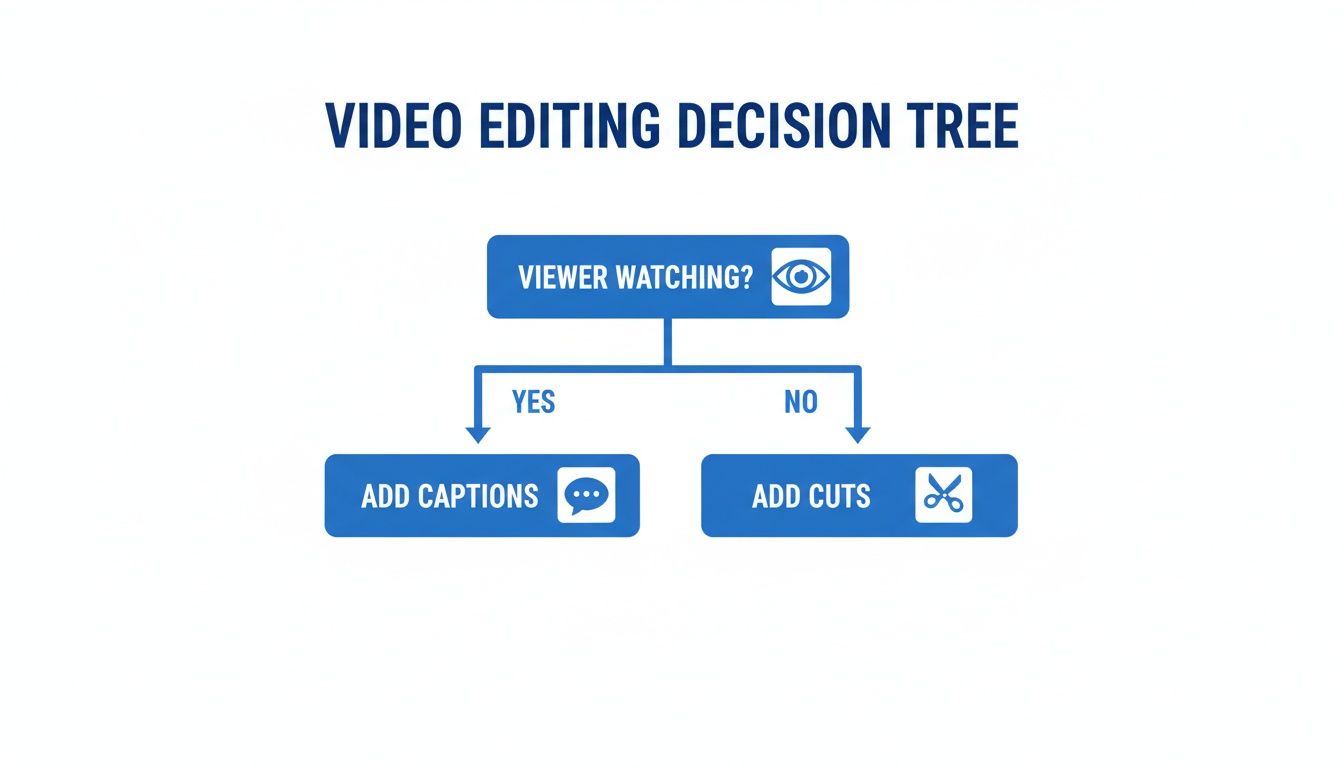
This just reinforces the core idea: when retention is low, you have a structural problem. Fix the pacing and cuts before worrying about anything else. Mastering this transforms you from a simple content creator into a growth engineer who is systematically building a path to virality.
A Few Common Questions About Going Viral
Alright, you've got the core playbook down—hooks, trends, editing, analytics. But I know there are still those nagging questions that pop up when you're in the trenches, trying to make it happen. Let's tackle some of the most frequent ones I hear.
Think of this as the final tuning. Getting these small details right is often what separates a video that gets a few hundred views from one that rockets onto millions of For You Pages.
How Many Times a Day Should I Post on TikTok to Go Viral?
This is probably the most asked question, and the answer isn't what most people expect. It’s not about a magic number. Consistency will always trump sheer frequency.
Sure, you'll see massive creators posting 1-3 times every single day, but they have teams. For most of us, the real goal is to find a rhythm you can stick to without your quality nose-diving. The algorithm rewards a steady stream of content because it gives it more data on you and your audience.
Honestly, posting two killer, high-retention videos a week is a million times better than posting five rushed, sloppy ones. Your mission is to consistently deliver value, not just to check a box. Find a cadence you won’t burn out on and make every post count.
Does Deleting a TikTok Video Hurt Your Account?
It’s so tempting, right? You post a video, it flops, and your first instinct is to scrub it from existence. Don’t do it.
The smarter play here is to set the video to 'Private'. This pulls it from public view, but crucially, it keeps the data intact. That data is a lesson—both for you and for the algorithm.
A single underperforming video won't sink your channel. It's just a data point in a very large set. Deleting videos messes with the learning process and robs you of the chance to figure out what went wrong.
Instead of hitting delete, get analytical. Why did it fail? Was the hook weak? Was the pacing off? Did the audio choice not land? Use your duds as free R&D for your next winner.
Can You Go Viral on TikTok Without Showing Your Face?
Absolutely, one hundred percent yes. "Faceless" content is a huge, thriving universe on TikTok. Your success is built on the exact same foundation we've been talking about: a magnetic hook, a great story, and insane retention. Virality cares about engagement, not your face.
In fact, some of the biggest trends are faceless:
- Oddly satisfying clips of things like cooking, power washing, or crafting.
- Compelling stories narrated over stock footage or even video game clips.
- Animated text explainers that break down a complex idea.
- Weirdly aesthetic videos made with AI-generated visuals.
As long as you create something visually interesting that makes people feel something, they won't care who's behind the account. The content is the star.
How Long Does It Take for a TikTok to Go Viral?
There's no countdown clock for virality. A video can blow up in an hour, or it can be a "slow burn," smoldering for days or weeks before catching fire.
Here's how it works: the algorithm first shows your video to a small test audience. If that group bites—watching all the way through, sharing, commenting—it pushes it out to a bigger circle. This repeats, and if you keep getting strong signals, you get that snowball effect.
Your job is to post when your audience is most active and use the right hashtags to give the algorithm a hint. After that? Let it go. Move on to the next video. Obsessing over the view count in the first hour will drive you nuts. Sometimes, the algorithm just needs a little time to find the perfect crowd for your work.
Ready to build a faceless content empire? ClipShort is the AI engine designed to automate the hard parts. It can take you from a simple idea to a finished, viral-ready video with animated captions and a human-like voiceover in just minutes. Stop spending hours editing and start scaling.