
How to Make Viral YouTube Videos That Actually Work
Ever feel like making a viral YouTube video is just a game of chance? It's not. For creators who consistently hit big numbers, it's a repeatable system, not a lottery ticket.
The whole formula boils down to three core parts: a killer idea, a video structure that glues eyeballs to the screen, and a smart promotion plan to get the ball rolling. Nail these, and you can start engineering content that the algorithm practically begs to push.
The Real Blueprint for Going Viral on YouTube
The dream of "going viral" feels like catching lightning in a bottle, but I've learned it's far more science than luck. The modern blueprint for making a viral video isn't about one-off hits; it’s about building a reliable system.
You have to understand what makes people actually share something. It's rarely just about being entertaining. It’s about triggering a strong emotion, being intensely relatable, or showing people something they've genuinely never seen before.
Think of it as a simple, three-stage workflow.
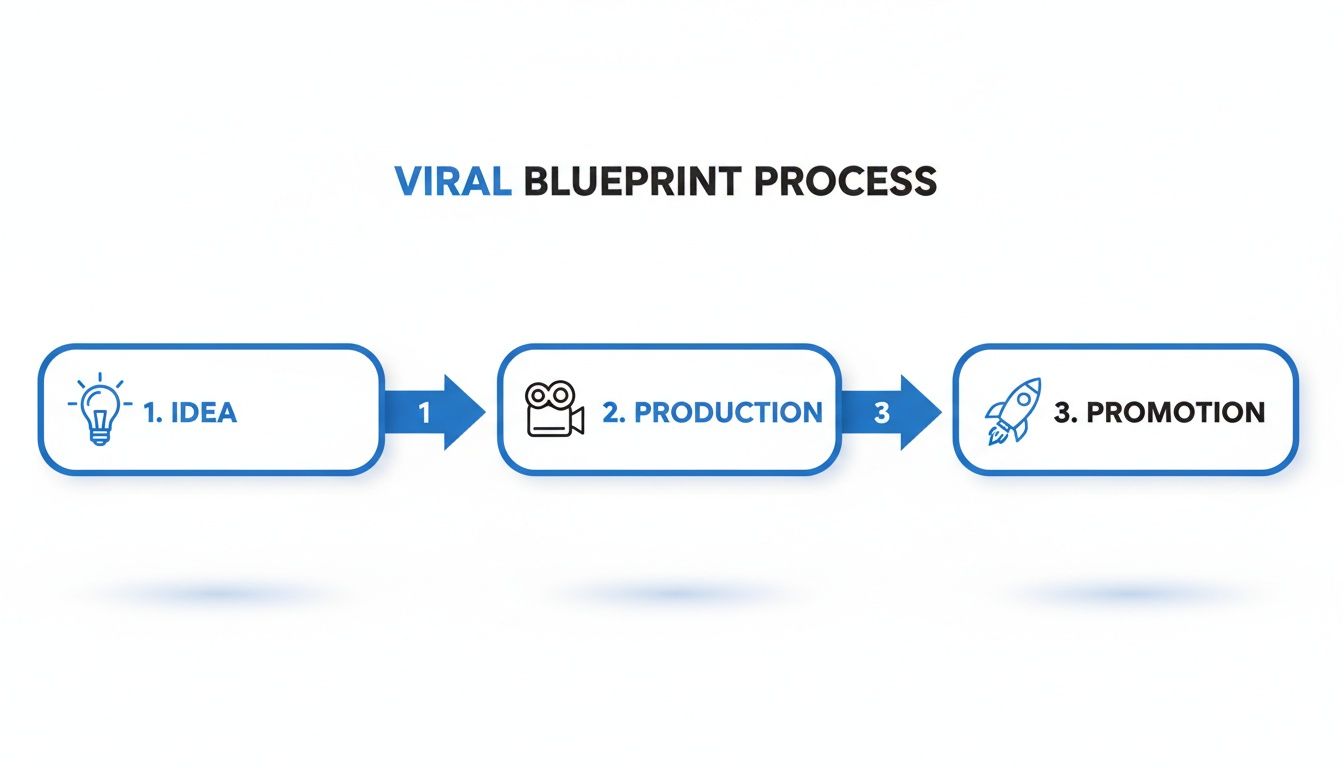
Each step—Idea, Production, Promotion—builds on the last. A great idea is completely wasted without solid execution, and a brilliantly produced video will die a quiet death without a smart promotional push. They all have to work together.
The Modern Viral Landscape Has Changed
In today's content world, short-form video is the undisputed king of growth. You can't ignore it.
Platforms like YouTube Shorts have totally rewired how audiences find new creators. The scale is just staggering—YouTube Shorts now pulls in over 70 billion daily views. That's not a number you can afford to overlook in your strategy.
This means your approach needs to be twofold. You create your compelling, long-form videos, but you use Shorts as a powerful funnel to drive fresh new viewers back to your main channel. The core principles of what makes a video go viral are the same for both, but the way you execute them is different.
Virality isn't just about total views; it’s about velocity. Getting a massive surge of views, likes, and shares in the first 24-48 hours sends a screaming-loud signal to the YouTube algorithm that this is something people need to see.
The Three Pillars of a Viral YouTube Video
To break this down further, I've found it's best to focus your energy on three key areas. Think of them as the legs of a stool—if one is weak, the whole thing topples over.
This table provides a quick look at the three pillars that form the foundation of any viral YouTube video. Each one plays a distinct, crucial role in the process.
| Pillar | Core Function | Key Action |
|---|---|---|
| High-Potential Idea | Captures interest before the click. | Find a topic with a built-in audience and high shareability. |
| Retention-Focused Production | Holds attention from start to finish. | Script and edit your video to maximize every second of watch time. |
| Strategic Packaging & Promotion | Drives the initial click and momentum. | Craft irresistible thumbnails and titles, then push the video out. |
By mastering the key action for each pillar, you create a complete system that gives your content its best shot at taking off.
While this guide is all about YouTube, these foundational ideas apply pretty much everywhere. If you want to zoom out, you can explore more general strategies for creating viral content for a broader perspective.
Now, let's dive deep into each of these pillars and break them down into actionable steps you can start using today.
Finding and Validating Your Next Viral Idea
Every viral video starts with a spark—an idea that has the potential to connect with millions. But here’s the thing: the best ideas are rarely pulled out of thin air. They’re discovered, refined, and validated through a specific process.
The goal is to stop guessing what might work and start building on concepts with a built-in audience. Too many creators make what they want to see, but viral content is all about what a massive audience wants to share.
This means you need to shift your mindset. You're not just a creator; you're part trend-spotter, part data analyst, always looking for the right wave to ride.
Tapping into Trending Topics
Your first stop for high-potential ideas should be the platforms where trends are born and bred. Viral videos almost always tap into a current conversation or a rising tide of interest. The trick is to spot these trends before they get completely oversaturated.
Here are the best places to look for that initial spark:
- YouTube Search Predictions: Just start typing a topic in your niche into the YouTube search bar. The autocomplete suggestions are a direct line into what real people are searching for right now.
- TikTok and Instagram Reels: These platforms are trend incubators. Pay close attention to recurring sounds, challenges, or video formats popping up in your niche. A rising trend on TikTok is often a sign of what will blow up on YouTube Shorts next week.
- Google Trends: This tool is a goldmine for spotting rising interest over time. You can compare different topics to see which has more search momentum and even find breakout search terms that signal a brand new trend is taking off.
- Reddit Communities: Find subreddits related to your niche (like r/gadgets or r/personalfinance). Look for the posts with a ton of upvotes and comments. These threads reveal the exact questions, pain points, and curiosities of a super-engaged audience.
The strategy here isn't to just copy what's popular. It’s about using these trends as a launchpad and asking, "What's my unique angle on this?"
The Art of the Unique Angle
Once you’ve spotted a rising trend, you need to apply what I call the 'Trend-Tapping' technique. This is all about taking a popular subject and filtering it through your unique perspective, format, or niche. Just rehashing what someone else did won't get you anywhere.
Let's say "AI Tools" are trending. Instead of another generic "Top 5 AI Tools" video, you could spin it with a unique angle:
- Format Twist: "I Replaced My Entire Workflow with AI for 24 Hours"
- Niche-Specific: "How a Freelance Writer Can 10x Their Output with AI"
- Counter-Narrative: "The AI Tools Everyone Loves That I Actually Hate"
The most powerful ideas live at the intersection of what is currently popular and what is uniquely you. This combination is what makes a video feel both relevant and fresh, giving it the best chance to stand out.
Before you even think about production, you have to know if there's an actual audience for your concept. You need to master product-market fit validation to make sure your ideas will connect. This principle is just as critical for content as it is for products.
Your Practical Idea Validation Checklist
Not every idea is a winner. Running your concepts through a quick validation checklist can save you hours of wasted effort on videos that were doomed from the start.
Before you ever hit record, ask yourself these simple but critical questions:
- Does it spark a strong emotion? Viral content makes people feel something intense—curiosity, awe, humor, shock, or inspiration. If your idea is purely informational and emotionally flat, its chances are slim.
- Is the thumbnail concept obvious? Can you instantly picture a simple, compelling thumbnail that tells a story? If you can't visualize a click-worthy thumbnail, the idea might be too complex or just plain boring.
- Can you explain it in one sentence? Could you pitch the video to a friend in a single, exciting sentence? If it takes a whole paragraph to explain, it’s not going to grab anyone's attention.
- Who is the second audience? Your subscribers are your first audience. But who will they share it with? A viral video needs to be so good that viewers send it to friends, family, or coworkers who might know nothing about your channel.
- Does it have a clear 'payoff'? Your title and thumbnail make a promise. Does your idea deliver a satisfying answer, a shocking result, or a genuinely valuable takeaway?
By systematically finding trends, adding your unique spin, and validating your concepts, you turn the process of making viral videos from a game of luck into a repeatable skill.
Scripting Your Video for Maximum Retention

A viral idea gets you in the game, but a solid script is what wins it. The single most important metric on YouTube isn't views—it's viewer retention. If you can keep people watching, you're telling the algorithm your video is worth pushing to a wider audience.
Your script is the blueprint for holding that attention. It’s where you strategically map out every second of the viewer's experience. Forget about just hitting record and hoping for the best. A tight, retention-focused script is how you turn a good concept into a viral hit.
The Make-or-Break 3-Second Hook
You have about three seconds. That's it. In that tiny window, you have to convince a viewer they made the right click. Your script needs to deliver a hook that either promises to solve their problem or presents a mystery they need to see solved.
Don't waste this precious time with long intros, fancy logos, or asking for likes. Get straight to the point.
- Promise a payoff: "This one trick will cut your editing time in half. I'm going to show you exactly how in the next 60 seconds."
- Create instant curiosity: "I spent $5,000 on the world's most expensive airline seat. Here's what I actually got for my money."
- Frame a relatable problem: "Are you tired of your videos getting zero views? I was too, until I discovered this one simple change."
This initial promise sets the tone for the entire video. For a deeper dive, our comprehensive guide to writing a video YouTube script breaks down even more frameworks.
Structuring Your Script to Keep Viewers Glued to the Screen
Once you've hooked them, the real work begins. A viral script isn't just a list of talking points; it's an experience designed to fight boredom at every turn.
This means using pattern interrupts—small, unexpected changes that reset a viewer's attention. I try to introduce a new visual, sound effect, camera angle, or on-screen graphic every 15 seconds or less. This constant stimulation keeps the experience from feeling stale.
Another killer technique is the open loop. This is a classic storytelling trick where you introduce an idea but delay the resolution. For example, you might say, "Later in the video, I'll reveal the biggest mistake I see new creators make..." This plants a seed of curiosity that keeps people watching just to get the answer.
Your script's only job is to make it harder for the viewer to click away than it is to stay. Every single line should either deliver value, build suspense, or create a moment of surprise that pulls them deeper in.
An Automated Workflow for Faceless Creators
If you're a faceless creator, especially on YouTube Shorts, your script is everything. You can't rely on an on-camera personality to keep people engaged. The good news? AI tools have made this process incredibly efficient.
You can now generate a high-retention video from a single prompt, completely automating the production process from start to finish.
- Generate a Script from a Prompt: Start with a simple idea, like "Three historical facts you won't believe are true." An AI script generator can instantly create a punchy script optimized for short-form content.
- Select a Lifelike Voiceover: Pick an AI voice that fits the vibe of your channel. Whether you need something high-energy or a calm, authoritative narrator, you can find it in seconds.
- Assemble Dynamic Scenes: Let the AI find relevant stock footage or generate unique images that match your script, creating a visually engaging story.
- Add Animated Captions: This is a non-negotiable for Shorts. Animated, easy-to-read captions keep viewers locked in, even when their sound is off.
This automated workflow lets you produce visually stimulating content at a scale that was impossible just a few years ago. It’s all about creating a rapid-fire experience that keeps the viewer's eyes on the screen.
The data doesn't lie. High viewer retention is the key to going viral on Shorts, with top-performing videos often hitting a 73-76% average percentage viewed. Some Shorts with over 1 million views even reach a 76% average watch time. That means most people are watching almost the entire video. Scripting for that level of retention is how you engineer a viral hit.
Crafting Thumbnails and Titles That Get Clicks
Your video could be a masterpiece, but if the packaging is weak, it’s dead on arrival. The title and thumbnail are that packaging. They're your video's first impression, and you have less than a second to convince someone to stop scrolling and click. Getting this right isn't just a small part of the process—it's everything.

You have to think of your thumbnail and title as a single unit. They work together to tell a tiny, irresistible story. The goal is to create a powerful mix of intrigue and clarity that stops people in their tracks and makes them feel like they have to know what happens next.
The Thumbnail Clarity, Curiosity, and Contrast Model
A great thumbnail doesn't just show what your video is about; it creates an emotional pull. The best ones are simple, powerful, and instantly understandable, even when they’re just a tiny image on a phone screen. I’ve always found a three-part model to be the most reliable way to nail this.
- Clarity: Can someone understand the video's core idea in a single glance? Ditch the clutter. Use one high-quality, simple image that screams the central concept.
- Curiosity: Does the image make someone ask a question? A human face showing genuine shock, confusion, or joy is incredibly powerful. We're wired to react to emotion.
- Contrast: Your thumbnail absolutely must pop. Use bright, saturated colors that stand out against YouTube's white or dark interface. Think about contrasting colors like blue and orange, or a super vibrant subject against a muted background to really draw the eye.
Just look at what top creators like MrBeast are doing. Their thumbnails are textbook examples of this model. They rarely use text, relying instead on a single, powerful image that tells the whole story without a single word.
Writing Titles That Spark Intrigue
While the thumbnail is what grabs their attention, the title is what seals the deal. It has to create a compelling narrative that blends searchable keywords with emotionally charged language. You're aiming for that sweet spot that sparks curiosity without being dishonest clickbait.
"My Trip to Japan" is descriptive, sure, but it's also incredibly boring.
Now, what about "I Tried to Survive 7 Days in Tokyo with Only $10"? That’s a story. It instantly creates stakes, a clear challenge, and an outcome the viewer needs to see.
The perfect title makes a promise. It tells the viewer exactly what value or emotional payoff they're going to get for their time, creating an open loop in their mind that can only be closed by clicking play.
I’ve seen a few formulas work time and time again:
- The Transformation: "I Tried [Difficult Challenge] for 30 Days and This Happened"
- The Unspoken Truth: "The Real Reason [Common Topic] Doesn't Work"
- The Surprising Result: "We Tested [Product] and Were Shocked by the Results"
These work because they tap into basic human desires: we want to see a journey, learn a secret, or witness something totally unexpected.
A/B Testing Your Way to a Higher Click-Through Rate
The best part is, you don't have to guess what works. YouTube's "Test & Compare" feature lets you A/B test different thumbnails to see which one your audience actually clicks on more. This is easily one of the most powerful tools you have for improving your click-through rate (CTR).
To keep your tests organized and effective, you need a system. This checklist is a great starting point for figuring out what really resonates with your audience.
Thumbnail and Title A/B Testing Checklist
| Test Element | Variation A (Control) | Variation B (Test) | Metric to Track |
|---|---|---|---|
| Emotion | Smiling or neutral face | Shocked or surprised face | CTR in first 24 hrs |
| Title Style | Descriptive, keyword-focused | Curiosity-driven question | CTR & Avg. View Duration |
| Color Palette | Your usual brand colors | High-contrast, bold colors | CTR & Impressions |
| Text Usage | No text or a single word | A 3-4 word compelling phrase | CTR & Audience Retention |
By constantly testing, you stop guessing and start making data-driven decisions. Even a small lift in your CTR, say from 4% to 6%, can translate into thousands of extra views. That's often the push a video needs for the algorithm to take notice and push it out to a massive audience.
Your Launch Strategy to Drive Initial Velocity
So you've crafted the perfect video. Don't let it die on the vine. The first 24 hours after you hit "publish" are everything. This is your window to convince the YouTube algorithm that you've got a hit on your hands. Your mission is to create a massive burst of momentum right out of the gate—what we call initial velocity.
This early wave of views, watch time, and engagement sends a blaring signal to YouTube: "People are loving this; show it to more people!" That's how you kick off the chain reaction that pushes your content way beyond your subscriber list. This isn't about getting lucky; it's about executing a smart, coordinated launch plan.
Prime Your Existing Audience
Before you even think about new viewers, you need to rally your tribe. Your subscribers are your day-one supporters and your most potent source of that crucial initial engagement. Getting them to watch and interact the second your video drops is priority number one.
Don't just upload it out of the blue. You have to build some hype.
- YouTube Community Tab: A few days before, post a teaser, a juicy behind-the-scenes photo, or a poll about the upcoming topic. Get your audience invested before they can even click play.
- Instagram Stories: This is perfect for building urgency. Share a short clip from the video or throw up a countdown sticker to remind followers exactly when to show up.
Cross-promoting is a huge piece of this pre-launch puzzle. For instance, knowing the right way of posting a YouTube video on Instagram can drive a significant chunk of your followers straight to your new upload. The idea is to turn your launch into an event, not just another piece of content.
Publish at the Perfect Time
This sounds simple, but it’s an incredibly powerful way to stack the deck in your favor. Don't guess when your audience is online—use the data.
Head over to your YouTube Studio Analytics and find the "When your viewers are on YouTube" report. That chart is your cheat sheet, showing you precisely when your audience is most active. Plan to publish about 1-2 hours before that peak activity. This gives the algorithm enough time to index your video and start feeding it to people right as they're logging on.
The first few hours of a video's life create a powerful feedback loop. A strong start gets you more impressions, which leads to more views, which tells the algorithm to promote it even more. Nailing your launch time is how you kickstart that entire cycle.
Leverage External Platforms for New Viewers
Okay, your core audience is fired up. Now it's time to expand. Sharing your video on the right external platforms can put it in front of thousands of potential new fans who’ve never even heard of your channel. But this has to be strategic—no spamming links into the void.
The trick is to find niche communities that are already obsessed with your video's topic.
- Reddit: Search for subreddits where your content would be a natural fit. Don't just dump a link. Frame it as a genuine contribution. If you made a tutorial, try something like, "Hey everyone, I put together a detailed guide on [Topic] and thought this group might find it useful."
- Niche Forums and Facebook Groups: Just like with Reddit, find the dedicated hangouts. Make sure you participate a bit first to build some goodwill, and always read the rules on self-promotion.
- Quora: Look for questions related to your video. Write a genuinely helpful answer, then subtly drop your video link as a resource for anyone who wants to go deeper.
This isn't about begging for views; it's about adding value. By putting your content in front of a highly targeted, interested audience, you attract high-quality viewers who watch longer and engage more. That's the final push you need to build that explosive initial velocity and turn a great video into a viral one.
Using Analytics to Engineer Future Success
That feeling when a video goes viral is amazing, but it shouldn't be a one-time fluke. The real pros build a system for repeatable success, and that system is fueled by one thing: YouTube Analytics.
Think of your analytics dashboard as your personal coach. It tells you exactly what you did right, where you went wrong, and how to win the next time. Too many creators get caught up in vanity metrics like subscriber counts. While those feel good, the data that actually engineers future hits lies in a few key areas that measure what your viewers actually do.
This is how you stop guessing and start knowing. By digging into the right data, you create a feedback loop that makes every video you upload smarter than the last.
The Two Metrics That Define Success
If you're going to ignore everything else, laser-focus on these two numbers: Click-Through Rate (CTR) and Average View Duration (AVD). This is the one-two punch that tells the YouTube algorithm whether your video is a certified banger.
- Click-Through Rate (CTR): This is simple. Of all the people who saw your thumbnail and title (an impression), what percentage actually clicked? A high CTR tells YouTube your packaging is irresistible.
- Average View Duration (AVD): Once they click, how long do they stick around? A high AVD is the ultimate signal that your content is delivering on the promise of your title and keeping people hooked.
When you nail both—a high CTR and a high AVD—you send a deafening signal to the algorithm. It proves that people aren't just clicking; they're staying. This is the magic combination that gets your content pushed out to a massive audience beyond your subscribers.
Decoding Your Audience Retention Graph
Your Audience Retention graph is the most brutally honest feedback you'll ever get. It shows you, second-by-second, the exact moment people decide to leave. This is your roadmap for fixing the leaks in your content.
When you open this graph, you’re on the hunt for a few key patterns:
- The Initial Cliff: See a massive drop in the first 10-15 seconds? Your hook failed. Plain and simple. People clicked, but your intro didn't give them a compelling reason to stay.
- Sudden Dips: Look for sharp, sudden drops in the middle of the video. Pinpoint that exact timestamp. Was it a slow-paced segment? A confusing explanation? A boring visual? These are red flags screaming, "I lost them right here!"
- Spikes and Bumps: See a part of the graph that actually goes up? That’s pure gold. It means people are re-watching that specific moment. It could be a killer joke, a shocking plot twist, or an incredibly valuable tip. Whatever it is, do more of that.
Analyzing your retention graph isn't just looking at data; it's getting a direct report card on your scripting and editing. The goal is to make your next graph flatter, with fewer steep drop-offs.
Creating a Data-Driven Feedback Loop
Now, let's put it all together. The secret to consistent growth is treating every video as part of an ongoing experiment. This is how you learn to make viral videos on purpose, not by accident.
Start by opening the analytics for your best-performing videos and your worst-performing ones. Put them side-by-side and look for the patterns.
| Metric | High-Performing Video | Low-Performing Video | What to Ask Yourself |
|---|---|---|---|
| CTR | 8-12% or higher | 2-4% or lower | What was different about the thumbnail's emotion? The title's curiosity gap? |
| AVD | 50-60% or higher | 20-30% or lower | Was my hook stronger? Did I use more pattern interrupts and quick cuts? |
| Retention | Flatter graph, fewer dips | Steep initial cliff | Where exactly did I lose them? How can I fix that specific spot next time? |
This process transforms abstract data into a concrete action plan. You might discover that thumbnails showing a shocked face always boost your CTR, or that your AVD jumps 20% when you use fast-paced B-roll. These aren't just observations—they are the building blocks of your unique viral formula. Stop guessing and start analyzing.
Ready to create scroll-stopping short-form videos without ever showing your face? With ClipShort, you can turn a simple idea into a polished, high-retention video in minutes. Use our AI to generate scripts, add lifelike voiceovers, and create dynamic scenes with animated captions. Start creating your next viral hit with ClipShort today!