
How to Make a Viral Video A Guide to Explosive Growth
If you think viral videos are just dumb luck, you're missing the entire playbook. Going viral isn't an accident; it's about engineering a moment so perfectly that people can't help but share it.
It boils down to a pretty reliable formula: a hook that stops the scroll in the first three seconds, an emotional gut-punch (like humor or shock), and a story so simple and compelling that hitting "share" is a reflex.
Deconstructing the Anatomy of a Viral Video

Before you even think about hitting record, you have to get inside the mind of the viewer. What separates a viral sensation from the millions of videos uploaded every day? It’s a science, really—a blend of human psychology and sharp, strategic content design. You're not just making a video; you're creating something that people feel compelled to share.
In many ways, the planning process isn't that different from learning how to make a high-impact commercial. You’re essentially creating a micro-ad for an idea, an emotion, or a can't-miss moment.
Let’s break down the essential pillars that turn an ordinary video into a viral hit.
Core Pillars of Viral Video Success
| Pillar | Why It Matters | Quick Tip |
|---|---|---|
| Instant Hook | You have less than 3 seconds to capture attention. If you fail here, the rest of your video is invisible. | Start with a bold claim, a question, or a visually jarring clip. |
| Emotional Trigger | Logic doesn't drive shares; emotions do. People share content that makes them feel something powerful. | Focus on one core emotion: humor, awe, shock, or deep relatability. |
| Relatability | Viewers share content that reflects their own experiences, beliefs, or identity. It’s a form of social validation. | Create "that's so me" moments that viewers instantly connect with. |
| Simple Narrative | A clear, easy-to-follow story with a satisfying payoff makes the video digestible and shareable. | Follow a simple structure: setup, buildup, and a memorable punchline or resolution. |
| Trending Audio | Using a popular sound taps into an existing conversation, dramatically boosting your video’s reach and relevance. | Browse the "For You" page for 15 minutes to find a sound that fits your idea. |
Each of these elements works together to create an experience that feels less like content and more like a moment worth sharing with others.
The Power of Emotional Triggers
Think about the last video you sent to a friend. I'll bet it made you laugh out loud, gasp, or feel a wave of "I've been there." Those emotional spikes are the jet fuel for virality.
Here are the most reliable triggers to aim for:
- Humor: Laughter is universal. It's easily the most common reason people smash the share button.
- Curiosity: Start with a mystery or a question. Humans are hardwired to stick around for the answer.
- Relatability: When someone watches your video and thinks, "that's so me," you've created an instant bond. They share it to show others, "see? I'm not the only one!"
- Shock or Controversy: This one is a bit riskier, but content that shatters expectations or presents a wild take can ignite a firestorm of discussion and engagement.
The secret to virality isn't just to make people watch. It's to make them feel something so intensely that sharing becomes a gut reaction. Your job is to start a conversation that everyone wants to be a part of.
Mastering the First Three Seconds
In the thumb-scrolling world of short-form video, you don't get a minute to make your case. You get three seconds. That initial hook is everything. If you don't grab them immediately, they're gone, and the rest of your brilliant content goes unseen.
This is exactly why short-form video platforms—TikTok, Instagram Reels, and YouTube Shorts—are the undisputed kings of virality in 2026. The data backs this up. A whopping 71% of marketers say that videos between 30 seconds and 2 minutes deliver the best results.
Even the format matters. On TikTok, vertical 9:16 videos have a 25% higher 6-second watch-through rate. The platform's algorithm rewards content that feels native, and that means respecting how people hold their phones.
Narrative Pacing and Audio's Role
Even a 15-second clip needs a story. It needs a beginning, a middle, and an end. The pacing has to be lightning-fast and deliver a satisfying punch. A classic structure that just works is the setup (your hook), the build-up (the core action), and the payoff (the surprise or resolution).
Finally, let’s talk about the unsung hero of viral videos: audio. A trending sound can single-handedly carry your video to millions of views by plugging it into an existing cultural moment. Audio sets the mood, amps up the emotional impact, and makes your video feel like it belongs on the platform. Never treat it as an afterthought.
Scripting Content for Maximum Impact

Let's be clear: viral videos are almost never an accident. They're meticulously engineered, and the script is the blueprint. A powerful script is what turns a random idea into a tiny, compelling story that people feel an uncontrollable urge to share.
It’s the difference between a video that gets a half-hearted glance and one that stops the scroll cold.
Your goal isn't to write a Hollywood screenplay. It's to master the art of punchy, conversational dialogue that hooks viewers in the first three seconds and holds them captive until the very end. This is where a few strategic formulas and a clear structure become your secret weapons.
Engineering the Perfect Hook
Think of your first line as your entire pitch. If it doesn't land, the rest of your video is dead on arrival. Forget long, winding intros. You need to hit them with a hook that creates immediate intrigue or tension.
Here are a couple of my favorite, battle-tested formulas for short-form video:
-
The Problem-Agitate-Solve (PAS) Formula: You start by calling out a pain point your audience knows all too well. Then, you poke that bruise by describing the frustration it causes. Finally, you ride in with the solution.
- Example: "(Problem) Tired of your houseplants always dying? (Agitate) You've tried everything—watering schedules, sunlight—but they still end up in the plant graveyard. (Solve) Here's the one ingredient you're missing..."
-
The Contrarian Take: This one is fun. Challenge a piece of common wisdom or a popular belief in your niche. This creates an instant knowledge gap and makes people stick around just to hear your unconventional take.
- Example: "Everyone tells you to wake up at 5 AM to be productive. They're wrong, and here's why."
A great script doesn't just inform; it provokes. It should make the viewer think, "Wait, what?" or "Finally, someone said it!" That initial jolt is what earns you the next ten seconds of their attention.
Crafting a 60-Second Narrative Arc
Even a 15-second video needs a story. A simple but satisfying narrative arc is what keeps people watching, which juices your watch-through rate—a metric the algorithms absolutely love. Your script needs to take the viewer on a mini-journey.
It breaks down like this:
- The Setup (0-3 seconds): This is your hook. Introduce the main idea, question, or conflict.
- The Build-up (4-15 seconds): Give a little context, build some tension, or show the process. This is where you deliver the real value.
- The Payoff (16-20+ seconds): Deliver the punchline, the final result, or the big reveal. This needs to be a satisfying and memorable ending.
This structure gives your content a rhythm that the human brain is wired to enjoy, making your videos feel much more polished and professional.
The Rise of AI Scripting for Faceless Content
For creators looking to scale up—especially with faceless content—scripting can quickly become the biggest bottleneck. This is where AI tools are completely changing the game. Platforms like ClipShort can spit out trend-aware scripts from a simple prompt, giving you a massive head start.
Imagine you want a video about a new productivity hack. Instead of staring at a blank page, you can just feed the AI a prompt like, "Write a 30-second script about the 'time-blocking' method using the PAS formula." Boom. You get a structured script with a hook, body, and call-to-action that you can then tweak to match your brand's voice.
If you want to get better at structuring these narratives, our guide on how to write a compelling YouTube video script is a great next step.
This isn't just about saving time; it's about rapid-fire A/B testing. You can generate five different hooks in a minute to see what resonates with your audience, all without spending hours writing manually. It's a true shortcut to maintaining a consistent posting schedule—which is absolutely critical if you want to learn how to make a viral video.
Tapping into Emotion and Riding the Trends

If your script is the blueprint, emotion is the electricity that brings it to life. A video can be technically perfect, but if it doesn't make someone feel something, it’s just noise in the feed. Emotion is the real currency on social media; it’s what compels a passive scroller to stop, comment, and share.
Your single most important job is to forge a real connection. Make someone laugh uncontrollably, feel a sudden pang of nostalgia, or just sit back in awe. That emotional spike is what short-circuits logic and triggers the very human impulse to share a powerful experience.
The Core of an Emotional Connection
So how do you actually engineer an emotional reaction? It boils down to a few universal human drivers. These aren't complicated psychological theories, just the raw feelings that guide us every day.
Pick one of these pillars and build your video around it:
- Humor: A genuine laugh is the fastest way to earn a share. It's a pure, positive connection that people want to pass on.
- Belonging: Content that makes people think, "That's so me!" creates an incredibly powerful bond. It taps into our need to feel seen and understood.
- Shock or Surprise: An unexpected twist or a jaw-dropping reveal makes a video impossible to forget. It shatters the monotony of the scroll.
- Inspiration or Awe: Videos showcasing incredible talent, deep kindness, or breathtaking beauty leave people feeling uplifted—and they’ll share that feeling with others.
These emotional hooks are often more important than high production quality. Just look at the 'Group 7' TikTok phenomenon. The creator's seventh test video exploded to over 84 million views simply by tapping into that universal craving for belonging, sparking a massive chain reaction of user responses. This makes perfect sense when you learn that 73% of social users are actively looking for entertaining and positive content.
Riding the Wave of Emerging Trends
While original, emotional content is your foundation, trends are the rocket fuel. Hopping on a trend at the right time can catapult your video in front of millions of people who would have never found you otherwise. The algorithms are literally designed to push content using trending formats, sounds, and challenges.
But here’s the key: adapt trends, don't just copy them. If you run a finance account, replicating a popular dance won't connect. The magic happens when you filter a trend through the lens of your own unique niche.
A trend is just a conversation the internet is already having. Your goal isn't to start a whole new conversation from scratch. It's to find a clever, authentic way to join in. Ask yourself: "How can I put my own spin on this?"
To get the most out of a trend, you absolutely have to understand how to find trending audio on Instagram Reels. More often than not, the audio is the single biggest engine driving a trend's momentum.
Using AI for Lightning-Fast Trend Response
Trends move incredibly fast. By the time you script, shoot, edit, and post, the wave might have already crashed. This is where AI tools give you a massive, almost unfair, advantage—especially for faceless content.
Imagine a new meme format blows up on a Tuesday morning. With a tool like ClipShort, you don't need to scramble for a film shoot. You can simply:
- Generate a script that adapts the trend to your niche using a quick prompt.
- Choose an AI voiceover that matches the trend's vibe.
- Produce a complete video with slick visuals and animated captions in just a few minutes.
This speed allows you to jump on a trend while it's peaking, not when it’s already becoming cringe. It turns trend-hacking from a time-sucking gamble into a repeatable, scalable strategy for explosive growth. When you combine powerful human emotion with the speed of AI production, you have a truly formidable engine for going viral.
Automating Production with AI Video Generators
If you want to master the algorithm, consistency is the name of the game. But let's be real—the constant grind of filming, editing, and scripting is a massive bottleneck. It’s enough to burn out even the most dedicated creators. This is where bringing artificial intelligence into your workflow isn't just a shortcut; it's a massive strategic advantage for anyone serious about learning how to make a viral video.
Imagine turning a simple script into a polished, engaging, faceless video in just a few minutes. No camera, no microphone, no problem. That’s the reality with today's AI video generators. They do all the heavy lifting, freeing you up to focus on the one thing that really matters: the idea.
Assembling Your Video Without a Camera
The first part of this automated process is turning your script into a dynamic visual story. It's surprisingly straightforward and completely removes the need for filming equipment, lighting, or even a location. You’re essentially becoming the director of an AI-powered production crew.
Here’s a look at how it generally works:
- Pick a Voice: You get to choose from a whole library of lifelike AI voiceovers. You can find different languages, accents, and tones—from super energetic to calm and authoritative—to perfectly match your brand’s personality.
- Choose a Visual Style: This is where you define the look and feel of your video. Options can range from cinematic and realistic to something more stylized like anime or a comic book, giving you full creative control.
- Generate the Scenes: The AI takes your script, breaks it down scene-by-scene, and generates visuals to match your chosen style. This all happens in seconds, creating a complete visual narrative straight from your text.
This hands-off approach is a total game-changer for anyone trying to maintain a consistent posting schedule. You can pump out high-quality content daily, feeding the algorithm the steady stream of content it absolutely loves.
Fine-Tuning for Maximum Retention
Once the basic scenes and voiceover are in place, the real magic begins. AI video tools are packed with features designed specifically to boost viewer retention—the single most important metric for going viral on platforms like TikTok and YouTube Shorts.
Your goal here is to make your content impossible to scroll past. This means adding layers of engagement that keep people’s eyes glued to the screen. Key customizations include:
- Animated Captions: Use templates with dynamic motion, cool colors, and fonts that really pop. Good captions can seriously increase watch time, especially since a huge chunk of users watch videos with the sound off.
- Subtitle Timing: Nail the timing of your subtitles so they appear word-by-word or phrase-by-phrase. This is often called the "Alex Hormozi style," and it’s brilliant for keeping viewers locked in as they read along.
- Emojis and Music: Sprinkle in relevant emojis to emphasize key points and pick background music that matches the emotional tone of your video. These small touches make your content feel more authentic and native to the platform.
We're not just making a video; we're creating a multi-sensory experience. Every single element—from the voice and visuals to the caption animations—has to work together to hold that viewer's attention from the first second to the very last.
The Strategic Advantage of AI-Powered Scale
Using AI isn't about replacing your creativity; it's about amplifying it. The biggest hurdle for any creator is the sheer volume of content you need to produce to stay relevant. AI generators solve this by slashing production time from hours or even days down to just a few minutes.
This speed unlocks strategies that are basically impossible with a traditional setup. You can A/B test different video hooks, experiment with a bunch of visual styles, or jump on a trending topic the moment it pops off. Instead of spending a whole day on one video, you can create and test five different versions to see what your audience actually connects with.
This rapid iteration is exactly how you find your winning formulas faster. For anyone wanting to see what these platforms can really do, checking out some of the best AI video generators will give you a clear picture of what's possible. By automating the tedious parts of production, you get to pour your energy into the high-impact creative decisions that make a video go viral.
Optimizing and Distributing for Algorithmic Success
So you’ve created a killer video. That's a huge win, but hitting "export" isn't the finish line. Honestly, the real battle for virality often begins after the creative work is done. Your optimization and distribution strategy is every bit as important as the script or the visuals.
Without a smart plan, even the most amazing content can just fade into the endless scroll. You need to feed the algorithms every signal you can that your video is worth showing to more people. This means getting into the weeds with the details—from your captions and hashtags to your posting schedule and analytics.
The Science of Scroll-Stopping Captions
Let’s be real: most people watch videos with the sound off. This makes dynamic captions more than just an accessibility feature; they’re a primary tool for keeping people hooked. Subtitles that are strategically timed, colored, and animated can make a massive difference in how long someone sticks around.
Think of captions as a visual guide. They pull the viewer's eye through the video and reinforce your message, making it stickier and easier to digest. Static, boring subtitles just don't have the same punch. Your captions need to feel alive.
- Pacing and Timing: Match the subtitles to the way you speak. Word-by-word or phrase-by-phrase reveals (you've probably seen the "Alex Hormozi style") keep viewers glued to the screen, waiting for the next word.
- Color and Emphasis: Make key words pop with bright, contrasting colors. It’s a simple visual trick that highlights your main points and gives your video a polished, professional feel.
- Motion and Emojis: Add subtle animations like zooms or slides on important phrases. A few well-placed emojis can also add personality and break up the text, making the whole thing more dynamic.
The right tools make this way easier. AI video generators like ClipShort have built-in templates designed for this exact style, letting you create eye-catching, animated captions without wrestling with a complex editing timeline.
Mastering Hashtags and Descriptions
Your video’s description and hashtags are your direct line to the algorithm. They provide crucial context, telling the platform what your content is about and who should see it. A lazy or generic description is a massive missed opportunity.
Keep your description short, punchy, and engaging. It should echo the video's hook and include a clear call-to-action to spark comments or shares. For instance, instead of just "Check out my new video," ask a question like, "Have you ever made this mistake? Tell me in the comments!"
Pro Tip: Use a mix of broad, high-volume hashtags and super-specific, niche ones. Broad tags (like #viralvideo) give you a shot at a huge audience, while niche tags (like #productivityhacks) help you connect with your ideal, most engaged viewers. Aim for 3-5 highly relevant tags.
This flow shows how AI tools can take a script and quickly turn it into a finished video with visuals and a voiceover.
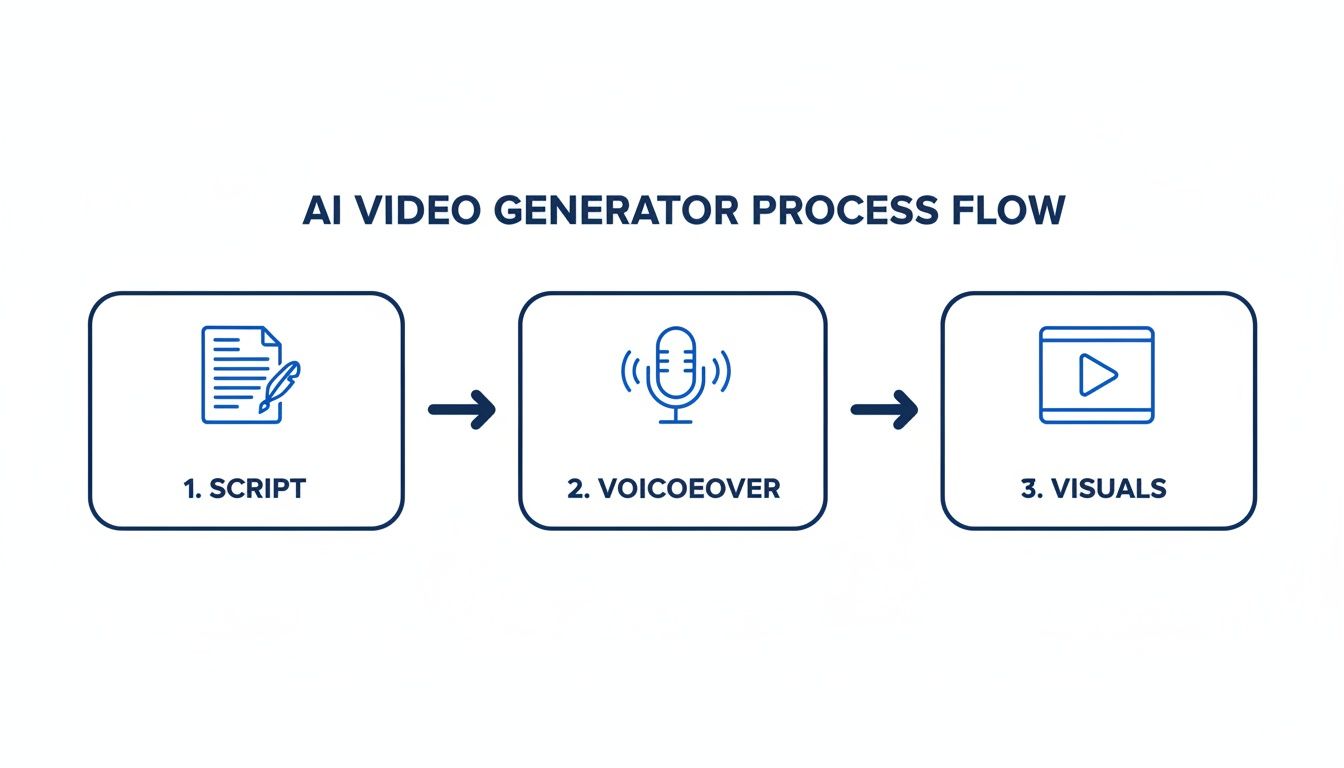
Each step builds on the last, which is how you can churn out high-quality content so quickly.
When and Where to Post for Maximum Reach
The final piece of the puzzle is timing. Posting when your audience is most active gives your video an initial push, which signals to the algorithm that it's worth promoting further. While the "best" time is unique to your audience, some general windows tend to work well:
- Weekdays: 6-9 AM (morning commute), 12-2 PM (lunch break), and 7-9 PM (evening scroll).
- Weekends: Afternoons and evenings are usually your best bet.
But don't just post and walk away. Promote your new video on all your other social channels. A simple tweet or an Instagram Story can drive that critical first wave of views. And if you want to dig deeper, check out our guide on how to boost social media engagement for more strategies to get your content seen.
Finally, get comfortable with A/B testing. Post the same video with two different hooks or captions and see what works better. The data you get back is gold. It shows you exactly what resonates with your audience, helping you turn the art of going viral into a repeatable science.
Your Questions About Viral Videos Answered
Diving into the world of viral content can feel like you're trying to piece together a puzzle with a million moving parts. You get the big picture, the frameworks, the strategies... but then the little, practical questions pop up right when you’re about to hit record.
Let's tackle some of the most common uncertainties creators run into. These are the details that can make or break your next video, so getting them right is crucial.
How Long Should My Video Be to Go Viral?
There’s no single magic number, but looking at a massive amount of data, a clear sweet spot has emerged for TikTok, Reels, and Shorts. You want to aim for a duration between 15 and 45 seconds.
This length is just short enough to hold a scroller's notoriously short attention span, but it's also long enough to tell a complete and satisfying micro-story. The real goal is to deliver your punchline or core value as quickly and cleanly as possible.
But honestly, the total length is irrelevant if your hook fails. If you can't grab someone in the first three seconds, it doesn't matter if the video is 10 seconds or 60—they're already gone.
Your video should be as long as it needs to be to tell the story and not a single second longer. Ruthlessly cut anything that doesn't push the narrative forward or add to the emotional payoff. Brevity is a sign of respect for your viewer's time.
Do I Need Expensive Equipment to Make a Viral Video?
Absolutely not. This is probably one of the biggest myths that holds new creators back. In fact, on platforms like TikTok where raw relatability is king, overly polished, high-production videos can sometimes feel sterile and out of place. Your smartphone is more than enough to get the job done.
What really matters is the strength of your idea, the punchiness of your script, and the emotional connection you create. The gear is secondary. The rise of AI video tools just proves this point further. Creators are now going viral without ever touching a camera, using AI-generated visuals to bring their stories to life. It completely levels the playing field and makes it clear that the message is what counts, not the equipment.
How Important Are Trends for Going Viral?
Think of trends as a powerful accelerator, not a mandatory ticket to virality. Hopping on a relevant, emerging trend can give your video a massive visibility boost because the algorithm is already actively pushing that sound or format to users. It’s like catching a wave that’s already building momentum.
Here’s the catch: the trend must align with your niche and brand identity. If you try to force it, your video will come across as disingenuous, and you risk confusing or alienating the audience you've worked to build.
A smart, sustainable strategy is a mix of two things:
- Original, Evergreen Content: These are the videos that serve your core audience and provide value no matter what’s trending.
- Strategic Trend-Jumping: This means selectively participating in trends that genuinely make sense for your brand and give you a unique angle to shine.
Can Faceless AI Videos Really Go Viral?
Yes, and they do it all the time. A video’s viral potential comes down to its ability to spark emotion, tell a great story, or share valuable information. None of those things actually require a human face to be on camera. People connect with the message, not always the messenger.
When you combine high-quality visuals, an engaging AI voiceover, and dynamic captions that pop off the screen, you can create a seriously immersive experience. The key is holding yourself to a high standard for scripting and visual execution. For a lot of audiences, the faceless format is even a plus—it lets them focus entirely on the content without distraction, which can lead to incredible engagement and shareability.
Ready to scale up your content without getting stuck in the filming and editing grind? With ClipShort, you can turn your ideas into polished, viral-ready videos in minutes. Create your first faceless AI video for free and see the difference.